
Litha traditions draw people in every June, but many first-time celebrants are unsure what the day really means. Is Litha an ancient festival, or a modern one? And what do people actually do on the longest day of the year? This guide answers both questions. You will learn where the name comes from, when the summer solstice falls, and which symbols and customs have the deepest roots. Then you will find a simple way to mark the day at home.
- Litha Meaning: An Old English Month With a Modern Name
- When Is Litha? Summer Solstice Dates for 2025 to 2027
- Old Litha Traditions: Stones, Saints and Bonfires
- Litha Symbols and What They Mean
- Fire, Water or Flowers? Choosing Among Litha Traditions
- Litha Rituals at Home: A Simple Summer Solstice Altar
- Keeping Litha Traditions Safe and Honest
- Frequently Asked Questions
- References
Litha Meaning: An Old English Month With a Modern Name
The meaning of Litha starts with a calendar, not a ritual. In Old English, Líða was the name for both June and July. June was the “earlier Líða” and July was the “later Líða.”[1] One Old English text explains the name simply. The month was called this because the air is calm and mild at that time of year.[1]
So the word first described gentle summer weather. It did not name a festival. The step from month to holiday came much later. In 1974, the American witch Aidan Kelly said he gave the summer solstice sabbat the name Litha, along with Ostara and Mabon.[2] The other sabbats already had traditional names, but these three did not.
This matters for anyone celebrating today. Litha as a pagan holiday is modern, yet it rests on very old midsummer customs. You can honor Litha traditions honestly by knowing which parts are old and which are new.
When Is Litha? Summer Solstice Dates for 2025 to 2027
Litha falls on the summer solstice, the day the sun reaches its highest point in the sky. The word solstice comes from Latin sol, “sun,” and sistere, “to stand still.”[3] For a few days, the sunrise seems to pause at the same spot on the horizon.
The exact moment changes each year. Here are the June solstice times in Universal Time (UTC), based on U.S. Naval Observatory data:[4]
| Year | June solstice (UTC) |
|---|---|
| 2025 | 21 June, 02:42 |
| 2026 | 21 June, 08:24 |
| 2027 | 21 June, 14:11 |
Your local date can differ. For example, the 2025 solstice fell on the evening of 20 June across the Americas. Also, in the Southern Hemisphere, the summer solstice arrives in December instead. So many southern pagans hold Litha then and keep June for the winter festival of Yule. In other words, Litha traditions follow your local sun rather than a fixed date.
Old Litha Traditions: Stones, Saints and Bonfires
Long before anyone said “Happy Litha,” people marked this turning point in stone. At Stonehenge, the builders arranged the monument to frame the summer solstice sunrise. On midsummer’s day, the sun rises just left of the outlying Heel Stone, seen from the center of the circle.[3] Today, thousands still gather there to watch it.
Later, Christian Europe folded midsummer into the feast of St John the Baptist on 24 June. As a result, many summer solstice pagan traditions survived as St John’s Eve customs. Across Europe, people danced, sang, lit bonfires and gathered flowers.[5] They also bathed in natural springs and decorated homes with greenery. People believed water and plants held special healing power at midsummer.[5]
In Sweden, the maypole became part of midsummer by the 1500s. Celebrants dress a tall wooden pole with flowers, then dance and sing around it.[5] Behind all of these customs sits one idea. Midsummer was a magical time of luck and healing.[5]

Litha Symbols and What They Mean
Modern Litha traditions draw their symbols from this long history. Here are the ones you will meet most often, and why each one fits the day.
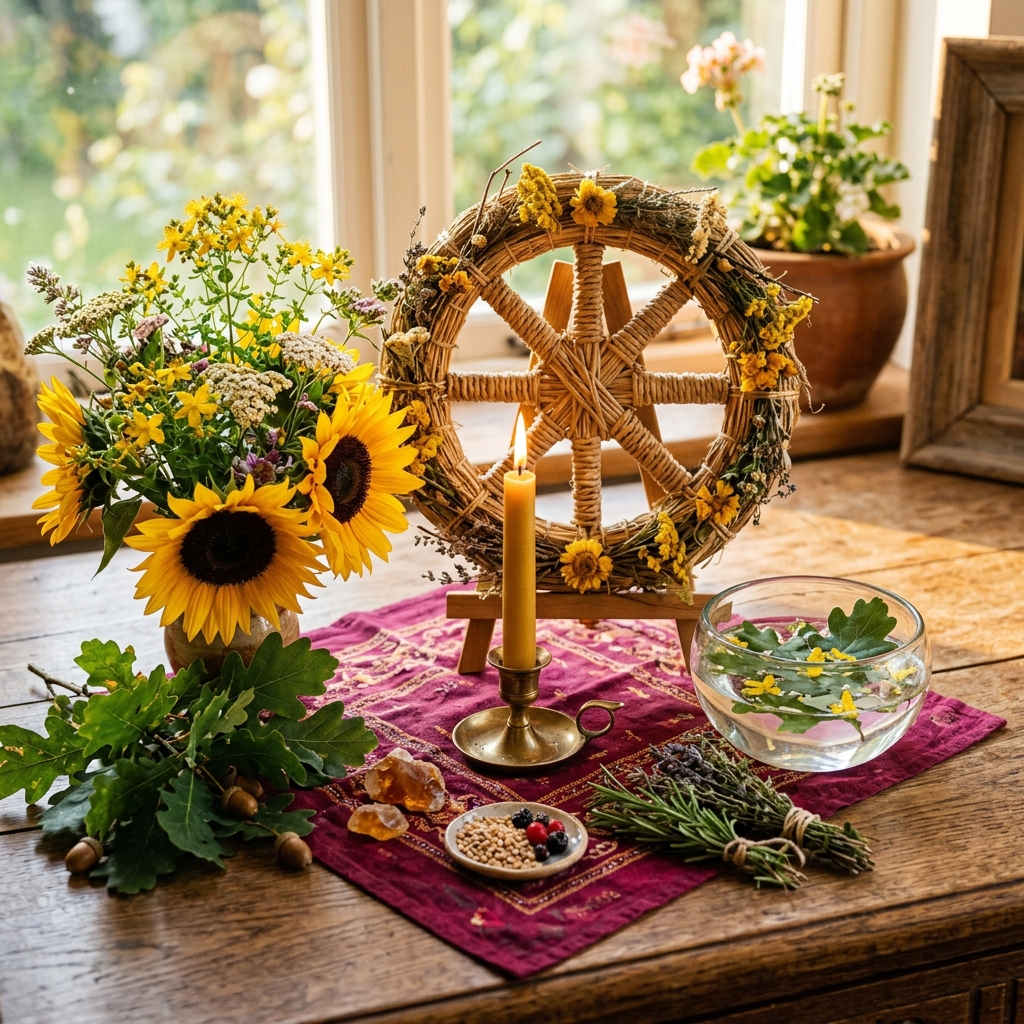
The sun wheel. A circle with spokes or rays stands for the sun at full strength. It also recalls the turning year, because the days start to shorten after the solstice.
Fire. Bonfires and candles echo the sun on the ground. In folk custom, midsummer fires were a place to gather, dance and celebrate together.
St John’s wort. This herb opens bright yellow, star-like flowers around midsummer. Its common name ties it directly to St John’s Day, which explains its place in solstice folklore.
Flowers and greenery. Flower crowns, garlands and fresh branches come straight from the old custom of dressing homes in green. They stand for growth at its peak.
Sunflowers and golden blooms. Many modern practitioners add sunflowers, marigolds or calendula to their altars. Their round, bright faces look like small suns, so they make an easy visual link to the day.
The Oak King. In many modern Wiccan traditions, the Oak King rules the light half of the year. At Litha, he yields to the Holly King, who rules as the days grow shorter. This story is modern, but it neatly explains why the longest day is also a turning point.
Faeries. Shakespeare set A Midsummer Night’s Dream on this magical night. Since then, many people link midsummer with faerie mischief and enchantment.

Fire, Water or Flowers? Choosing Among Litha Traditions
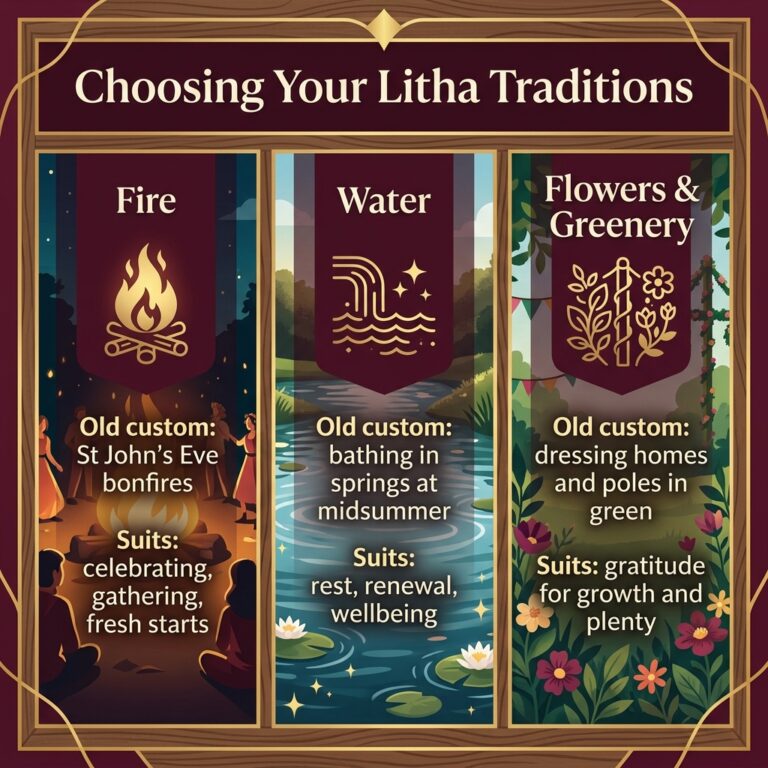
Put side by side, the old midsummer customs keep returning to three elements: fire, water and green plants. Stonehenge honors the sun itself. St John’s Eve adds bonfires, spring water and flowers. Swedish midsummer centers on a flower-covered pole. Each one reaches for the same peak of light and growth from a different angle.
That pattern offers a practical way to plan your own day. Instead of copying every custom at once, choose the element that fits what you hope to mark. Here is a simple guide, built from the traditions above:
- Choose fire to celebrate, gather with others or mark a fresh start. It follows the bonfire customs of St John’s Eve.
- Choose water to focus on rest, renewal and wellbeing. It follows the old habit of bathing in springs at midsummer.
- Choose flowers and greenery to give thanks for growth and plenty. It follows the custom of dressing homes and poles in green.
In short, the three elements work less like rules and more like doorways. Each one leads back to the same old belief that midsummer brings healing and good fortune. So picking one element is not a lesser Litha. Instead, it is how most historical communities celebrated, each in their own local style.
Litha Rituals at Home: A Simple Summer Solstice Altar
You do not need a stone circle or a village bonfire. A small summer solstice altar and a short ritual are enough to bring Litha traditions into your home. Here is one approach that works for most practitioners.
1. Rise with the sun, or wait for sunset. Sunrise mirrors the Stonehenge alignment. Sunset, meanwhile, marks the moment the light begins to wane.
2. Build your altar. Use a yellow, gold or green cloth. Then add a sun wheel, fresh flowers, a bowl of water and a candle. If you like, include St John’s wort, sunflowers or oak leaves.
3. Light your Litha incense. Many modern practitioners choose scents they link with the sun and summer. Common choices include frankincense, lemon peel, rosemary and lavender.
4. Work with your chosen element. Light the candle for fire, touch the water to your hands for water, or weave a small flower crown for greenery.
5. Speak your thanks and your intention. First, name what has grown for you this year. Then name what you want to carry into the darker half.
6. Close gently. Let the candle burn out safely or put it out. Afterwards, return water and flowers to the earth.
You can adapt these steps to almost any setting. In a small flat, a single candle and a glass of water on a windowsill work well. With children, making flower crowns or drawing sun wheels keeps the day playful. In a group, each person can bring one flower and speak one wish for the season ahead.
Belief, Intention & The Power of Magic
Witchcraft, spells, and manifestation are deeply rooted in belief, intention, and spiritual practice. If these practices do not resonate with you, this may not be the path for you, and that’s perfectly okay. But if you believe in divine powers, trust your intentions, and feel drawn to the mysteries of the unseen, we invite you to continue exploring with Madame Celestine and discover the magic that speaks to your soul.
Keeping Litha Traditions Safe and Honest
A few common mistakes are easy to avoid. First, treat fire with care. Check local fire rules before any outdoor blaze, and never leave candles burning alone.
Second, take care with plants. Only gather wild herbs where it is legal and safe. Also, St John’s wort can interact with many medicines, so keep it on the altar rather than in your tea.
Third, be honest about history. Litha rituals today are a modern practice built on older customs. There is no need to claim an unbroken ancient religion. The real story is interesting enough.
Finally, make it your own. Litha can be a quiet morning, a family picnic or a gathering around a fire. The best Litha traditions are the ones you will return to each year, because repetition is what turns a custom into a tradition. For a deeper look at the gods and goddesses often honored on this day, explore these summer deities of sun and abundance.
Frequently Asked Questions
What is the meaning of Litha?
Litha comes from Líða, the Old English name for June and July. It referred to the calm, mild weather of early summer before it became the name of a modern sabbat.
Is Litha a Wiccan summer solstice holiday?
Yes, Litha is one of the eight sabbats in the modern Wiccan and pagan Wheel of the Year. It marks the summer solstice, the longest day of the year.
When is Litha in 2027?
The 2027 June solstice falls on 21 June at 14:11 UTC. In the Southern Hemisphere, Litha is celebrated at the December solstice instead.
What are the most common Litha traditions?
Popular customs include watching the sunrise, lighting bonfires or candles, and wearing flower crowns. Many people also build a summer solstice altar and share a seasonal meal.
Can I celebrate Litha traditions in the Southern Hemisphere?
Yes. Most southern pagans move Litha to the December solstice, so the festival matches their own longest day.
References
- Líða. An Anglo-Saxon Dictionary Online (Bosworth-Toller). Charles University. https://bosworthtoller.com/21762
- As pagans celebrate autumn equinox, some question why Mabon is its symbolic deity. Heather Greene, Religion News Service, 22 September 2022. https://religionnews.com/2022/09/22/as-pagans-celebrate-autumn-equinox-some-question-why-mabon-is-its-symbolic-deity/
- Here comes the sun! Stonehenge and the summer solstice. Dr Susan Greaney, British Museum, 15 June 2022. https://www.britishmuseum.org/blog/here-comes-sun-stonehenge-and-summer-solstice
- Earth’s Seasons: Equinoxes, Solstices, Perihelion, and Aphelion. U.S. Naval Observatory, Astronomical Applications Department. https://aa.usno.navy.mil/data/Earth_Seasons
- Midsummer. Encyclopaedia Britannica. https://www.britannica.com/topic/Midsummer-holiday
Not sure where to start? You don’t have to do this alone.
Madame Celestine offers guided spellwork for beginners — real support for your first working, not just another guide to read.
Related reading: Mabon Traditions Around the World: Harvest Festivals Witches Borrow From · Blood Moon Ritual to Connect With Your Ancestors

About Wren Ashby
Wren Ashby is the pen name our editorial team uses for articles on sigils, Tarot and modern traditional witchcraft. Articles under this byline are researched from published sources and reviewed by Madame Celestine before publishing.