

A blood moon ritual can feel like the perfect time to reach toward the family who came before you. The moon turns a deep copper red, the night goes strangely quiet, and many people sense a door standing open. But what is really happening in the sky, why do practitioners link it with ancestors, and how do you work with it respectfully? In this guide, you’ll learn the science and folklore behind the blood moon, when the next one arrives, and a simple five-phase ritual that follows the eclipse from start to finish.
- Why the Moon Turns Red: The Sky Behind the Blood Moon Ritual
- Jaguars, Demons and Peacemaking: Blood Moon Lore Around the World
- Why a Blood Moon Ritual Suits Ancestor Work
- When Is the Next Blood Moon? Timing Your Ritual
- Preparing Your Blood Moon Ritual Space
- A Blood Moon Ritual in Five Phases
- Adapting the Ritual for Family, Solo or Adoptive Lines
- Common Blood Moon Ritual Mistakes
- Frequently Asked Questions
- References
Why the Moon Turns Red: The Sky Behind the Blood Moon Ritual
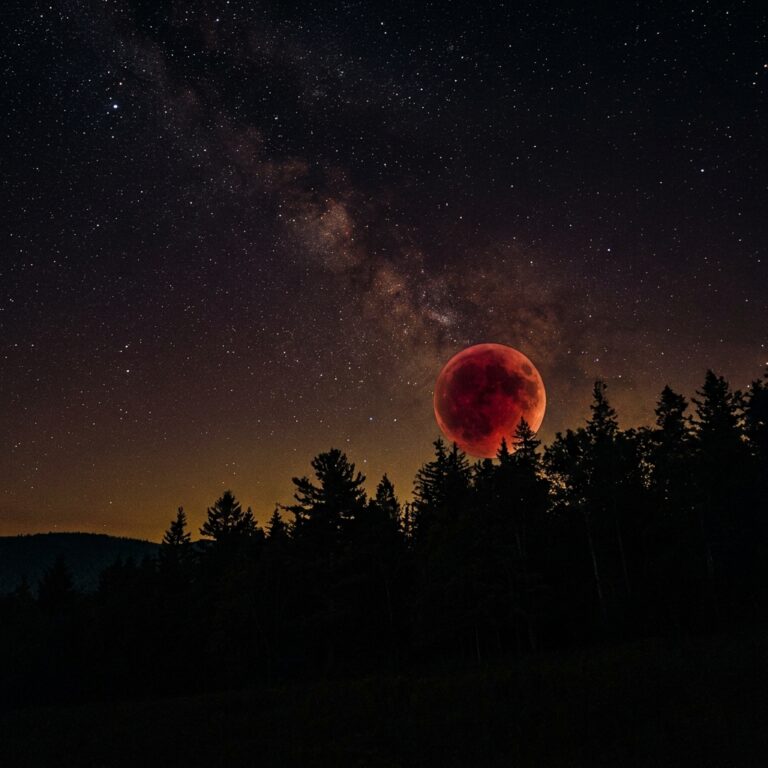
A “blood moon” is the popular name for a total lunar eclipse. It happens when Earth passes directly between the sun and the full moon. Earth’s shadow then covers the moon completely, yet the moon does not go dark. Instead, it glows red.
NASA explains why. Earth’s atmosphere scatters blue light more easily than red. So the only sunlight that reaches the moon has passed through a thick slice of our air, and it arrives filtered to orange and red. In NASA’s lovely phrase, it is as if all the world’s sunrises and sunsets are projected onto the moon.[1] The more dust or cloud in the atmosphere, the redder the moon appears.[1]
That detail matters for ancestor work. A blood moon is literally lit by every dawn and dusk happening on Earth at that moment. For many practitioners, this makes it a picture of connection: one light shared by all the living, falling on a moon that stands between worlds.
Jaguars, Demons and Peacemaking: Blood Moon Lore Around the World
People have always tried to explain the red moon, and their answers reveal what they valued. The ancient Inca read the deep red color as a jaguar attacking and eating the moon.[2] They also feared the jaguar might then crash to Earth and turn on people.[3]
In ancient Mesopotamia, a lunar eclipse was seen as a direct attack on the king.[2] National Geographic notes that the attackers were imagined as seven demons.[3] To protect the real ruler, priests installed a stand-in king for the duration of the danger.[2]
West Africa offers a gentler reading. The Batammaliba people of Togo and Benin say the sun and moon are fighting during an eclipse, and people must encourage them to stop.[3] As a result, they treat the eclipse as a time to come together and settle old feuds.[3] This is the tradition that speaks most directly to ancestor work, because healing family conflict is at the heart of honoring a lineage.
Why a Blood Moon Ritual Suits Ancestor Work
It is worth being honest here. No single ancient text says “contact your ancestors during a lunar eclipse.” Instead, the modern blood moon ritual for ancestors grows from several older ideas working together.
First, there is the color. In many African and diaspora traditions, blood stands for lineage and life force, the living thread that runs from the oldest ancestor to you. So a moon the color of blood becomes a natural symbol of that thread.
Second, there is the threshold. An eclipse is an in-between time, neither fully night nor fully lit. Many traditions treat such moments, like dusk, midnight or the turning of a season, as times when the boundary between worlds feels thinner.
Third, there is the peacemaking theme from the Batammaliba. If an eclipse is a time to end quarrels, it is also a good time to ask for peace within a family line, including with those who have died.
When Is the Next Blood Moon? Timing Your Ritual
Lunar eclipses are more common than many people think. NASA notes that four to seven eclipses of the sun or moon happen each year, and each lunar eclipse is visible from half of Earth.[1] However, total lunar eclipses, the true blood moons, are rarer.
The last one took place on March 3, 2026. According to Space.com, the next will not come until December 31, 2028, with about 71 minutes of totality visible from Africa, Europe, Asia, Australia, Canada and Alaska.[4] In other words, there is a long wait ahead.
So what do you do in the meantime? Many practitioners adapt the blood moon ritual to a partial lunar eclipse or simply to a full moon. The red light is missing, but the core practice still works as an act of remembrance. If you want to prepare something from the next eclipse in advance, this guide to eclipse moon water explains how practitioners collect and store it.
Preparing Your Blood Moon Ritual Space
Preparation starts a day or two before. Check the local times for the partial and total phases, because the whole eclipse can last several hours. Then choose a place where you can see the moon, or at least sit by a window facing it.
Next, set a small ancestor space. A white cloth, a clear glass of fresh water and a white candle are enough. White is widely used for the dead in African and diaspora traditions, because it signals peace and coolness. Many people also add a single red candle for the blood moon itself, so the two colors sit side by side.
Finally, place photos or written names of family members who have passed. Add a small offering they enjoyed, such as coffee, bread or fruit. Keep it simple, because the eclipse is the main event.
A Blood Moon Ritual in Five Phases
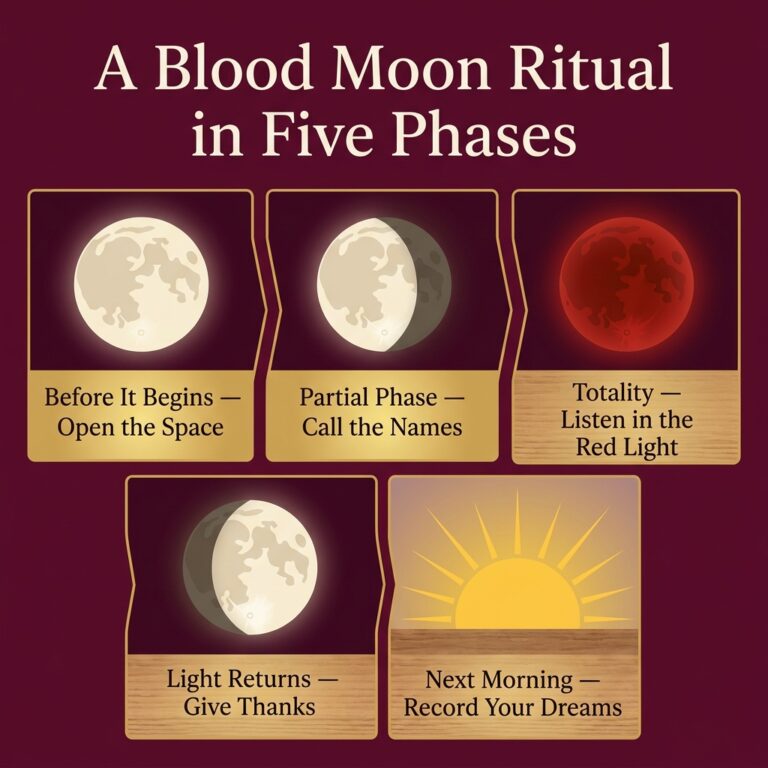
This blood moon ritual follows the eclipse itself, so each step has a clear moment in the sky.
1. Before It Begins: Open the Space
Light the white candle and sit quietly for a few minutes. Knock gently three times on the table or floor to announce that you are present. Then say aloud why you are here, in one simple sentence.
2. Partial Phase: Call the Names
As Earth’s shadow creeps across the moon, speak the names of your ancestors. Start with the most recent and move back as far as you know. Then add a line for “all those whose names are lost.”
3. Totality: Listen in the Red Light
When the moon turns fully red, light the red candle. Ask one clear question, or ask for peace in one family conflict. Then stay silent. Notice memories, images or feelings that come, without judging them.
4. As the Light Returns: Give Thanks
When the first white edge of the moon reappears, thank your ancestors by name. Let the candles burn a little longer if it is safe, then put them out. Afterward, pour the water outside onto the earth as a sign of respect.
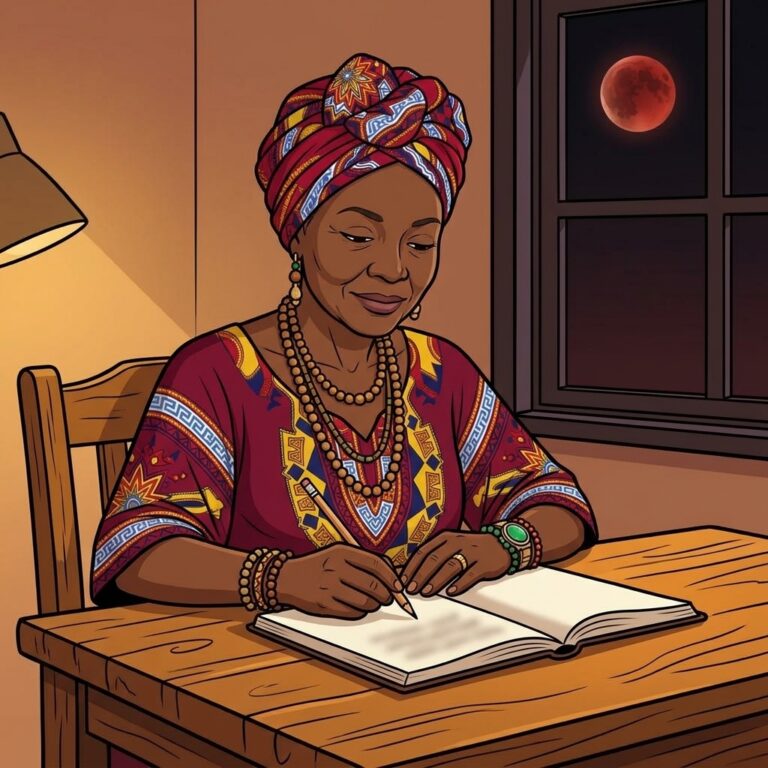
5. The Next Morning: Record Your Dreams
Write down any dreams as soon as you wake. Many practitioners believe ancestors answer slowly, so keep noting dreams and small signs for three nights. Remove any food offering within a day.
Belief, Intention & The Power of Magic
Witchcraft, spells, and manifestation are deeply rooted in belief, intention, and spiritual practice. If these practices do not resonate with you, this may not be the path for you, and that’s perfectly okay. But if you believe in divine powers, trust your intentions, and feel drawn to the mysteries of the unseen, we invite you to continue exploring with Madame Celestine and discover the magic that speaks to your soul.
Adapting the Ritual for Family, Solo or Adoptive Lines
The steps above suit one person, but a blood moon is a lovely event to share. With children, keep it short and story-led. Let each person tell one memory of a grandparent while the moon is red. That way, the ritual doubles as a way of passing family history down.
With older relatives, the eclipse can become an oral history night. Ask them to name their own parents and grandparents while you write the names down. As a result, your altar gains names you might never have learned otherwise.
Some people don’t know their birth family, perhaps because of adoption, migration or a broken record. You can still take part. Many practitioners honor the ancestors of the family who raised them, the ancestors of the land they live on, or simply “those who loved me into being.” The intention matters more than a family tree.
Common Blood Moon Ritual Mistakes
The most common mistake is treating the eclipse as a time of fear. Old myths of jaguars and demons are fascinating, but many practitioners today see a blood moon ritual as an act of love, not defense. Approach it calmly, the way you would visit an elder.
Another mistake is rushing. A total eclipse can last over an hour, so there is no need to cram every request into a few minutes. One question, asked sincerely, tends to feel more meaningful than a long list.
People also sometimes invite every ancestor without thought. If a relative caused real harm, you are not obliged to call them. Instead, you can address only the “well and wise” ancestors, a phrase many modern practitioners use.
Finally, don’t forget the practical side. Dress warmly if you sit outside, keep candles away from curtains, and remember that looking at a lunar eclipse with the naked eye is safe, unlike a solar eclipse.
Frequently Asked Questions
What is a blood moon ritual?
A blood moon ritual is a spiritual practice timed to a total lunar eclipse, when the moon turns red. Many practitioners use it for ancestor work, such as calling family names, making offerings and listening for guidance.
When is the next blood moon?
After the total lunar eclipse of March 3, 2026, the next one falls on December 31, 2028. It will be visible from parts of Africa, Europe, Asia, Australia, Canada and Alaska.
Can I do an ancestor ritual without a blood moon?
Yes. You can adapt the same steps to a partial lunar eclipse or a full moon. The red light is a powerful symbol, but remembrance and offerings matter more than the exact sky.
Why is the blood moon red?
Sunlight passes through Earth’s atmosphere before reaching the moon, and the atmosphere scatters blue light away. The remaining red and orange light gives the eclipsed moon its copper color.
Is a blood moon a bad omen?
Some ancient cultures feared it, but others, like the Batammaliba of Togo and Benin, saw it as a time to make peace. Many practitioners today treat it as a calm, meaningful time for reflection.
References
- Eclipses and the Moon. NASA Science. https://science.nasa.gov/moon/eclipses/
- Blood moon: lunar eclipse myths from around the world. The Conversation. https://theconversation.com/blood-moon-lunar-eclipse-myths-from-around-the-world-100548
- Lunar Eclipse Myths From Around the World. Jane J. Lee, April 14, 2014. National Geographic. https://www.nationalgeographic.com/science/article/140413-total-lunar-eclipse-myths-space-culture-science
- The total lunar eclipse on March 3 will be the last until New Year’s Eve 2028. Jamie Carter, March 2, 2026. Space.com. https://www.space.com/stargazing/lunar-eclipses/the-total-lunar-eclipse-on-march-3-will-be-the-last-until-new-years-eve-2028
Not sure where to start? You don’t have to do this alone.
Madame Celestine offers guided spellwork for beginners — real support for your first working, not just another guide to read.
Related reading: Eclipse Moon Water: How to Make It and What It’s Used For · Southern Hemisphere Sabbats: Why the Wheel Turns Backwards Down Under

About Thakathi
Thakathi is the pen name our editorial team uses for articles on Ifá, Orisha traditions and ancestor reverence across the African diaspora. Articles under this byline are researched from published sources and reviewed by Madame Celestine before publishing.