

A self-love spell doesn’t need a full altar, a ritual bath or a free Saturday. For many practitioners, it starts with a cup of tea made slowly and on purpose, before the day gets loud. If you’ve searched for self love spells and found jar recipes with a dozen ingredients, this one is simpler. It turns a morning habit into a short daily ritual for worth and care. Below, you’ll learn what goes into the cup and why, the steps in order, where tea rituals come from, and how to adjust the practice when life gets busy.
- Why a Self-Love Spell Begins in the Kitchen
- Rose, Chamomile and Honey: The Self-Love Spell Blend
- How to Cast a Self-Love Spell With Your Morning Tea
- What Old Tea Masters Share With a Self-Love Ritual
- When to Do a Self-Love Spell: Mornings, Fridays and Missed Days
- Make the Self-Love Spell Your Own
- Mistakes That Weaken a Self-Love Spell
- Frequently Asked Questions
- References
Why a Self-Love Spell Begins in the Kitchen
Most spells aim at something outside the caster, such as a lover, a job or a stuck situation. A self-love spell turns that around. The person holding the cup is the target, so the usual worries about consent fall away. As a result, most modern witches treat work on their own mood and outlook as the gentlest kind of magic there is.
With a self-love spell, daily repetition is the whole point. A one-off candle spell asks for a big effort on a single night. By contrast, a tea ritual asks for ten quiet minutes, again and again. Practitioners believe repetition is what lets an intention settle in, much like a path forms in grass after many walks across the same spot.
There’s also a useful link to psychology here. Researcher Kristin Neff describes self-kindness as being understanding toward yourself when you fail or feel inadequate, instead of judging yourself harshly[1]. She also names two other parts of self-compassion. First, struggle is part of the shared human experience. Second, painful feelings can be noticed without being exaggerated or pushed away[1]. A spell for self love doesn’t replace that kind of inner work. Still, it gives that work a shape and a time of day, so it becomes much easier to keep doing.
Rose, Chamomile and Honey: The Self-Love Spell Blend
The blend for this ritual uses a handful of kitchen ingredients, and each one has a job.
Rose petals sit at the heart of most self love spells. Modern practitioners link the rose with Venus, the Roman goddess of love, so a few dried petals bring that association into the cup. Use food-grade petals sold for tea, because florist roses aren’t grown to be eaten.
Chamomile brings calm. Its name comes from the Greek for “earth apple,” a nod to the flowers’ apple-like scent[2]. In kitchen witchcraft, it’s a go-to herb for soothing nerves and for gentleness toward yourself.
Honey sweetens. In folk magic, sweetening a situation means making it kinder. So stirring honey into your own cup is a small statement that you deserve a softer tone from yourself.
You can also add a black or green tea base if you want caffeine. Before you drink any blend, check that every herb is safe for you, especially if you’re pregnant, take medication or have allergies. A pharmacist can tell you quickly. If you’re building a small kit for this practice, the guide to tools of kitchen witchcraft covers the spoons, jars and kettles practitioners keep on hand.
How to Cast a Self-Love Spell With Your Morning Tea
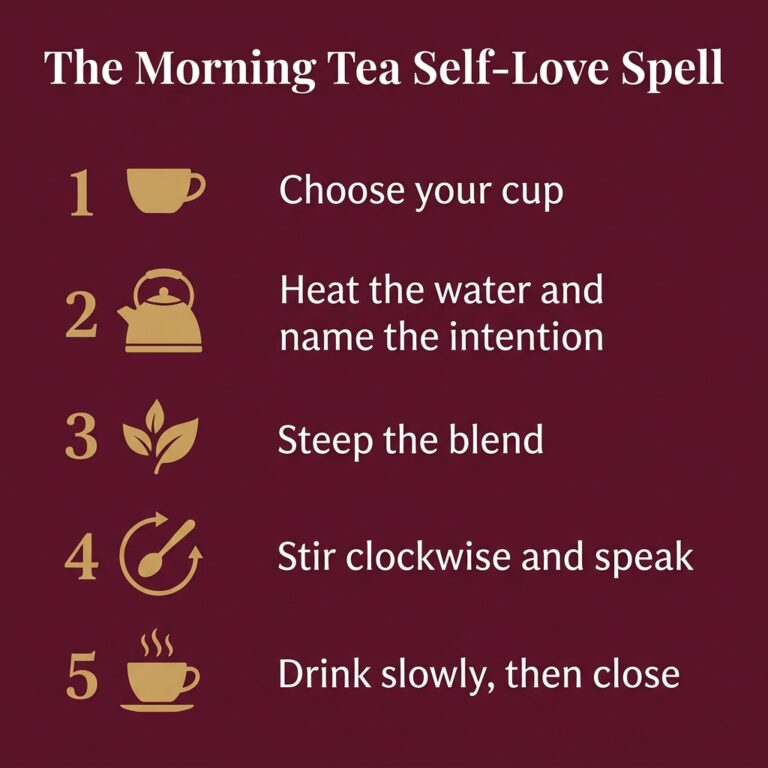
To cast a self-love spell with tea, choose a cup you like, then heat the water while you name your intention. Next, steep rose and chamomile, and stir clockwise while you speak one kind sentence about yourself. Finally, drink slowly with no distractions. The whole ritual takes about ten minutes, and you repeat it each morning.
- Choose your cup. Pick one you enjoy holding. Some witches keep a cup only for this ritual, so reaching for it becomes the signal to slow down.
- Heat the water and name the intention. While the kettle heats, say in one sentence what you want to grow. For example: “I want to speak to myself the way I speak to a friend.”
- Steep the blend. Add a teaspoon of the blend and let it steep for about five minutes. Watch the color deepen, and breathe instead of checking messages.
- Stir clockwise and speak. Add honey, then stir clockwise. Witches call this direction deosil, from a Gaelic word built on deas, meaning “right” or “south”[3]. Practitioners treat the clockwise turn as drawing something in. As you stir, say your sentence, such as “I am worth my own care.”
- Drink slowly, then close. Finish the cup without your phone. Afterward, rinse the cup and put it back in its place. That small act tells your mind the ritual is complete.
Belief, Intention & The Power of Magic
Witchcraft, spells, and manifestation are deeply rooted in belief, intention, and spiritual practice. If these practices do not resonate with you, this may not be the path for you, and that’s perfectly okay. But if you believe in divine powers, trust your intentions, and feel drawn to the mysteries of the unseen, we invite you to continue exploring with Madame Celestine and discover the magic that speaks to your soul.
What Old Tea Masters Share With a Self-Love Ritual
Treating tea as a ritual is far older than modern witchcraft. In Tang dynasty China, the writer Lu Yu wrote The Classic of Tea sometime between 760 and 780 CE. He urged readers to pay strict attention to each step and each utensil, and to make the whole process beautiful[4].
Later, Japanese tea masters built a full ceremony on similar ground. The Japanese tea ceremony rests on four principles: wa, kei, sei and jaku, or harmony, respect, purity and tranquility[5]. Sen no Rikyū, the master who perfected the way tea is made, tied the practice closely to Zen[5]. In that setting, purity meant both a clean room and a clear mind.
Western kitchen witchcraft then adds direction and words. The stir has a meaning, and the sentence spoken over the cup has a target. Here is how the pieces line up:
| Tradition | What it stresses | What your ritual borrows |
|---|---|---|
| Lu Yu’s Classic of Tea | Attention to every step and tool | Making the tea slowly, one step at a time |
| Japanese tea ceremony | Harmony, respect, purity, tranquility | A clean cup, a calm mind, respect for yourself as the guest |
| Kitchen witchcraft | Stirring direction and spoken intention | A clockwise stir and one kind sentence |
Put side by side, these traditions share one thread. In each, the care goes into how the tea is made. So the attention you give the cup is the attention you give yourself. Read that way, the morning ritual works through a simple swap: for ten minutes, you are both host and guest. For that reason, the pace of the ritual counts as an ingredient too, and arguably the main one.
When to Do a Self-Love Spell: Mornings, Fridays and Missed Days
Morning suits most people because it sets the tone before anyone else’s demands arrive. If mornings are chaos, though, an evening cup works too. Just switch to caffeine-free herbs.
Friday also has an old link to love. The English name means Frigg’s day, after a Germanic goddess tied to married love. That name is itself a translation of the Latin dies Veneris, the day of Venus[6]. So witches who like extra timing often begin a self-love spell on a Friday and continue daily from there.
Missed a day? Nothing breaks. On low-energy days, practitioners often shrink the ritual to one cup of plain tea and one spoken sentence. The habit carries on from wherever you pick it up.
Make the Self-Love Spell Your Own
Once the basic steps feel natural, you can make the ritual fit what you need right now.
After heartbreak. Add a pinch of lavender for rest, and change your sentence to “I am still whole.” Many people come to a self-love spell after a breakup, and it’s often wise to start here before any romance work. The guide on telling a love spell from self-sabotage explains why.
Before a hard day. Add a small piece of cinnamon stick for warmth, and say “I can handle what today brings.”
The mirror version. Drink your tea in front of a mirror and say your sentence to your reflection. It feels awkward at first, which is partly the point.

Paired with outward magic. A self-love ritual looks inward. On the other hand, a glamour spell for beauty and attraction works on how others see you, and some witches pair the two.
With loose leaves. If you brew loose tea, you can end by reading the tea leaves left in the cup. It turns the last sip into a moment of reflection.
Mistakes That Weaken a Self-Love Spell
The most common mistake is rushing. Drinking while scrolling turns a self-love spell back into a plain cup of tea. Give it ten minutes, or give it five on purpose.
Negative wording is another. “I’m not ugly” keeps the old word at the center of the sentence. Instead, say what you want to feel, such as “I like the person I’m becoming.”
Also, don’t expect overnight change. Practitioners see this as slow work, closer to watering a plant than flipping a switch. Notice small shifts, like a kinder thought after a mistake.
Finally, keep real support in the picture. If low mood lasts for weeks, talk to a doctor or therapist. A daily ritual can sit alongside that care.
Frequently Asked Questions
Can I cast a spell on myself?
Yes. Most practitioners consider a spell on yourself the most ethical kind, because you are the one consenting to the change. A self-love spell is one of the most common examples.
Do self-love spells actually work?
Practitioners believe these spells work slowly, by focusing intention through daily repetition. Many describe the result as a gradual shift in how they talk to themselves.
Should I do a self-love ritual before a love spell?
Many witches suggest it. They feel that working on your own sense of worth first gives any later love work a steadier base.
Can a self-love spell backfire?
Because the spell targets only you, there’s little to backfire. Some people do feel a burst of confidence that surprises them, so ease into new choices at your own pace.
What if I don’t like rose or chamomile?
Swap in any safe herb you enjoy, such as lavender, mint or lemon balm. The intention, the stir and the spoken sentence matter more than the exact blend.
Can a self-love ritual replace therapy?
No. A daily ritual can support your mood, but it isn’t a treatment. If you’re struggling, a doctor or therapist is the right next step.
References
- Exploring the Meaning of Self-Compassion and Its Importance. Kristin Neff, Self-Compassion.org. https://self-compassion.org/what-is-self-compassion/
- Camomile: Etymology, Origin & Meaning. Online Etymology Dictionary. https://www.etymonline.com/word/camomile
- Deasil: Etymology, Origin & Meaning. Online Etymology Dictionary. https://www.etymonline.com/word/deasil
- Sip It Slowly, And Other Lessons From The Oldest Tea Book In The World. Jeff Koehler, NPR (republished by WRVO Public Media), May 26, 2015. https://www.wrvo.org/2015-05-26/sip-it-slow-and-other-lessons-from-the-oldest-tea-book-in-the-world
- The Way of Tea. Five Colleges, Incorporated. https://www.fivecolleges.edu/tea_ceremony
- Friday: Etymology, Origin & Meaning. Online Etymology Dictionary. https://www.etymonline.com/word/Friday
Not sure where to start? You don’t have to do this alone.
Madame Celestine offers guided spellwork for beginners — real support for your first working, not just another guide to read.
Related reading: Free Love Spells Without Ingredients: Words and Intention Only · Relationship Spell: A Bottle Ritual to Strengthen Love

About Wren Ashby
Wren Ashby is the pen name our editorial team uses for articles on sigils, Tarot and modern traditional witchcraft. Articles under this byline are researched from published sources and reviewed by Madame Celestine before publishing.