
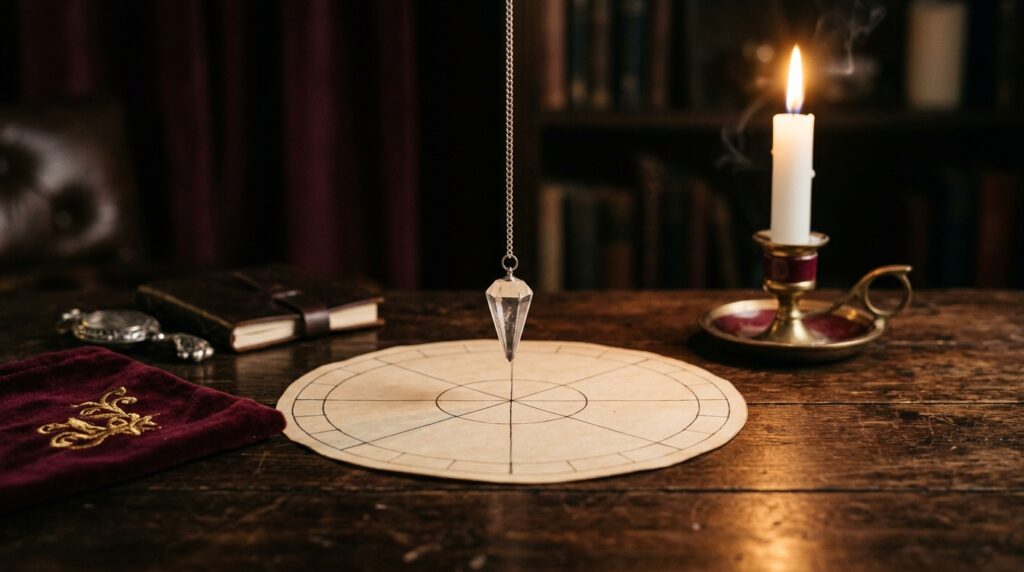
A pendulum yes or no reading looks simple. You hold a weight on a chain, ask a question and watch it swing. Then the answers start to contradict each other, and you wonder whether the pendulum is talking or you are. That doubt is healthy, so keep it. In this guide I’ll show you how to hold a pendulum, how to calibrate it and where your own hopes can slip into the swing. You’ll also learn what a French chemist reported in 1833, and why witches and scientists end up giving the same advice.
- What Do Pendulums Do? Divination With a Pendulum, Then and Now
- How Do Pendulums Work Spiritually? Two Honest Answers
- How to Hold a Pendulum for Yes or No Divination
- Calibrate Your Yes and No Pendulum Swings
- Where Witches and Scientists Agree on Pendulum Yes or No Bias
- Why Yes No Pendulum Answers Change, and How to Interrupt a Session
- How to Protect Yourself When Using a Pendulum
- Online Yes or No Pendulum Tools Versus a Real Chain
- Frequently Asked Questions
- References
What Do Pendulums Do? Divination With a Pendulum, Then and Now
The pendulum belongs to an older family of practices called dowsing. Dowsing seems to have come into fashion in Europe during the Middle Ages. Dowsers worked with a forked branch of hazel, rowan or willow, a Y-shaped metal rod, or a pendulum hung on a nylon or silk thread[1].
The practice also picked up some wonderful nicknames. In English it’s been called water witching, divining and even doodlebugging. Dowsers worked on the land itself, and some also worked over maps from a distance[2].
So what are pendulums used for today? Pendulum uses fall into two groups. The first is finding things, such as lost keys, water or the right spot on a map. The second is divination with a pendulum, where you ask a clear question and read the swing as yes, no or “not now.” This article focuses on the pendulum yes or no use, because that’s where most readers get stuck.
How Do Pendulums Work Spiritually? Two Honest Answers
Ask ten practitioners and you’ll hear a few different answers. Some believe a spirit guide or ancestor moves the weight. Others believe the pendulum speaks for your higher self, the deeper part of you that knows more than your busy mind. Many simply call it intuition made visible. If you already work with guides, it also helps to know their quieter ways of speaking, so read up on recognizing signs from spirit guides.
The scientific explanation goes back more than two centuries. The French chemist Michel Eugène Chevreul tested hand-held pendulums in 1812 and published his findings in 1833 as an open letter to the physicist Ampère. When he was blindfolded, the swinging soon faded. He concluded that a muscle movement in his own arm, too small to feel, had started the swing[3].
In 1852 the English physiologist William Carpenter named this the “ideo-motor” effect. The term means that a strong idea can produce a movement without any conscious choice[3]. A more recent lab study, shared as a preprint, added a twist. People whose fingers naturally moved more were also more successful at making a pendulum swing by imagination alone[4].
Even if you believe spirit guides the answer, the message still travels through your hand. That’s why I want every pendulum yes or no reading calibrated first.
How to Hold a Pendulum for Yes or No Divination
Pinch the top of the chain between your thumb and forefinger. Then leave a few inches of chain hanging below your fingers, so the weight swings freely without wobbling. Rest your elbow on the table and keep your wrist loose instead of stiff. Finally, hold the weight about an inch above the table or your pendulum chart.
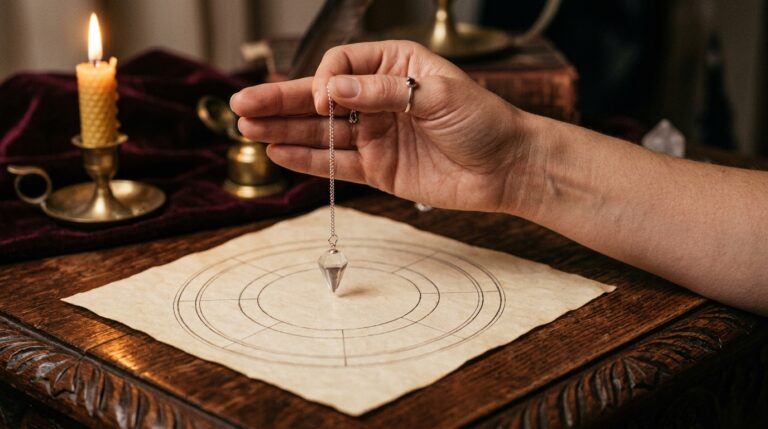
Before every question, stop the weight with your other hand and let it hang still. A pendulum that’s already swinging gives you a muddy start. Also, sit somewhere quiet. If your arm is tired or you’ve just had three coffees, your hand will tremble, and a trembling hand makes a nervous pendulum. A steady posture makes every pendulum yes or no answer easier to read.
Calibrate Your Yes and No Pendulum Swings
Calibration means learning how your pendulum yes or no signals look today, in your hand. Directions differ from person to person. For one reader yes is a clockwise circle, and for another it’s a forward-and-back line. So never borrow someone else’s chart without testing it first.
- Still the weight. Take one slow breath, then let it hang without movement.
- Ask “Show me yes.” Watch for a few seconds and note the direction.
- Ask “Show me no.” The swing should look clearly different from yes.
- Request a “can’t answer” sign. Many readers get a small wobble or stillness here. This becomes your “not now.”
- Test with known answers. Ask four questions you already know, two true and two false, such as “Am I sitting down?” The false ones matter, because they catch a pendulum that leans toward yes.
- Write it down. Keep a short log of each session’s yes, no and test results.
If your test answers come back wrong, don’t push on. Instead, reset and calibrate again, or come back tomorrow. A pendulum yes or no that fails a known question shouldn’t be trusted with an unknown one.
Belief, Intention & The Power of Magic
Witchcraft, spells, and manifestation are deeply rooted in belief, intention, and spiritual practice. If these practices do not resonate with you, this may not be the path for you, and that’s perfectly okay. But if you believe in divine powers, trust your intentions, and feel drawn to the mysteries of the unseen, we invite you to continue exploring with Madame Celestine and discover the magic that speaks to your soul.
Where Witches and Scientists Agree on Pendulum Yes or No Bias
Practitioners and researchers disagree about what moves the pendulum. Yet when you put their advice side by side, they recommend almost the same habits. Here’s how the two views line up.
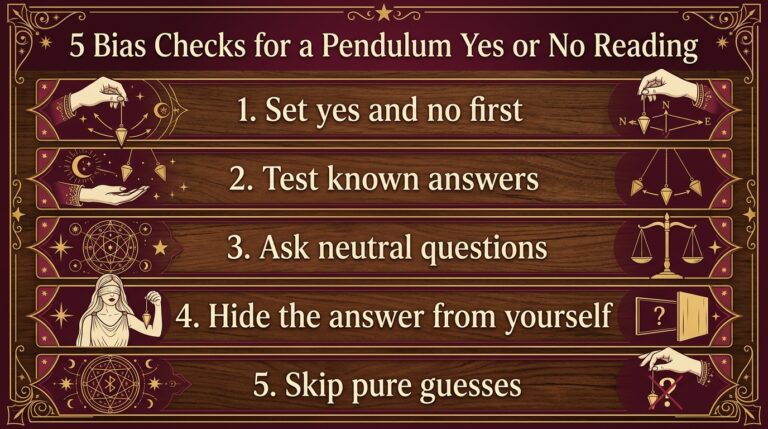
| Habit | What practitioners say | What the research shows |
|---|---|---|
| Set yes and no first | Agrees on a shared language with spirit | Shows your own small muscle habits |
| Test known answers | Confirms the connection is clear | Catches a swing drifting toward your wishes |
| Ask neutral questions | Keeps ego out of the reading | A strong hope is the “idea” that moves the hand |
| Hide the answer from yourself | Lets spirit speak without interference | Chevreul’s swing faded without sight |
| Skip pure guesses | Some things aren’t ready to be known | Guesses came out at about chance |
That last row comes from a 2021 study. People answered general knowledge questions with a pendulum, and on the questions they had rated as pure guesses, the pendulum did no better than chance[5]. A skeptic reads that as proof the pendulum only shows what you already know. A practitioner might say it was never meant to be a quiz machine.
Put side by side, these views agree on one practical point. You don’t have to settle what moves the pendulum to get cleaner pendulum yes or no answers, because both camps tell you to guard against your own wishes first.
Why Yes No Pendulum Answers Change, and How to Interrupt a Session
Changing pendulum yes or no answers usually come from a few common habits. The biggest one is asking the same question again because you didn’t like the first answer. Each repeat adds more hope, and as a result the swing starts to follow it. Questions with high emotional stakes do the same thing. Vague timing causes trouble too, because “Will I get the job?” has no deadline, while “Will I hear back by Friday?” does.
Fatigue matters as well. After a dozen questions, your arm gets tired and your focus slips. So set a limit before you start, for example five questions.
Sometimes you need to interrupt a pendulum mid-session. Maybe it’s swinging wildly, or the answers feel off. First, catch the weight gently in your free palm. Then say “stop” or “reset” out loud and set the pendulum down. Breathe, shake out your hand and drink some water. Finally, recalibrate before you ask anything else. If it still feels wrong, end the session for the day.
How to Protect Yourself When Using a Pendulum
Protection starts before the first pendulum yes or no question. I’d ask you to open every session with a short statement of intent, such as “I ask only for answers that serve my highest good.” Then ground yourself by feeling your feet on the floor for a few breaths.

Keep your tool clean, too. Many witches cleanse a pendulum before the first use and after a heavy session. If you’re unsure which method suits you, compare smoke, salt or water cleansing first.
Some practitioners believe trickster spirits can step in when a session is left open. If the answers turn mocking, erratic or frightening, stop. Thank whatever you’ve worked with, close with a statement like “This session is ended,” and put the pendulum away.
Finally, set boundaries on what you ask. A pendulum shouldn’t replace a doctor, lawyer or financial advisor. It also shouldn’t be used to spy on another person’s private choices.
Online Yes or No Pendulum Tools Versus a Real Chain
An online yes or no pendulum is a fun toy, but it works differently. Software picks the answer, so your hand plays no part. That means you can’t calibrate it to your own swing, and the ideomotor link between your thoughts and the weight doesn’t exist. For a quick moment of play it’s harmless. For a real question, however, a pendulum yes or no reading with a chain you’ve calibrated tells you far more about your own mind.
If the pendulum feels right for you, it may also be worth exploring traditional and modern divination methods that pair well with it, such as runes or tarot.
Frequently Asked Questions
Can I use a necklace or ring as a pendulum?
Yes, any balanced weight that hangs freely from a chain or thread can work as a pendulum. Choose something symmetrical so it swings evenly, and calibrate it before you use it.
Can I still use a chipped or broken pendulum?
Many practitioners keep using a chipped pendulum if it still hangs straight and swings evenly. Recalibrate it first, and if the swing turns lopsided, retire it with thanks.
Do I need to cleanse a new pendulum before using it?
Most practitioners cleanse a new pendulum before the first session to clear the energy of everyone who handled it. Smoke, a night in moonlight or a sound cleanse are common choices.
Why did my pendulum stop answering?
Many readers take a still pendulum as a not-now signal, or as a sign that you’re tired or tense. Stop, rest and recalibrate later instead of forcing an answer.
Is pendulum divination witchcraft?
Witches use pendulums, but so do people with no magical practice, such as water dowsers. It becomes part of witchcraft when you use it within that practice.
References
- Dowsing. Encyclopaedia Britannica. https://www.britannica.com/topic/dowsing
- Rare Books: Dowsing Collection. Southwest Collection/Special Collections Library, Texas Tech University. https://swco.ttu.edu/rare_books/dowsing.php
- Chevreul’s Report on the Mysterious Oscillations of the Hand-Held Pendulum: A French Chemist’s 1833 Open Letter to Ampère. Herman H. Spitz and Yves Marcuard. Skeptical Inquirer, July/August 2001. https://cdn.centerforinquiry.org/wp-content/uploads/sites/29/2001/07/22164826/p35.pdf
- Moving by thoughts alone? Amount of finger movement and pendulum length determine success in the Chevreul Pendulum Illusion. Debora Cantergi, Bhuvanesh Awasthi and Jason Friedman. bioRxiv. https://www.biorxiv.org/content/10.1101/841445v1
- Expressing unconscious general knowledge using Chevreul’s pendulum. Gyorgy Moga and Zoltan Dienes. American Journal of Clinical Hypnosis, 2021. University of Sussex. https://sussex.figshare.com/articles/journal_contribution/Expressing_unconscious_general_knowledge_using_Chevreul_s_pendulum/23485877
Not sure where to start? You don’t have to do this alone.
Madame Celestine offers guided spellwork for beginners — real support for your first working, not just another guide to read.
Related reading: Letting Go Spell: A Release Ritual for Heartache · Protection Talisman: How to Enchant Jewelry as an Amulet

About Madame Celestine
Madame Celestine has practiced and taught spellwork, divination, and seasonal ritual for over two decades, helping newcomers build a grounded, confident practice from their very first spell.