
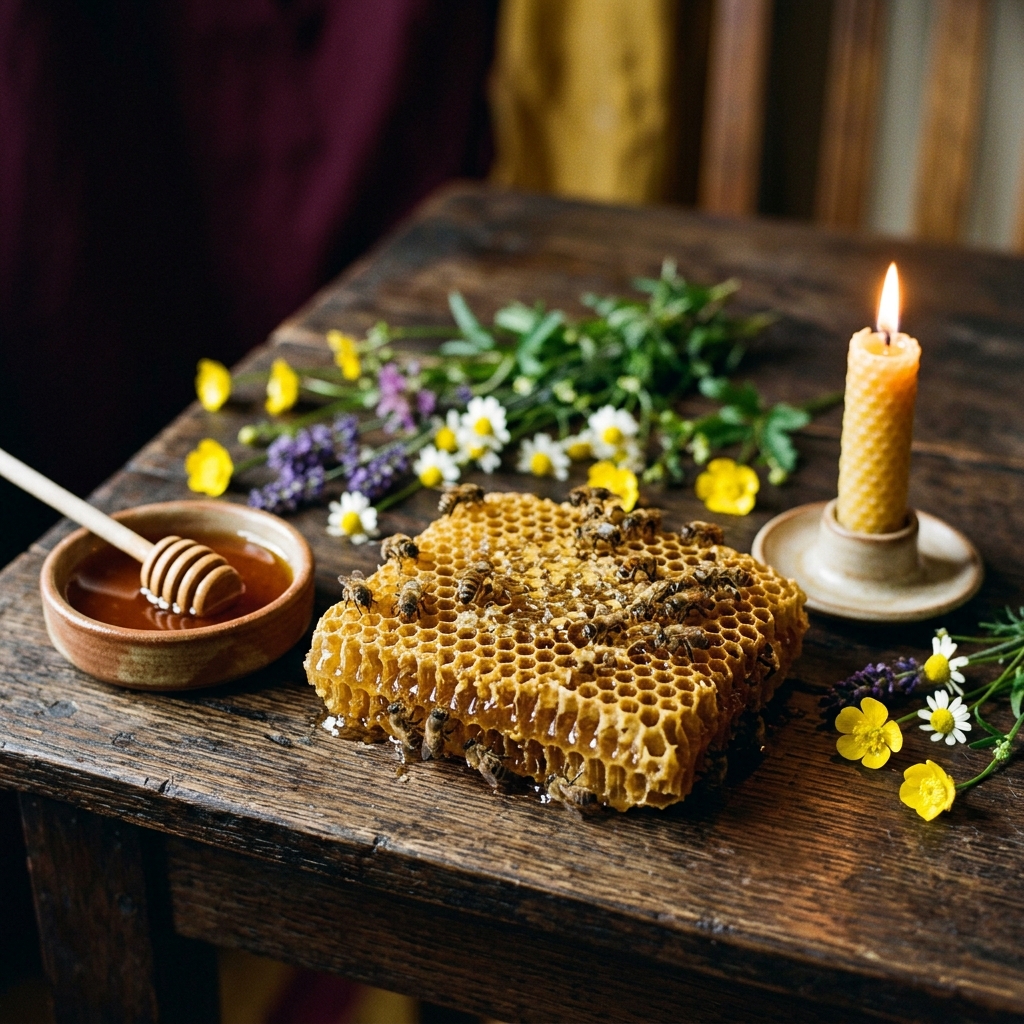
Bee mythology is older than writing in some places, and it turns up in cultures that never met each other. Egyptian bee mythology says bees came from a god’s tears. Greeks called certain priestesses “bees,” and English families once whispered their news to the hive. So why did the humble honeybee become sacred in so many places? In this guide, you’ll meet the gods and goddesses of bees, learn what the bee meant across cultures, and discover a gentle, modern form of beehive witchcraft you can practice today.
- Born From a God’s Tears: Egyptian Bee Mythology
- Is There a Greek Goddess of Bees? Priestesses, Nymphs and Aristaeus
- Bee Goddesses and Gods Beyond Greece and Egypt
- The Common Thread in Bee Mythology Across Cultures
- What Is Beehive Witchcraft?
- Honey and Beeswax: The Bee’s Gifts in Ritual
- A Simple Bee Offering You Can Try
- Bee Symbolism Today: Community, Work and Sweetness
- Frequently Asked Questions
- References
Born From a God’s Tears: Egyptian Bee Mythology
Ancient Egypt gives us one of the oldest pieces of bee mythology in the world. According to an Egyptian myth, the sun god Ra wept, and his tears fell to the ground and became bees.[1] So honey and beeswax were, quite literally, gifts from the sun.
The bee also sat at the heart of royal power. Entomologist Gene Kritsky explains that the bee hieroglyph formed part of the title “King of Upper and Lower Egypt,” where it stood for Lower Egypt. The oldest honeybee hieroglyph dates to about 3000 BCE.[1]
Honey was precious too. Kritsky notes it appears in roughly 500 of about 900 known ancient Egyptian medical prescriptions.[1] In other words, the bee was sacred, royal and healing all at once.
Egyptian beekeepers were also skilled. They kept bees in horizontal tube hives made of dried mud, stacked one on top of another. Kritsky points out that similar hives are still used in parts of Azerbaijan and Iran today.[1] So the practical craft and the sacred story grew up side by side, which is a pattern that repeats throughout bee mythology.
Is There a Greek Goddess of Bees? Priestesses, Nymphs and Aristaeus
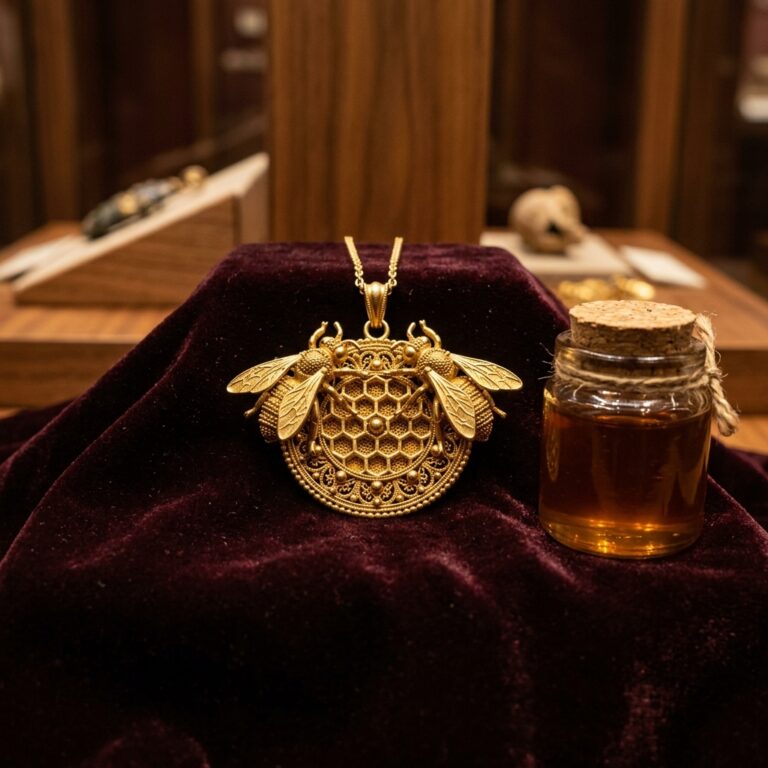
Greece had no single goddess of bees, but bees were everywhere in its religion. Long before classical Greece, the Minoans of Crete made a famous gold pendant, now in the Heraklion Archaeological Museum. It dates to about 1800 to 1700 BCE and shows two bees facing each other around what is probably a honeycomb, holding a drop of honey.[2]
Later, at the great Temple of Artemis in Ephesus, the bee became a civic symbol. A 6th-century BCE coin from Ephesus shows a bee on its face. The Spurlock Museum notes that certain priests of the temple were called “king bees,” while its priestesses were known as the melissae, or honeybees.[3] So when people search for a Greek goddess of bees, Artemis of Ephesus is one of the strongest answers.
Greek myth also offers a bee god of sorts. Aristaeus introduced beekeeping, along with the vine and the olive. According to Britannica, his bees died after Eurydice, wife of Orpheus, was fatally bitten by a snake while fleeing him. He could not keep bees again until he made offerings to her spirit.[4] The Roman poet Virgil tells this story in his Georgics.[4] Some readers also know the Thriae, three bee-like maidens linked with prophecy in an early Greek hymn to Hermes.
Bee Goddesses and Gods Beyond Greece and Egypt
Bee deities appear in many other places. In Lithuanian folklore, Austėja is a goddess of bees who protected hives and families. In Hindu tradition, the goddess Bhramari, whose name means “of the black bees,” is said to take the form of a swarm. Among the Maya of the Yucatán, Ah-Muzen-Cab is known as a god of bees and honey.
These figures of bee mythology come from very different places and eras. Yet they share a surprising number of themes. That shared ground is where the mythology of bees gets most interesting.
The Common Thread in Bee Mythology Across Cultures
Put side by side, the bee stories from these cultures keep returning to the same three ideas.
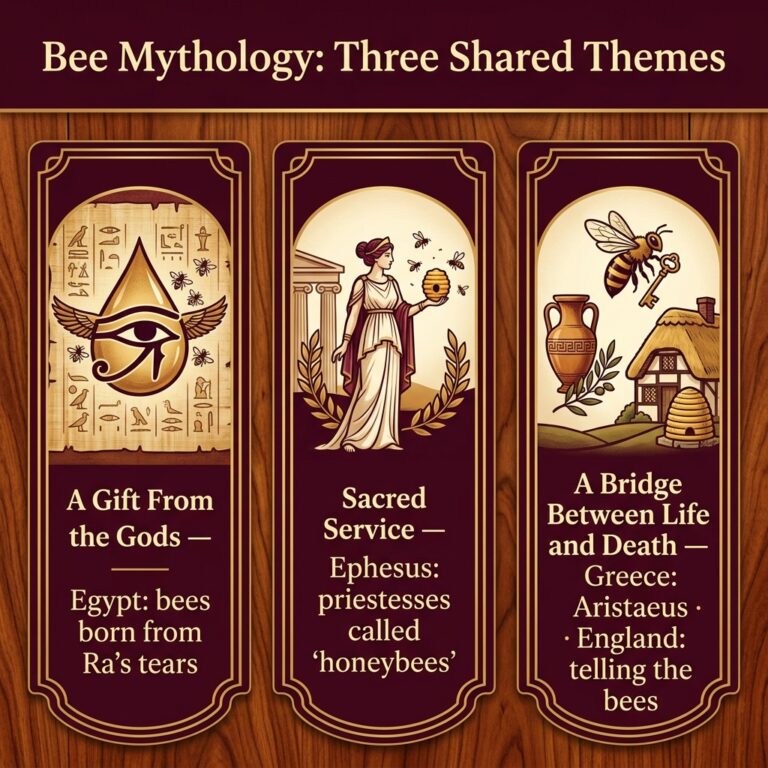
| Shared theme | Where it appears |
|---|---|
| A gift from the gods | Egypt: bees born from Ra’s tears |
| Sacred service | Ephesus: priestesses called “honeybees” |
| A bridge between life and death | Greece: Aristaeus’s bees die with Eurydice; England: telling the bees of a death |
The third theme is the most striking. In Greece, Aristaeus’s bees die because of a death and return only after offerings to the dead.[4] In England, centuries later, families told the bees whenever someone in the household died. The Museum of Dartmoor Life describes how families tapped each hive with the house key and whispered the news inside. They then draped the hives in black.[5] People believed that failing to tell the bees could make them leave or even die.[5]
Here is the insight. Across these traditions of bee mythology, people treat bees less like livestock and more like members of the household, or even of the temple. Families inform them, respect them and include them in their joys and sorrows. For modern practice, that suggests beehive witchcraft is really about relationship. It works best as ongoing care and communication rather than as a one-time spell.
What Is Beehive Witchcraft?
Beehive witchcraft is a modern term for magical practice built around bees, honey and beeswax. It does not come from one ancient tradition. Instead, practitioners draw on the older bee mythology above and on folk customs like telling the bees.
In practice, it often includes honey offerings, beeswax candles, planting flowers for pollinators and keeping a small bee-themed altar. Some beekeepers also bring the old “telling” custom into their routine, sharing family news at the hive. Others who don’t keep bees simply honor them through gardening and gratitude.
Honey and Beeswax: The Bee’s Gifts in Ritual
Much of bee mythology centers on what bees make. Honey was one of the few sweeteners the ancient world had, and it keeps for a very long time without spoiling. So it became a natural offering for gods and ancestors, a gift that seemed to resist decay.
Beeswax carried its own meaning. It burns with a clean, warm glow and a faint honey scent. For that reason, many churches and temples in later centuries preferred beeswax candles for sacred use. Modern practitioners often choose them for the same reason, because the candle itself comes from the bee.
Today, honey offerings are simple. A spoonful on a small dish, set on an altar for a day, is enough. Afterward, many people return it to the earth, or share it with the household as a blessing. Either way, the gesture echoes one of the oldest themes in bee mythology: sweetness as a gift passed from the divine to people and back again.
A Simple Bee Offering You Can Try
This short practice honors bees without disturbing a hive. It suits anyone, whether or not you keep bees.
First, choose a sunny morning, when bees are most active. Then light a beeswax candle indoors, since beeswax is the bee’s own gift. Place a small dish of honey beside it.
Next, go outside to a flowering plant, a garden or a window box. Stand quietly and watch the bees for a few minutes. Notice how each one moves from flower to flower. Then, in the spirit of telling the bees, speak one piece of news from your life aloud, whether joyful or sad.

After that, return indoors and let the candle burn a little longer if it is safe. Finally, give something real back to the bees. Plant a pollinator-friendly flower, leave part of your garden unmown, or set out a shallow dish of water with pebbles for thirsty bees. Many practitioners see this practical care as the heart of the offering.
A note on safety: never open or disturb a hive unless you are a trained beekeeper. Also skip close contact if you have a bee sting allergy.
Belief, Intention & The Power of Magic
Witchcraft, spells, and manifestation are deeply rooted in belief, intention, and spiritual practice. If these practices do not resonate with you, this may not be the path for you, and that’s perfectly okay. But if you believe in divine powers, trust your intentions, and feel drawn to the mysteries of the unseen, we invite you to continue exploring with Madame Celestine and discover the magic that speaks to your soul.
Bee Symbolism Today: Community, Work and Sweetness
Modern readers often turn to bee mythology for simple lessons. The hive stands for community, since no bee survives alone. Honey stands for sweetness earned through patient work. The bee’s flight from flower to flower suggests connection, as it links plants that would otherwise never meet.
These modern meanings grow naturally from the older ones. Egyptians saw bees as divine gifts, Ephesians saw them as sacred servants, and English families saw them as household members who deserved the news. So when a bee lands near you, many practitioners read it as a reminder to care for your own community and share what you have.
Bee mythology also belongs to the wider world of earth and harvest deities. If that interests you, this guide to earth goddesses and gods explores the deities of soil and grain whose fields the bees help to pollinate.
Frequently Asked Questions
Who is the Greek goddess of bees?
Greece had no single goddess of bees. However, Artemis of Ephesus is closely linked to them, because her temple’s priestesses were called melissae, or honeybees, and the city’s coins showed a bee.
Is there a bee god?
Yes. In Greek myth, Aristaeus introduced beekeeping, and among the Maya, Ah-Muzen-Cab is known as a god of bees and honey.
What do bees mean in mythology?
Across many cultures, bees stand for a gift from the gods, sacred service and a link between life and death. They are also symbols of community and hard work.
What is telling the bees?
Telling the bees is an old English custom of sharing household news, especially deaths, with the family’s bees. People tapped the hive, whispered the news and sometimes draped the hive in black.
What is beehive witchcraft?
Beehive witchcraft is a modern practice built around bees, honey and beeswax. It often includes honey offerings, beeswax candles and caring for pollinators.
References
- The Beekeepers of Ancient Egypt. Living on Earth, November 13, 2015. https://loe.org/shows/segments.html?programID=15-P13-00046&segmentID=7
- Gold bee pendant. Heraklion Archaeological Museum. https://heraklionmuseum.gr/en/exhibit/gold-bee-pendant/
- Coin: Drachm, Ephesus. Spurlock Museum of World Cultures, University of Illinois. https://www.spurlock.illinois.edu/collections/search-collection/details.php?a=1900.63.0678
- Aristaeus. Encyclopaedia Britannica. https://www.britannica.com/topic/Aristaeus
- Telling the Bees: Dartmoor’s Unique Tradition Explained. Museum of Dartmoor Life, March 4, 2026. https://www.dartmoorlife.org.uk/telling-the-bees/
Not sure where to start? You don’t have to do this alone.
Madame Celestine offers guided spellwork for beginners — real support for your first working, not just another guide to read.
Related reading: Earth Goddesses and Gods: Deities of Soil and Harvest · Hekate: Goddess of Witchcraft, Altars, Crystals and Incense

About Wren Ashby
Wren Ashby is the pen name our editorial team uses for articles on sigils, Tarot and modern traditional witchcraft. Articles under this byline are researched from published sources and reviewed by Madame Celestine before publishing.