
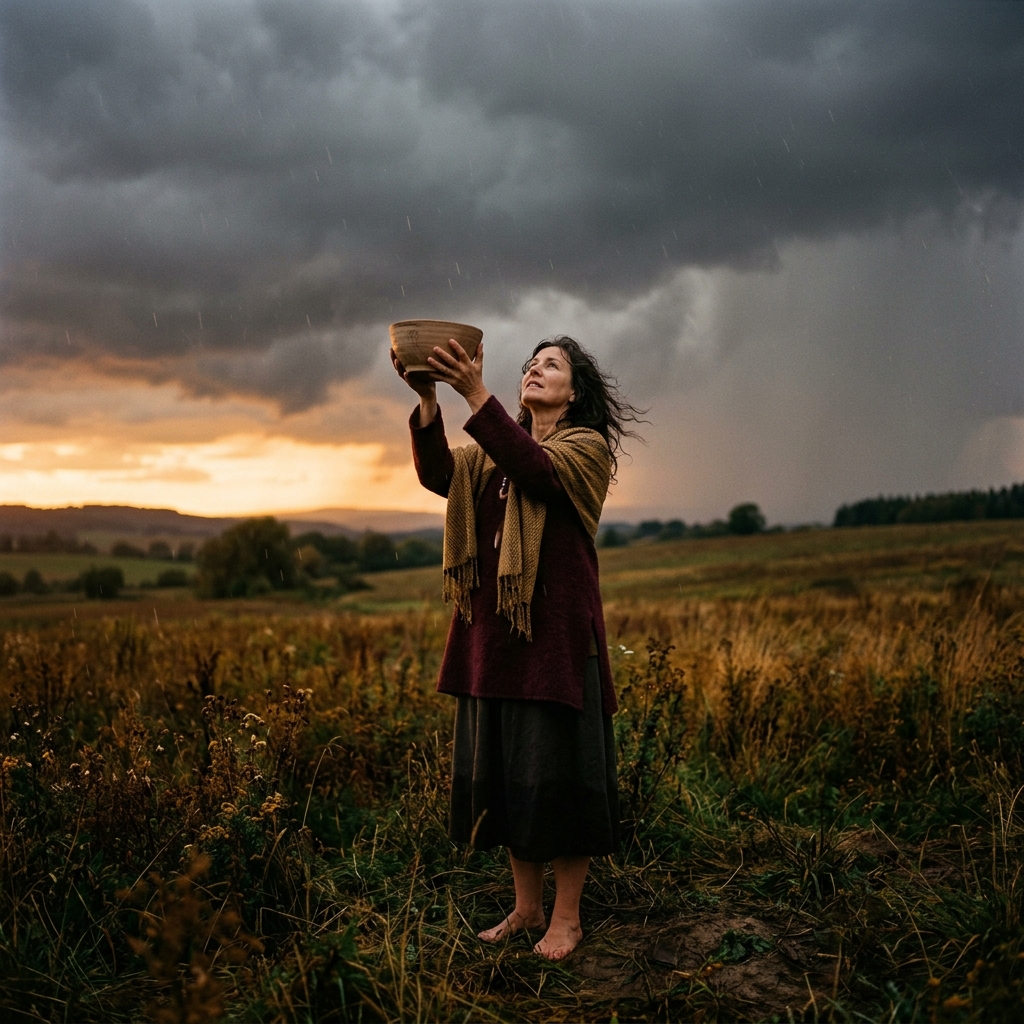
A rain prayer is one of the oldest rituals people have ever performed. For most of history, rain decided whether a village ate or went hungry, so asking the sky for water was never a small thing. In this article, you will meet the rain gods of the Aztec and Maya worlds and learn how medieval Europe walked its fields in prayer. You will also discover the surprising science behind the smell of rain. Finally, you will find a simple rain prayer ritual you can use for your garden, or for a dry season in your own life.
Why the Rain Prayer Is One of Humanity’s Oldest Rituals
Rain has always been both blessing and threat. Too little brings drought and hunger, while too much brings floods. That double nature shows clearly in Tlaloc, the Aztec god of rain. His name means “He Who Makes Things Sprout,” and his worship goes back at least to the city of Teotihuacán, between the third and eighth centuries[1].
Tlaloc mattered enormously. At the Great Temple of Tenochtitlán, his shrine stood beside that of the sun god Huitzilopochtli, and his sanctuary wore white and blue[1]. Yet people also feared him, because the same god could send drought, lightning and storms. In other words, a rain prayer was always a request for balance, not simply for more water.
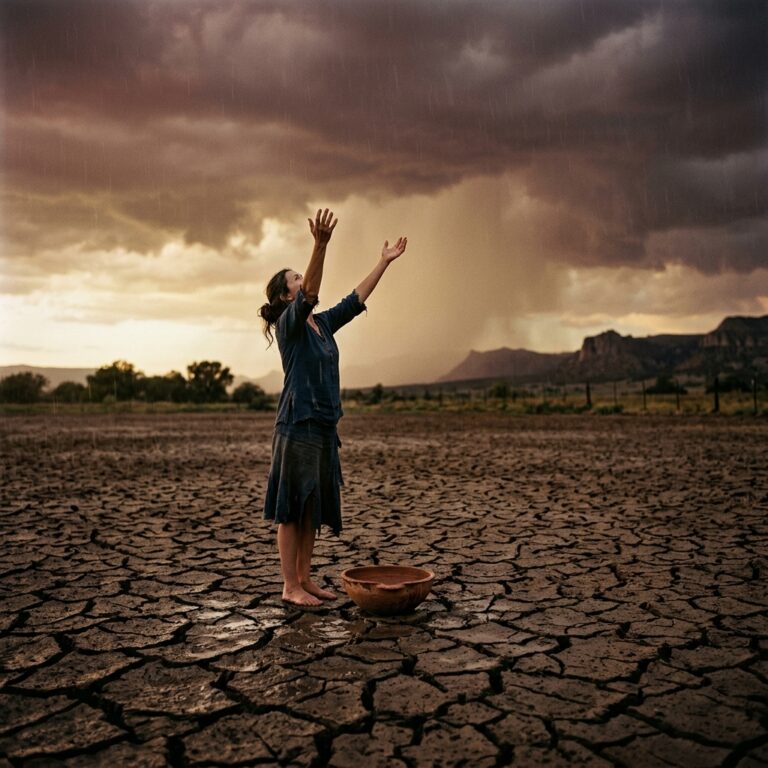
Chac and the Four Directions of Rain
Farther south, the Maya of the Yucatán honored Chac, their rain god. Like other major Maya gods, Chac had a fourfold form, one for each direction of the compass. Each had its own color: white for north, red for east, black for west and yellow for south[2].
That idea still shapes rain prayer today. Many practitioners turn to each of the four directions in turn, because rain can arrive from any side of the sky. Interestingly, after the Spanish conquest, the Chacs became linked with Christian saints and were even shown on horseback[2]. The old prayers simply found new forms.
Rogation Days: Walking the Fields to Pray for the Harvest
Europe had its own tradition of prayer for the growing season. Rogation Days were Catholic observances with special prayers for crops. By the year 598, the Church had made the Major Rogation, held on April 25, a Christian replacement for Robigalia, a Roman festival meant to protect crops from blight[3].
Around 470 CE, Saint Mamertus of Vienne added the Minor Rogations in Gaul. Communities walked in procession, sang litanies and fasted, asking to be spared from famine[3]. So even under a new religion, the basic rain prayer stayed the same: people went out to the land itself and asked for it to be fed.

The Smell of an Answered Rain Prayer
Almost everyone knows the earthy smell that comes with the first rain. Surprisingly, it did not have a scientific name until 1964. That year, Australian scientists Isabel Joy Bear and Richard Thomas called it petrichor in the journal Nature[4].
The word joins the Greek petra, meaning stone, with ichor, the fluid said to run in the veins of the gods[4]. So the modern name for the smell of rain quietly calls it the blood of the gods drawn from stone. Even more charming, perfumers in India had already captured the scent in an oil called matti ka attar, or “earth perfume”[4].
A Simple Rain Prayer Ritual
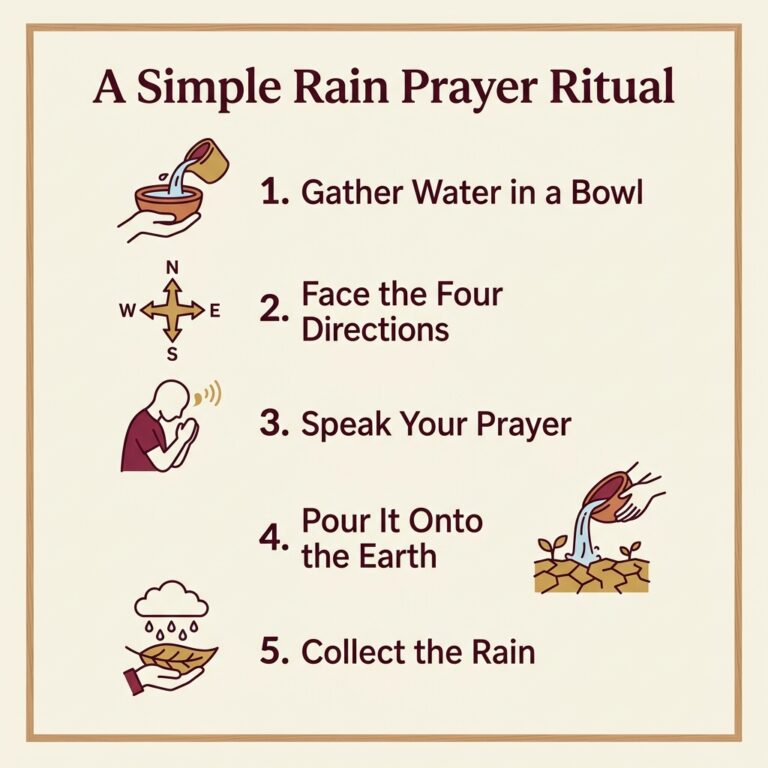
This ritual works for a thirsty garden, a dry spell in your creativity, or simply to honor the rain. Do it outdoors if you can.
- Gather water in a bowl. Use saved rainwater if you have it. Otherwise, use fresh tap water, which you will return to the earth.
- Face the four directions. Turn slowly to north, east, south and west, pausing at each. This honors the idea that rain can come from any side of the sky.
- Speak your rain prayer. Keep it simple and sincere, such as “Let gentle rain return to this land and to my life.”
- Pour the water onto the earth. Offer it to a plant, tree or patch of soil as a gift and a sign of what you are asking for.
- Collect rainwater when it comes. When the next rain falls, set out a clean jar and thank the sky as it fills.
Belief, Intention & The Power of Magic
Witchcraft, spells, and manifestation are deeply rooted in belief, intention, and spiritual practice. If these practices do not resonate with you, this may not be the path for you, and that’s perfectly okay. But if you believe in divine powers, trust your intentions, and feel drawn to the mysteries of the unseen, we invite you to continue exploring with Madame Celestine and discover the magic that speaks to your soul.
Using Rainwater After Your Ritual
Many practices treasure rainwater collected after a rain prayer. Some people use it to water houseplants, while others add it to cleansing baths or keep a small jar on their altar. If you want to go further, you can charge it under the moon. Our moon water recipe for every phase shows how.
Finally, remember that rainwater is not safe to drink without treatment. Keep ritual water for outer use only.
Frequently Asked Questions
What is a rain prayer?
A rain prayer is a ritual request for rain, usually made to a deity, the sky or the land itself. People have offered them for thousands of years, especially in farming communities.
Who were the ancient gods of rain?
Well-known rain gods include Tlaloc of the Aztecs and Chac of the Maya. Both could bring life-giving rain but were also linked with storms and drought.
What does petrichor mean?
Petrichor is the earthy smell that comes with rain. The word joins Greek terms for stone and for the fluid said to flow in the veins of the gods.
Can I do a rain prayer indoors?
Yes. Use a bowl of water and a potted plant, and face each direction in your room. Outdoors is traditional, but sincerity matters most.
Is it safe to drink collected rainwater?
No, not without proper treatment. Keep ritual rainwater for watering plants, altar use or outer cleansing.
References
- Tlaloc. Encyclopaedia Britannica. https://www.britannica.com/topic/Tlaloc
- Chac. Encyclopaedia Britannica. https://www.britannica.com/topic/Chac
- Rogation Days. Encyclopaedia Britannica. https://www.britannica.com/topic/Rogation-Days
- The Smell of Rain: How Our Scientists Invented a New Word. CSIRO, March 2015. https://www.csiro.au/en/news/all/articles/2015/march/the-smell-of-rain-how-our-scientists-invented-a-new-word
Not sure where to start? You don’t have to do this alone.
Madame Celestine offers guided spellwork for beginners — real support for your first working, not just another guide to read.
Related reading: Crafting Worry Stones and Their Magickal Use: Tips and a DIY Recipe: Materials, Method & Ritual Context · Sigils of Lilith: Meaning, Origin & How to Work With Them: Symbolism, Interpretation & Ritual Practice

About Madame Celestine
Madame Celestine has practiced and taught spellwork, divination, and seasonal ritual for over two decades, helping newcomers build a grounded, confident practice from their very first spell.