
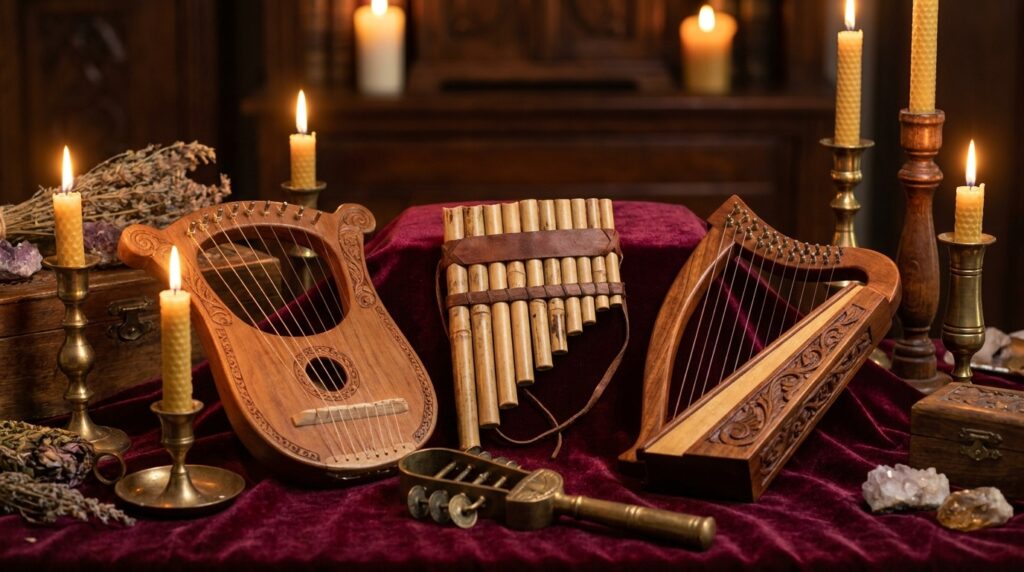
The pagan gods of music are some of the most vivid figures in ancient myth. There is a baby god who built a lyre on the day he was born, a goat-legged piper in the hills, a goddess honored with a sacred rattle, and a harp that could call in the seasons. In this article, you will meet five of these gods of music from Greek, Egyptian, Norse and Irish tradition. You will learn which instrument belongs to each and what their stories reveal about sound as sacred. Finally, you will find a simple music offering ritual to try at home.
Why Music Belonged to the Gods
In many ancient cultures, music was not just entertainment. It marked the moment a person stepped into sacred space, carried prayers and helped worshippers move into a different state of mind. That is why so many instruments came with a divine origin story.
For modern practitioners, this history matters. When you play, sing or even shake a simple rattle in ritual, you are joining one of the oldest ways people have reached toward the unseen. The gods of music below show how differently cultures imagined that link. If you enjoy meeting deities by their stories, our guide to goddesses of the ocean is a good companion read.
Hermes and Apollo: The Lyre Made From a Tortoise Shell
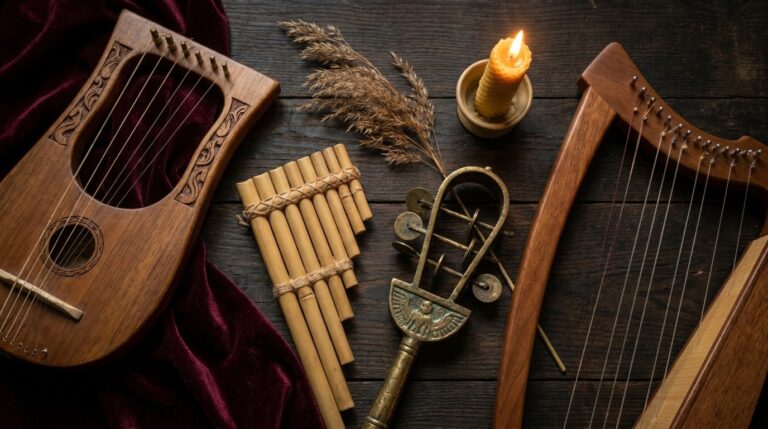
One of the most charming myths about music comes from the Homeric Hymn to Hermes. On the very day he was born, the infant Hermes found a tortoise and made a lyre from its shell. Later, he gave the lyre to his brother Apollo[1].
The story explains why Apollo, not Hermes, became the great lord of the lyre in Greek tradition. It also shows something practitioners still value. Hermes turned an ordinary creature into a sacred instrument, which suggests that music can begin with whatever you have at hand.
Pan’s Pipes: Wild Music of the Shepherd God
Pan was the Greek god of shepherds and wild places. Like the herdsmen he protected, he was a piper who rested at noon[2]. His panpipes, made of reeds of different lengths, still carry his name today.
In a famous myth, the nymph Syrinx fled from Pan and was turned into reeds, which he then cut to make his first pipes. As a result, Pan’s music has always had a wild, slightly unsettling edge. Among the gods of music, he is the one practitioners often call on for outdoor ritual, creativity and a return to instinct.
Hathor’s Sistrum: Egypt’s Sacred Rattle
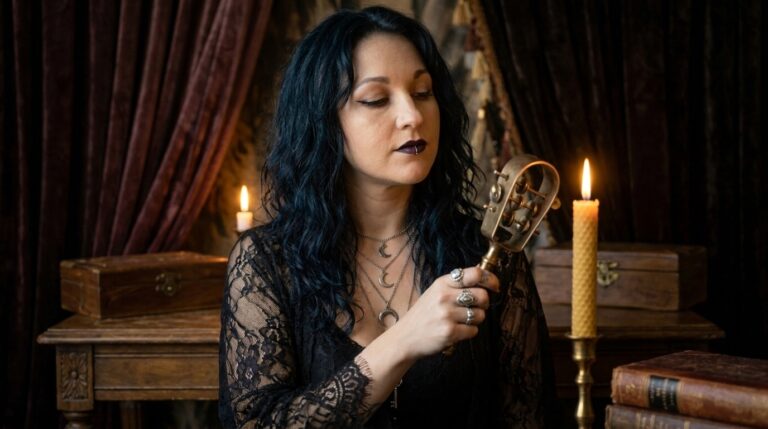
In ancient Egypt, Hathor was the divine patroness of music. Her instrument was the sistrum, a handheld rattle with metal pieces that jingled when shaken. Temple musicians shook it during ceremonies and when coming into the presence of a god[3].
Here is a lovely detail. According to the Metropolitan Museum of Art, the sistrum’s sound imitated rustling papyrus stalks. That echoed myths of the god Horus growing up hidden in the marshes[3]. So every shake of the rattle carried a small memory of a sacred landscape.
Bragi and the Dagda: Northern Gods of Poetry and the Harp
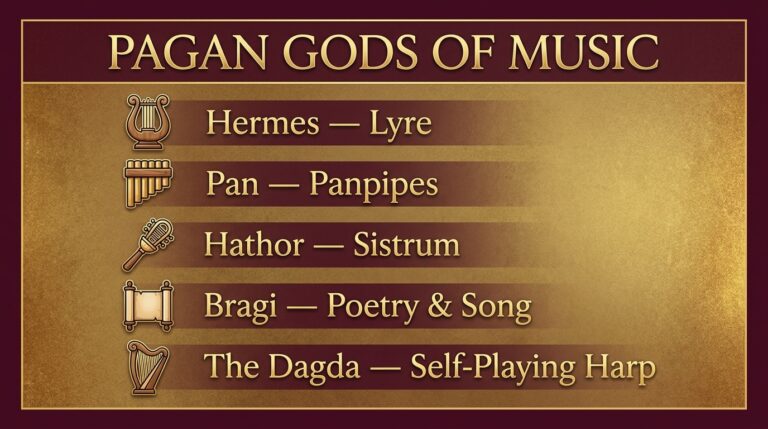
Farther north, the gods of music were closely tied to poetry and storytelling. In Norse myth, Bragi is the god of poetry and the husband of Idun, keeper of the apples of immortality. Interestingly, the first recorded Norse court poet, who lived in the ninth century, was also named Bragi. Some scholars think this real poet may have been turned into a god over time[4].
Irish myth offers the Dagda, a powerful father figure of the Tuatha Dé Danann. Alongside a cauldron that was never empty, he owned a harp that played by itself and summoned the seasons[5]. In other words, his music did not just please listeners. It kept the natural year in order.
A Simple Music Offering Ritual
You do not need training to honor the gods of music. Your voice, a drum or a homemade rattle works well. This ritual takes about fifteen minutes.
- Choose a deity. Pick the god whose story speaks to you, such as Hathor for joy or the Dagda for the turning seasons.
- Prepare a small altar. Light a candle and add a symbol, such as a feather for Hermes or a sprig of reeds for Pan.
- Make a simple instrument. A jar with dried beans can stand in for a sistrum. Shake it three times to mark the start.
- Offer your music. Sing, hum, drum or play for about three minutes. Focus on feeling rather than skill.
- Sit in silence. Listen for a minute afterward, then thank the deity aloud and snuff the candle.
Belief, Intention & The Power of Magic
Witchcraft, spells, and manifestation are deeply rooted in belief, intention, and spiritual practice. If these practices do not resonate with you, this may not be the path for you, and that’s perfectly okay. But if you believe in divine powers, trust your intentions, and feel drawn to the mysteries of the unseen, we invite you to continue exploring with Madame Celestine and discover the magic that speaks to your soul.
Frequently Asked Questions
Who is the Greek god of music?
Apollo is the best-known Greek god of music, closely linked with the lyre. However, myth credits the infant Hermes with inventing the lyre and giving it to Apollo.
What is a sistrum?
A sistrum is an ancient Egyptian rattle linked with the goddess Hathor. Temple musicians shook it during ceremonies and when approaching a deity.
Is there a Norse god of music?
Bragi is the Norse god of poetry, which was closely tied to song and recitation. Some scholars think he began as a real ninth-century poet.
Can I honor the gods of music if I cannot play an instrument?
Yes. Your voice, a simple drum or a homemade rattle is enough. Many practitioners believe sincerity matters more than skill.
Which god of music is best for beginners?
Many people start with a deity whose story they connect with. For example, Hathor suits joy and celebration, while Pan suits outdoor and creative work.
References
- Hesiod, the Homeric Hymns, and Homerica (Hymn to Hermes), translated by Hugh G. Evelyn-White. Project Gutenberg. https://www.gutenberg.org/files/348/348-h/348-h.htm
- Pan. Encyclopaedia Britannica. https://www.britannica.com/topic/Pan-Greek-god
- Arc Sistrum of Tapenu, Chantress of Sobek of Khenyt. The Metropolitan Museum of Art. https://www.metmuseum.org/art/collection/search/553814
- Bragi. Encyclopaedia Britannica. https://www.britannica.com/topic/Bragi
- Dagda. Encyclopaedia Britannica. https://www.britannica.com/topic/Dagda
Not sure where to start? You don’t have to do this alone.
Madame Celestine offers guided spellwork for beginners — real support for your first working, not just another guide to read.
Related reading: Signs From Your Spirit Guides: How to Find & Meet Them: Ritual Ideas, Meaning & Practical Guidance · What an Ancestral Guidance Ritual Actually Involves

About Madame Celestine
Madame Celestine has practiced and taught spellwork, divination, and seasonal ritual for over two decades, helping newcomers build a grounded, confident practice from their very first spell.