
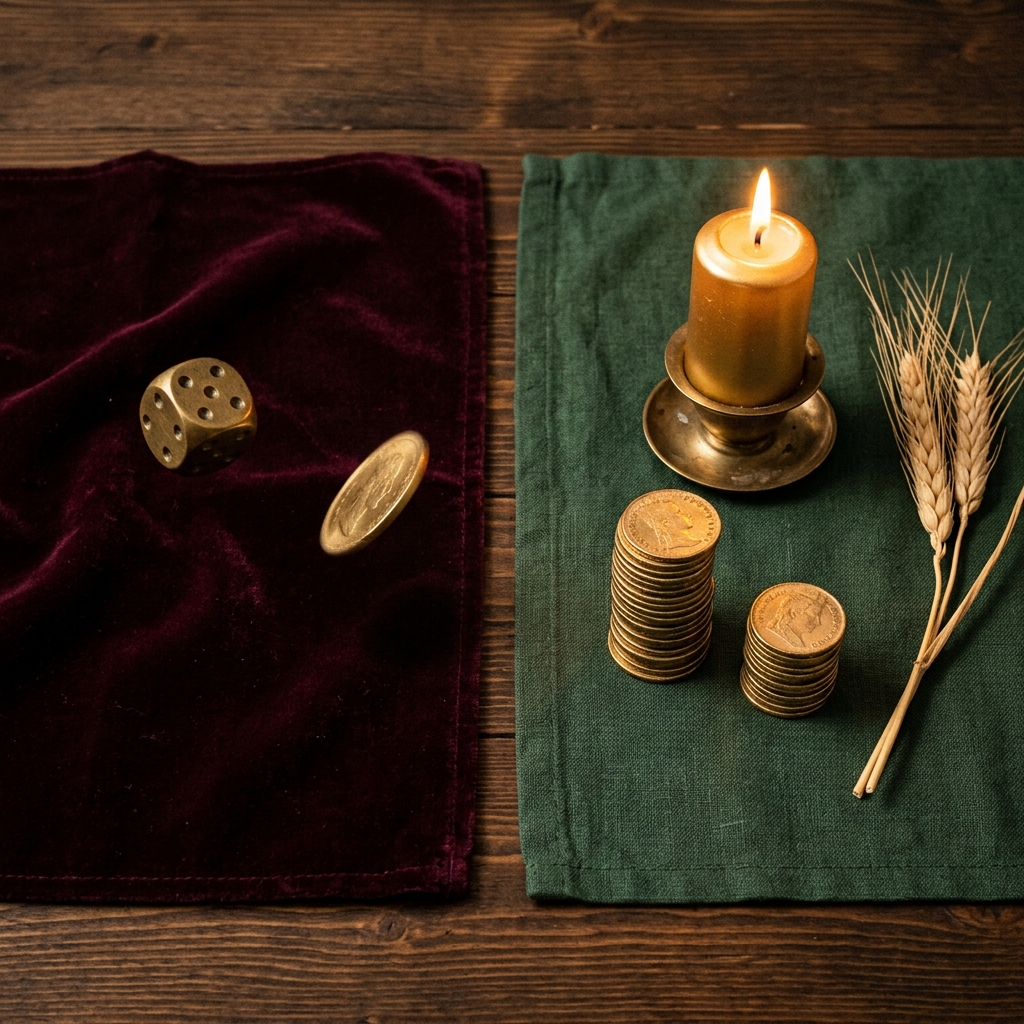
Are Satanic luck rituals just prosperity rituals with a darker costume? Many people use the two words as if they mean the same thing. However, older magical books and modern Satanic writers treat them quite differently. One aims at a single moment of chance. The other aims at a steady condition you build over months. In this guide, you’ll learn where each idea comes from and what the grimoires say about wealth. You’ll also see how practitioners tell the two kinds of work apart.
- Chance vs. Harvest: What Satanic Luck Rituals Aim At
- Fortuna’s Ball and Cornucopia: An Ancient Split
- From Solomon to LaVey: Where Infernal Wealth Work Comes From
- Satanic Luck Rituals vs. Prosperity Rituals, Side by Side
- How Satanic Luck Rituals Are Usually Built
- How Prosperity Rituals Are Built Differently
- Common Mistakes With Satanic Luck Rituals and Prosperity Work
- Frequently Asked Questions
- References
Chance vs. Harvest: What Satanic Luck Rituals Aim At
The simplest way to see the difference is to look at the words themselves. “Luck” is a surprisingly young word in English. It arrived around 1500, probably from the early Middle Dutch luc, a short form of gheluc, meaning happiness or good fortune. Some scholars even think English first borrowed it as a gambling term[1]. So from the start, luck belonged to the roll of the dice.
“Prosperity” has a very different root. It comes from the Latin prosperus, meaning favorable or fortunate. Traditionally, scholars read this as pro spere, “according to one’s hope”[2]. In other words, prosperity described life going the way you hoped over time, not a lucky break on one night.
This split still shapes practice today. Satanic luck rituals usually focus on one event, such as an interview, a contract or a first meeting. Prosperity rituals, by contrast, focus on a state of life, such as steady income, savings or a thriving business. Because the goals differ, the timing, tools and patience needed differ as well.
Fortuna’s Ball and Cornucopia: An Ancient Split
The Romans already sensed this difference, and they put both ideas into one goddess. Fortuna ruled “chance or lot,” yet Romans also honored her as a bearer of prosperity and increase. Her earliest roots were probably agricultural, linked to fertile soil and to women’s fruitfulness[3].
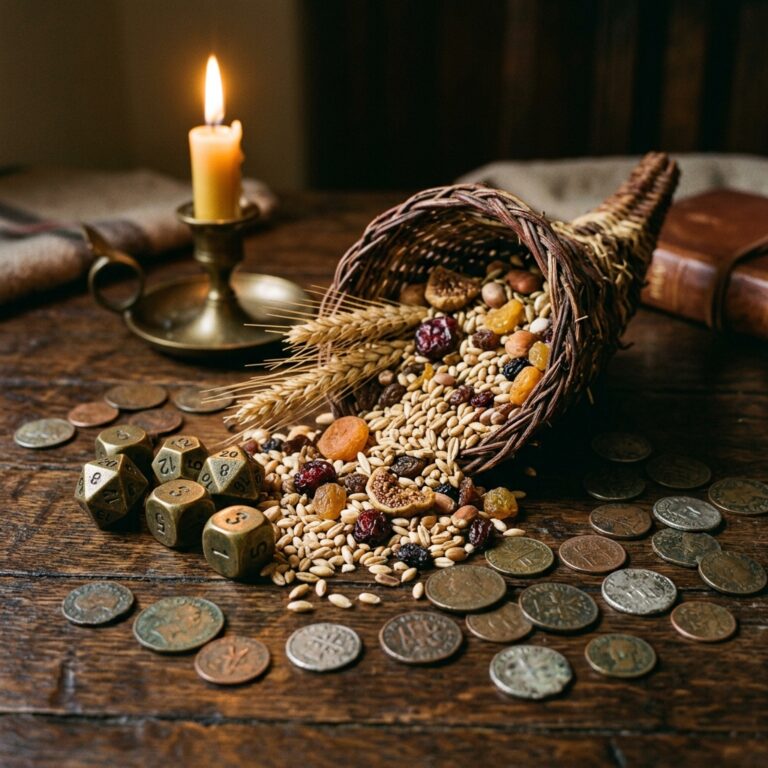
Her symbols tell the story best. First, she carried a cornucopia, the horn of plenty, which stands for lasting abundance. Next, she held a rudder, which showed her steering people’s destinies. Finally, artists showed her with a ball, a sign of how uncertain fortune is[3]. The ball rolls, so luck can turn at any moment. The horn, however, keeps pouring as long as the harvest holds.
Romans also visited her oracle shrines at Praeneste and Antium to ask about the future, and they later linked her with the Greek goddess Tyche[3]. For a modern practitioner, this is a useful picture. Luck work reaches for the rolling ball. Prosperity work, on the other hand, tends the horn of plenty.
From Solomon to LaVey: Where Infernal Wealth Work Comes From
Much of what people now call Satanic prosperity work borrows from older grimoires, the handbooks of ritual magic. The best known is the Goetia, the first part of the Lesser Key of Solomon. It lists 72 spirits, and several of them have money-related “offices,” or duties. For example, the text says Bune, the 26th spirit, gives riches and makes a person wise and eloquent. Purson, the 20th, knows hidden things and can discover treasure[4].
Notice the difference between those two offices. Finding treasure is a sudden windfall, which is close to luck. Gaining wisdom and a persuasive voice, by contrast, builds the skills that earn money over years, which is close to prosperity. So even the old spirit lists hint at both kinds of work.
The older Key of Solomon works the same way through Jupiter. The book offers its Second Pentacle of Jupiter, a drawn talisman, for glory, honours, riches, “all kinds of good,” and great tranquillity of mind. Its Fourth Pentacle serves to acquire riches and honour and to possess much wealth[5]. That is prosperity language, since it describes a lasting state rather than a lucky moment.
It helps to be precise here. Magicians who commanded spirits through divine names wrote these Solomonic books. So they are not Satanic texts. Modern Satanism came much later. Anton LaVey founded the Church of Satan on April 30, 1966, and published The Satanic Bible in 1969. In his system, Satan was a symbol of self-assertion rather than a literal being, and he designed rituals as psychodramas[6]. As a result, many modern Satanic practitioners mix grimoire imagery with a strong focus on personal will.
Satanic Luck Rituals vs. Prosperity Rituals, Side by Side
With the history in place, the practical differences become easier to see. The infographic below sums them up, and the notes after it explain the reasoning.
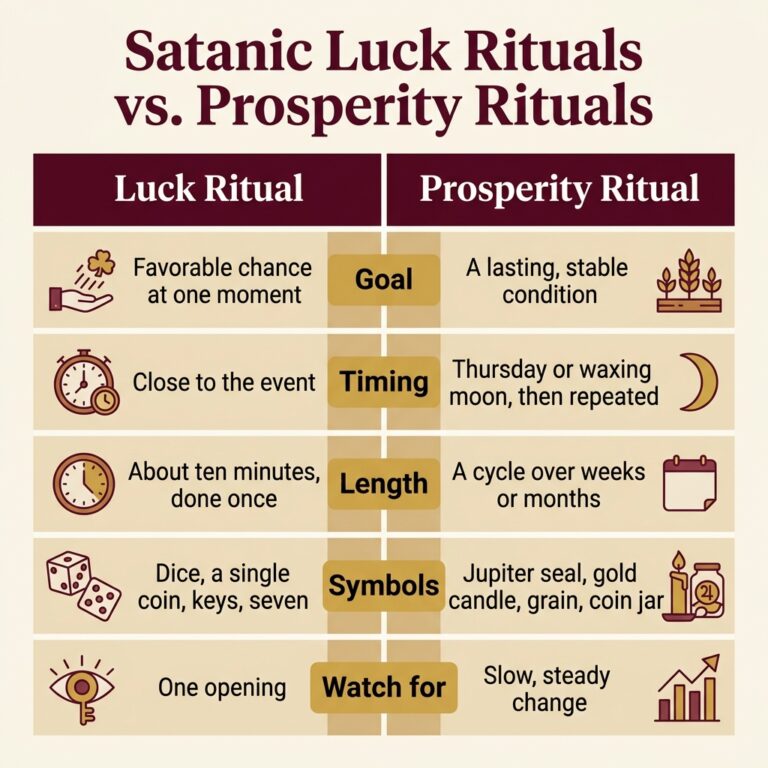
Goal. Satanic luck rituals ask for favorable chance at a named moment. Prosperity rituals ask for a stable condition, such as a reliable income.
Timing. Practitioners often do luck work close to the event, so the intention stays sharp. Prosperity work, instead, often starts on a waxing moon or on a Thursday, the day named for Jupiter in Latin tradition, and then repeats.
Length. A luck ritual may take ten minutes and happen once. A prosperity working usually runs as a cycle over weeks or months.
Symbols. Luck work favors dice, coins tossed once, keys and the number seven. Prosperity work favors Jupiter seals, gold candles, grain and slowly growing objects, such as a coin jar you add to each week.
What practitioners watch for. After luck work, people watch for a single opening. After prosperity work, however, they watch for slow change in habits, confidence and steady results.
How Satanic Luck Rituals Are Usually Built
Most Satanic luck rituals are short and pointed. They also tend to follow a similar shape, and each step has a clear reason behind it.
First, practitioners name the exact moment. A vague wish for “more luck” gives the mind nothing to aim at, so they write down one event and its date. Second, they choose a symbol of chance, often a single die or a coin. The object stands in for the rolling ball of Fortuna, so it reminds them that the outcome is open.
Third, they state their will aloud. In LaVeyan practice, this spoken claim matters more than any borrowed spirit name, because the ritual is meant to charge the speaker’s own intention. Some people then add a sigil, a simple symbol made from the letters of their goal. Finally, they carry the coin or die to the event itself. That way, the ritual and the real-world action stay linked.
Afterward, most practitioners let the matter go. Repeating the same luck ritual again and again tends to feed worry instead of focus.
How Prosperity Rituals Are Built Differently
Prosperity work is slower, and its structure reflects that. Rather than one strike, it works like tending a garden.
To begin, practitioners define the condition they want in plain terms, such as “three months of savings.” Then they choose a start date, often a Thursday or a waxing moon. Both carry old links to growth. Next, they set up a small space that can stay in place, such as a gold candle, a green cloth and a copy of a Jupiter seal.
Each week, they return to the space for a few minutes. They light the candle, add a coin to a jar and note one practical step they took toward the goal. This repetition is the point. The ritual acts as a regular check-in that keeps the aim in view, so the growing jar mirrors the growing savings.
Finally, many practitioners close each cycle by reviewing what changed. If they reach the goal, they end the working with thanks or a simple closing statement. If not, they adjust the plan and begin again.

Belief, Intention & The Power of Magic
Witchcraft, spells, and manifestation are deeply rooted in belief, intention, and spiritual practice. If these practices do not resonate with you, this may not be the path for you, and that’s perfectly okay. But if you believe in divine powers, trust your intentions, and feel drawn to the mysteries of the unseen, we invite you to continue exploring with Madame Celestine and discover the magic that speaks to your soul.
Common Mistakes With Satanic Luck Rituals and Prosperity Work
The most common mistake is using the wrong tool for the job. For example, someone behind on rent may do a luck ritual every night and hope for a windfall. Yet their real need is a stable condition, which is prosperity work paired with practical steps.
The opposite mistake happens too. A person facing one key interview may start a slow, month-long prosperity cycle the day before. In that case, a short, focused luck ritual fits the moment better.
Another mistake is mixing symbols without thought. Dice on a long-term prosperity altar send a mixed message, because they stand for chance rather than growth. Likewise, practitioners who skip real action often feel let down. Both traditions, old and new, treat ritual as a support for effort, not a replacement for it.
If you’d like to see how the same split plays out in folk spellwork, this guide to money spells vs. luck spells covers it from a New Orleans angle.
Frequently Asked Questions
Are Satanic luck rituals the same as prosperity rituals?
No. Satanic luck rituals aim at favorable chance around one specific event, while prosperity rituals aim at a lasting condition, such as steady income, built over weeks or months.
Do Satanic luck rituals involve worshipping Satan?
Not always. In LaVeyan Satanism, Satan is a symbol of self-assertion rather than a being to worship, although some theistic practitioners do see him as a real presence.
Can I do a luck ritual and a prosperity ritual at the same time?
Many practitioners do, but they keep them separate. A long prosperity cycle can run in the background, while they save a short luck ritual for one key moment.
Why do grimoires link Jupiter with wealth?
In traditional astrology, Jupiter is the planet of growth and good fortune. So the Key of Solomon gives Jupiter's pentacles offices such as riches, honour and peace of mind.
How often should a luck ritual be repeated?
Most practitioners perform it once per event and then let it go. Repeating it many times tends to build anxiety rather than focus.
References
- Luck – Etymology, Origin & Meaning. Online Etymology Dictionary. https://www.etymonline.com/word/luck
- Prosper – Etymology, Origin & Meaning. Online Etymology Dictionary. https://www.etymonline.com/word/prosper
- Fortuna. Encyclopaedia Britannica. https://www.britannica.com/topic/Fortuna-Roman-goddess
- The Lesser Key of Solomon: Goetia: Shemhamphorash. Internet Sacred Text Archive. https://sacred-texts.com/grim/lks/lks05.htm
- Pentacles of Jupiter 1–4, Plate IV – The Key of Solomon the King. Internet Sacred Text Archive. https://sacred-texts.com/grim/kos/kos27.htm
- Church of Satan. Encyclopaedia Britannica. https://www.britannica.com/topic/Church-of-Satan
Not sure where to start? You don’t have to do this alone.
Madame Celestine offers guided spellwork for beginners — real support for your first working, not just another guide to read.
Related reading: Before You Book a Satanic Career Ritual: 10 Questions About Scope and Claims · The Black Flame in Luciferian Thought: Knowledge, Ambition, and Self-Discovery

About Edmund Hale
Edmund Hale is the pen name our editorial team uses for articles on grimoires, Qabalah, ceremonial magic and British folklore. Articles under this byline are researched from published sources and reviewed by Madame Celestine before publishing.