

Rejection has a way of making you smaller. You replay the moment, soften your own needs in hindsight, wonder if you asked for too much just by wanting to be chosen. If your first instinct after being turned away is to shrink and apologize for having wanted anything at all, the adversary archetype offers a different response: standing your ground instead of disappearing.
What the Adversary Archetype Actually Represents
In Hebrew, “satan” originally meant accuser or opposer — a legal-sounding role, not a monster. Later religious tradition turned that figure into the personification of evil, but the older meaning survives inside Satanic and Luciferian symbolism: the adversary is the one who refuses to go along with a judgment they believe is unjust, who opposes rather than submits. It’s a figure of resistance, not villainy for its own sake.
Used symbolically, the adversary archetype isn’t about harming anyone. It’s a lens for a specific psychological stance: when you’re told no, dismissed, or cast aside, you don’t have to accept the story that you deserved it. You’re allowed to oppose that verdict internally, even while you process the loss.
Why Rejection Activates the Adversary in You
Rejection triggers an old survival instinct: appease, apologize, make yourself smaller so the group lets you back in. That instinct made sense when being cast out of a tribe was a physical danger. It makes much less sense when the “tribe” is a single person who decided not to choose you.
The adversary archetype interrupts that appeasement reflex. Instead of asking “what’s wrong with me that this happened,” it asks a different question: “what am I going to do with this energy now that it’s here.” Anger, wounded pride, and stubborn self-respect stop being things to suppress and become material to work with.

A Ritual for Reclaiming Ground After Rejection
This working is meant as private, symbolic processing — not a spell aimed at changing another person’s mind or feelings.
Begin by writing down, without editing yourself, exactly what the rejection made you feel small about. Read it aloud once, then set it beneath a black candle. As you light the candle, state a single sentence of opposition — not directed at the person who rejected you, but at the internal verdict that you were wrong to want what you wanted. Something like: “I do not accept that wanting this made me foolish.”
Sit with the candle for several minutes. Notice where in your body the old instinct to apologize still lives, and consciously release your shoulders, your jaw, your stomach. Close by naming one action you’ll take this week that has nothing to do with the person who rejected you — a boundary, a goal, a plan you’re reclaiming for yourself. Extinguish the candle once you’ve named it.
Belief, Intention & The Power of Magic
Witchcraft, spells, and manifestation are deeply rooted in belief, intention, and spiritual practice. If these practices do not resonate with you, this may not be the path for you, and that’s perfectly okay. But if you believe in divine powers, trust your intentions, and feel drawn to the mysteries of the unseen, we invite you to continue exploring with Madame Celestine and discover the magic that speaks to your soul.
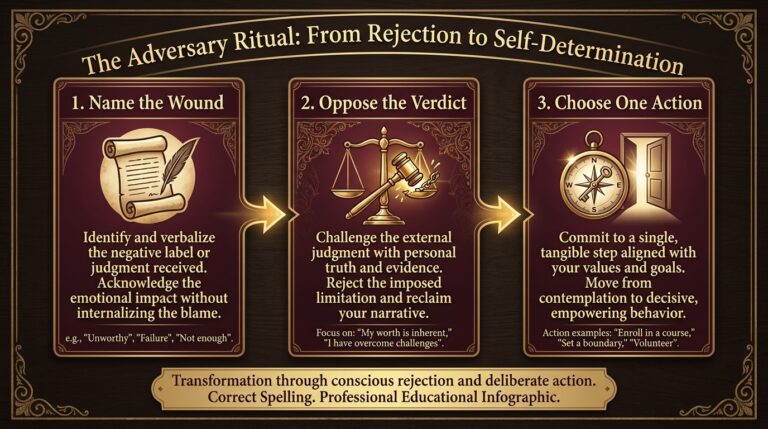
Turning the Adversary’s Defiance Into Practical Self-Determination
Symbolic defiance only matters if it eventually points somewhere. The point of naming an action during the ritual is to convert the emotional charge of rejection into forward motion instead of letting it curdle into rumination. That might mean finally setting a boundary you’d been avoiding, applying for something you talked yourself out of, or simply resuming a routine the rejection had knocked you off of.
This lines up with mainstream resilience research, not just occult symbolism. Mayo Clinic describes resilience as the capacity to adapt to setbacks while taking purposeful action rather than avoiding the problem — which is precisely what the ritual’s closing step asks you to do. If you want a structured path for continuing that self-reclamation work, our piece on Luciferian self-mastery after rejection goes further into rebuilding personal power once the initial sting has passed.

Where Symbolic Defiance Crosses Into Avoidance
The adversary archetype is meant to restore self-respect, not to become a permanent identity built around resentment. Watch for the shift: if “opposing the verdict” turns into replaying the rejection for the satisfaction of feeling wronged, or if the ritual becomes a way to avoid grieving the loss honestly, the practice has stopped working and started stalling you.
A useful check is whether the defiance is pointed at something — a boundary, a goal, a version of yourself you’re rebuilding — or whether it’s just pointed at the person who rejected you, on a loop. The first is self-determination. The second is just rejection wearing a different costume.
Frequently Asked Questions
Is the adversary archetype about worshipping Satan?
No. In this context, “the adversary” is a symbolic stance of refusing an unjust verdict about your own worth, not a literal figure to be worshipped.
Can this ritual be used to get someone to change their mind?
No. It’s designed as internal processing to rebuild your own self-respect, not as a working aimed at another person’s feelings or decisions.
What if I don’t feel angry, just numb?
Numbness is a valid starting point. Write down whatever is actually present, even if it’s “nothing,” rather than forcing anger you don’t feel.
How is this different from just journaling about rejection?
The ritual structure adds deliberate steps — naming, opposing, and committing to one action — that push the reflection toward a concrete next step rather than open-ended venting.
Should I repeat this ritual for the same rejection?
Occasionally, if the feeling resurfaces. If you find yourself repeating it weekly with no shift in how you feel, that’s a sign to bring in outside support, like a therapist.
Not sure where to start? You don’t have to do this alone.
Madame Celestine offers guided spellwork for beginners — real support for your first working, not just another guide to read.
Related reading: Can Shadow Work Help You Process a Breakup? A Satanic Practice Perspective · Satanic Conjuration in Occult Literature: What the Term Means and What It Doesn’t

About Madame Celestine
Madame Celestine has practiced and taught spellwork, divination, and seasonal ritual for over two decades, helping newcomers build a grounded, confident practice from their very first spell.