
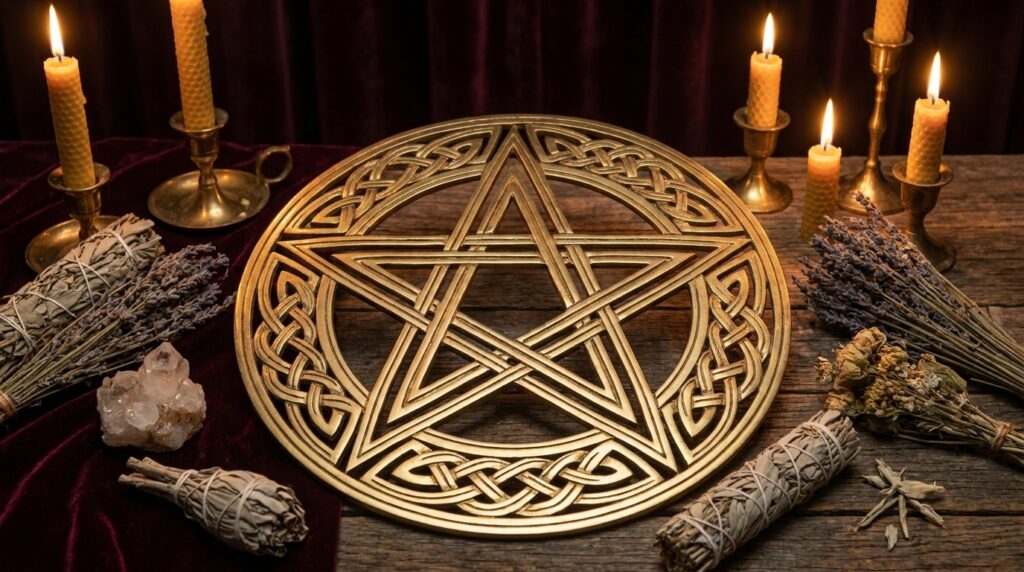
You have probably seen the Celtic pentacle on a pendant, an altar cloth or a tattoo: a five-pointed star woven from knotted lines and held inside a circle. So what does it actually mean, and is it truly Celtic? In this guide, you will learn where the design really comes from and why the word “pentacle” was first linked to protection. You will also see how each point maps to an element and how practitioners work with the symbol today.
- What Makes a Celtic Pentacle “Celtic”? The Knot Behind the Star
- Pentacle vs. Pentagram: A Word Built to Ward Off Demons
- Gawain’s Endless Knot: The Pentacle’s Medieval Cousin
- Five Points, Five Elements: Reading the Celtic Pentacle’s Symbolism
- Upright or Inverted? How Direction Changes the Meaning
- How to Work With a Celtic Pentacle in Your Own Practice
- Frequently Asked Questions
- References
What Makes a Celtic Pentacle “Celtic”? The Knot Behind the Star
Here is the honest answer first. There is no clear evidence that the ancient Celts used the pentagram as a religious sign. Instead, the “Celtic” part of a Celtic pentacle comes from its style, not its star.
That style is interlace, often called knotwork. It grew into a signature art form in Ireland between the 6th and 12th centuries, alongside spirals and maze-like fretwork.[1] Monks used it to fill the pages of Gospel books such as the Book of Kells. So the knotwork most people call “Celtic” is largely a Christian-era art.
However, the knots were not just pretty. One study of the Book of Kells argues that its knotwork may have been meant to turn evil away, protecting the reader, the community or even the book.[2] Scholars call this an apotropaic function, which simply means “warding off harm.” As a result, when modern artists wove a pentacle from the same kind of lines, they joined two symbols that were both linked to protection.

Pentacle vs. Pentagram: A Word Built to Ward Off Demons
People often use these two words as if they mean the same thing. Today, though, most witches draw a simple line between them. A pentagram is the five-pointed star on its own. A pentacle is that star set inside a circle, or carved onto a flat disc.
The word “pentacle” has a more magical history than many expect. It first appeared in English in the 1590s. Back then, it named a figure used in magical ceremonies and thought to defend against demons.[3] It came from Medieval Latin pentaculum, a blend of the Greek word for “five” and a Latin ending. Also, magicians later stretched the word to cover other power symbols, even six-pointed stars.[3]
The shape itself hides some neat maths, too. In a regular pentagram, the lines cut each other in the golden ratio, so each tip forms a “golden triangle.”[4] For many practitioners, this built-in harmony is part of why the star feels balanced and complete.
Gawain’s Endless Knot: The Pentacle’s Medieval Cousin
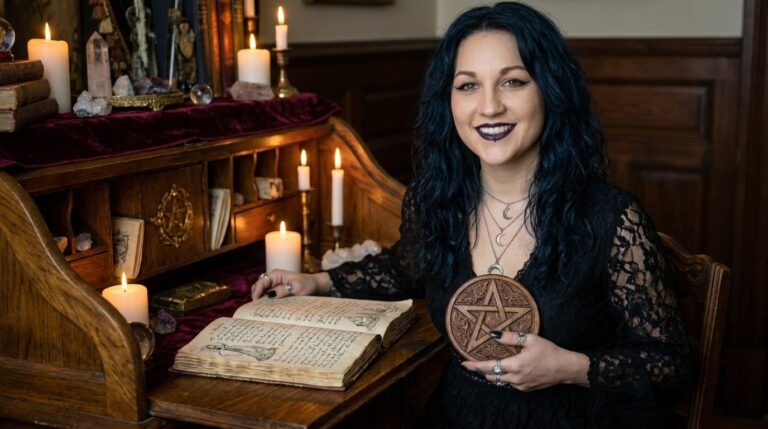
One of the best early clues to the star’s meaning in the British Isles is a poem. In Sir Gawain and the Green Knight, written in the late 1300s, the hero carries a red shield painted with a gold pentangle. The poet calls it a sign of truth that Solomon first set down.[5]
Next, the poet explains why the shape matters. Each line overlaps the others and has no beginning or end, so the English called it “the endless knot.”[5] Then he ties each point to a set of five virtues, including Gawain’s five senses and the five wounds of Christ.
This is where the story links back to knotwork. An endless knot and a woven Celtic pentacle express the same idea: an unbroken line that nothing can slip through. That is why many practitioners read the knotted version as a sign of wholeness and steady protection.
Five Points, Five Elements: Reading the Celtic Pentacle’s Symbolism
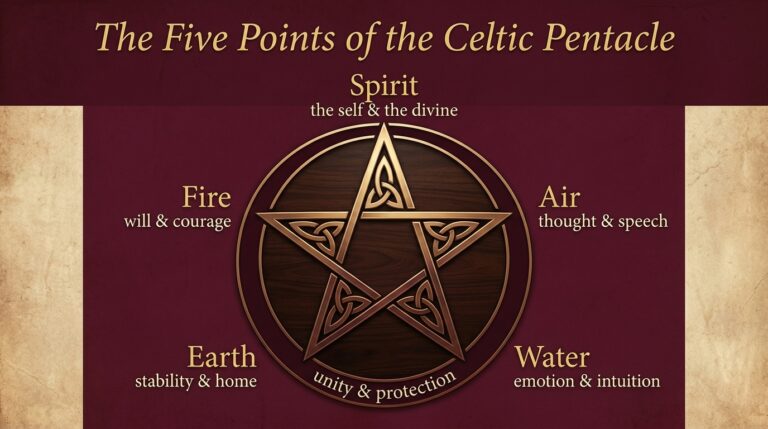
In modern witchcraft, each part of the Celtic pentacle carries its own meaning. The most common pattern gives the four lower points to the classical elements. The top point then stands for spirit, which rules over and connects the other four.
- Earth: the body, stability, home and money.
- Air: thought, speech and learning.
- Fire: will, courage and passion.
- Water: emotion, intuition and love.
- Spirit: the self, the divine and the link between all things.
The circle adds a second layer. It holds the elements together and marks a boundary, much like the circle a witch casts before ritual. The knotwork adds a third layer, because every strand passes over and under the others. For example, some practitioners read this weaving as a reminder that the elements never act alone. If you want to go deeper into the elements, our guide to elemental spirits and the four directions explains how each one is called in ritual.
Upright or Inverted? How Direction Changes the Meaning
Direction matters a great deal with this symbol. With one point up, spirit sits above the four elements. For this reason, most witches and Wiccans use the upright form for protection and balance.
The inverted star, with two points up, has a much younger reputation than many assume. It traces back to the French occultist Éliphas Lévi, whose book on high magic first appeared in 1854. Lévi hinted at a reversed star set on a goat’s head, an image later occultists developed further.[6] Later still, Anton LaVey used an inverted star in The Satanic Bible in 1969, and that tied it to modern Satanism.[6]
Meanwhile, Lévi himself described the pentagram as sacred and radiant.[6] So the dark reputation of the star comes largely from one reversed form, not from the pentacle as a whole.
How to Work With a Celtic Pentacle in Your Own Practice
You do not need a costly tool to begin. A simple pendant, a wooden disc or a hand-drawn design will serve. What matters most is the meaning you bring to it.
- Choose your form. Pick a pendant to carry the symbol with you, or a disc for your altar. Traditionally, the altar pentacle sits in the north, the direction linked to earth.
- Cleanse it first. Pass it through incense smoke or leave it on a windowsill in moonlight. This step is meant to clear any energy it picked up before it came to you.
- Trace the knot. Slowly follow the woven lines with your finger, point by point. Name each element as you reach it, then finish at spirit. Because the line never breaks, this acts as a quiet focusing exercise.
- Set your intention. Hold the pentacle and state, in one clear sentence, what you want it to stand for. For instance, you might name protection, balance or a fresh start.
- Place or wear it. Finally, keep it where you will see it each day. Many witches also lay small items on an altar pentacle, such as crystals or herbs, so that they rest within its circle.
Belief, Intention & The Power of Magic
Witchcraft, spells, and manifestation are deeply rooted in belief, intention, and spiritual practice. If these practices do not resonate with you, this may not be the path for you, and that’s perfectly okay. But if you believe in divine powers, trust your intentions, and feel drawn to the mysteries of the unseen, we invite you to continue exploring with Madame Celestine and discover the magic that speaks to your soul.
Frequently Asked Questions
Is the Celtic pentacle an ancient Celtic symbol?
Not in the way most people think. The knotwork style is rooted in early medieval Irish art, but the knotted pentacle itself is a modern design that joins that style with the five-pointed star.
What is the difference between a Celtic pentacle and a pentagram?
A pentagram is the plain five-pointed star. A Celtic pentacle sets that star inside a circle and draws it with woven, over-and-under knotwork lines.
What does the Celtic pentacle protect against?
Practitioners use it as a general symbol of protection and balance rather than a shield against one named threat. Its meaning rests on the belief and intention of the person working with it.
Can anyone wear a Celtic pentacle?
Yes. Many people wear it as a sign of their spiritual path, while others simply love the design and what it stands for.
Is an upright pentacle linked to Satanism?
No. The upright form is the one most witches and Wiccans use, while the inverted star is the version later tied to modern Satanism.
References
- Manuscript art: the eye and the algorithm. Department of History of Art and Architecture, Trinity College Dublin. https://www.tcd.ie/History_of_Art/research/manuscript_art.php
- The Apotropaic Function of Celtic Knotwork in the Book of Kells. Medievalists.net, January 10, 2016 (summarizing a 2015 thesis by Diego González Hernández, University of Valladolid). https://www.medievalists.net/2016/01/the-apotropaic-function-of-celtic-knotwork-in-the-book-of-kells/
- Pentacle. Online Etymology Dictionary. https://www.etymonline.com/word/pentacle
- Eric W. Weisstein. Pentagram. Wolfram MathWorld. https://mathworld.wolfram.com/Pentagram.html
- Sir Gawain and the Green Knight, translated by Jessie L. Weston (1898). The Camelot Project, Robbins Library Digital Projects, University of Rochester. https://d.lib.rochester.edu/camelot/text/weston-sir-gawain-and-the-green-knight.html
- Julian Strube. The “Baphomet” of Eliphas Lévi: Its Meaning and Historical Context. Correspondences, 2016. https://pure.uva.nl/ws/files/11865179/39_138_1_PB
Not sure where to start? You don’t have to do this alone.
Madame Celestine offers guided spellwork for beginners — real support for your first working, not just another guide to read.
Related reading: Working with Echoes of the Ancients: Pagan Gods of Music: Ritual Context, Meaning & Practice · Signs From Your Spirit Guides: How to Find & Meet Them: Ritual Ideas, Meaning & Practical Guidance
About Madame Celestine
Madame Celestine has practiced and taught spellwork, divination, and seasonal ritual for over two decades, helping newcomers build a grounded, confident practice from their very first spell.