
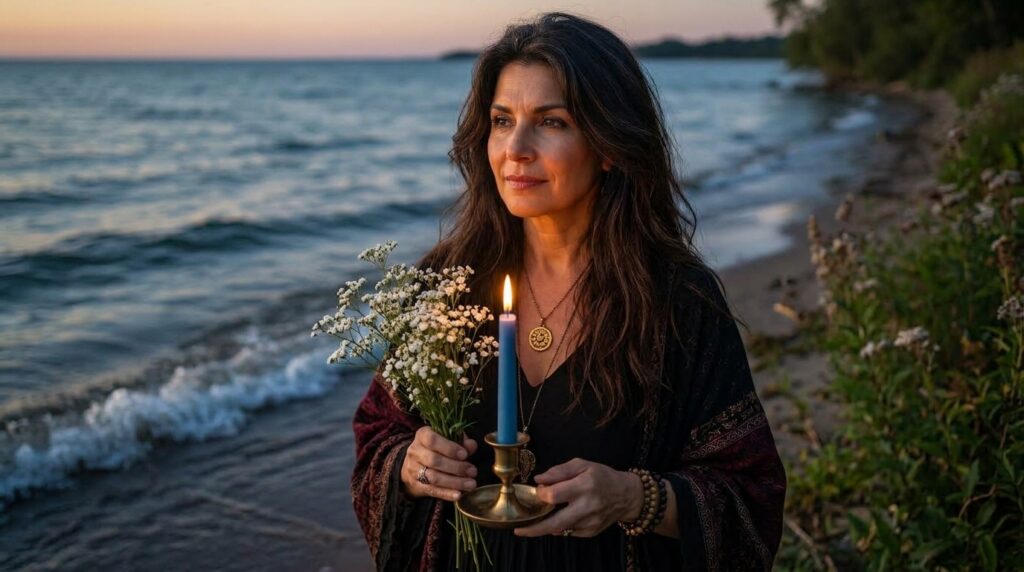
Have you ever stood at the edge of the sea and felt strangely held? Then you have already met the idea behind the Yemaya goddess. Many people first meet her name on a candle label or in a song. Then they wonder who she really is. In this guide, you will learn what her name means and how she crossed an ocean with her people. You will also learn why her devotees use blue, white and the number seven. Finally, I will share the simple candle and prayer practice I use at my own altar in New Orleans.
- Yemaya Goddess Meaning: The Mother Whose Children Are Fish
- How the Yemoja Goddess Crossed the Ocean
- Yemaya Colors and Symbols: The Language of the Sea
- Offerings to the Yemaya Goddess: What the Ocean Mother Receives
- A Simple Candle and Prayer for the Yemaya Goddess at Home
- Honoring the Yemaya Goddess With Respect
- Frequently Asked Questions
- References
Yemaya Goddess Meaning: The Mother Whose Children Are Fish
Her oldest name is Yemoja, and it comes from the Yoruba people of what is now Nigeria and Benin. The name joins three Yoruba words for mother, children and fish[1]. So the Yemoja goddess is, quite literally, the mother whose children are fish. That picture says a lot. She is a mother on such a vast scale that every creature in the water belongs to her.
In Yoruba belief, she is also honored as the giver of life and as the mother of all the orishas[1]. An orisha is a divine spirit of the Yoruba tradition. However, an orisha is not a distant god on a mountain. Instead, each one rules a force of nature and a part of human life. For Yemoja, that part is water, birth and care.
You will see her name spelled in many ways. Yemoja, Yemayá, Iemanjá and Yemanjá all point to the same mother. Some people even search for a “Yamaya god,” but she is always a goddess, and always a mother first.

How the Yemoja Goddess Crossed the Ocean
In Yorubaland, Yemoja began as a river mother, closely tied to the Ogun River in Nigeria. For example, the Museo Nacional Thyssen-Bornemisza in Madrid describes her as the mother of rivers and waters in Yoruba culture[2]. So how did a river goddess become the Queen of the Sea?
The answer is a painful one. During the Atlantic slave trade, Yoruba people were forced across the ocean to Cuba, Brazil and later the United States. They carried their orishas with them, and today Yoruba sacred art is still made across that whole diaspora[3]. For the people on those ships, the ocean was the water that parted them from home. As a result, the mother of the river became the mother of the sea. That is how the Yemaya goddess came to rule the ocean.
In Cuba, Yemayá became linked with the Virgin of Regla. This Black Virgin is honored in the town of Regla, across the bay from Havana. Every September, thousands of people gather to honor this Virgin, who also embodies Yemayá[4]. Meanwhile, in Brazil, Iemanjá grew into one of the best-loved figures of Candomblé. This Afro-Brazilian religion is built around the orixás, the Portuguese spelling of orishas[5].
Yemaya Colors and Symbols: The Language of the Sea
Every orisha has a visual language, and the Yemaya goddess has one of the clearest. Once you learn it, you will spot her on altars from Havana to New Orleans.
Blue and white come first. At the Regla feast, devotees dress in deep azure, turquoise, baby blue and white[4]. The blue is the sea itself. The white, on the other hand, is the foam on the waves and the calm she is asked to bring.
Next comes the number seven. Many practitioners link her to the seven seas, so beads and offerings often come in sevens. That is also why people in Rio jump seven small waves at New Year.
Her main Yemaya symbols also include these:
- The fan. Sacred fans are made for the water goddesses Yemoja and Oshun[3]. A fan moves the air the way she moves the tides.
- Cowrie shells. These small sea shells were once used as money in West Africa. So they carry the idea of wealth as well as water.
- The mirror. A mirror echoes the still surface of water. It is also a favorite gift for her in Brazil.
- The moon. The moon pulls the tides, so it often appears on her altar.

Offerings to the Yemaya Goddess: What the Ocean Mother Receives
Every gift follows one simple logic. You give a mother what feeds her, soothes her or delights her.
Liquids matter most. In Yoruba culture, pouring a liquid is itself a meaningful offering, and gifts to Yemoja include honey, coconut and indigo[2]. Indigo is a lovely detail, because it is the deep blue dye of West African cloth. In other words, the offering literally carries her color.
Other traditional Yemaya offerings include these:
- Watermelon or melon, a fruit full of water.
- Molasses and sweet syrups, for a sweet life.
- White flowers, especially roses.
- Perfume, soap, combs and small mirrors, the gifts you might give a woman who loves to feel beautiful.
- Fish and white corn, which trained priests offer in more formal rites.
The most famous offerings are public ones. Before dawn on February 2, crowds fill the Rio Vermelho neighborhood of Salvador, Brazil. Their flowers are gathered into baskets, and boats then carry them out to sea[5]. Similarly, crowds gather on Copacabana beach in Rio each New Year to honor her. The custom grew from Candomblé and Umbanda[6]. If the sea takes a gift, many say she has accepted it. If the waves push it back, some read it as a gentle no.
A Simple Candle and Prayer for the Yemaya Goddess at Home
You do not need a beach to honor the Yemaya goddess. At my altar in New Orleans, I keep this practice small and regular. Here is how I do it, and why each step is there.
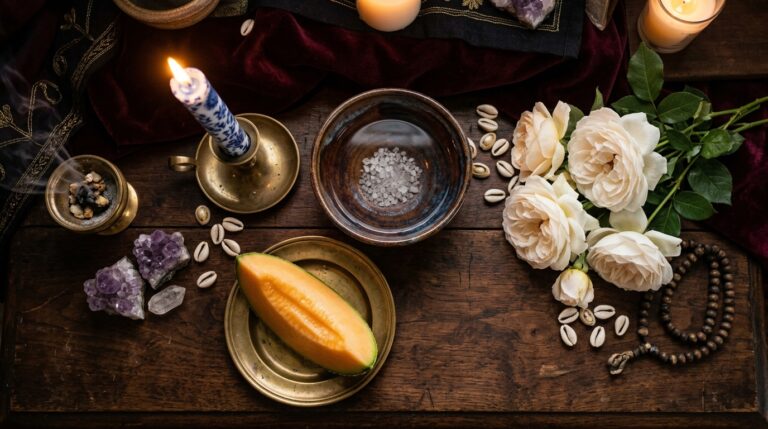
- Set a bowl of water. Use a blue or white bowl and add a pinch of sea salt. The salt turns tap water into a small piece of the sea.
- Light a Yemaya candle. Choose a blue or white candle, or a seven-day glass candle in her colors. Blue calls her waters, while white asks for calm.
- Add a sweet offering. A slice of melon, a spoon of molasses or a few white flowers is enough. Sweetness is how you tell a mother you hope for a gentle answer.
- Say a prayer for Yemaya. Speak simply and from the heart. For example: “Mother of the waters, hold me as the sea holds the fish. Wash away what is heavy, and teach me to care for myself as you care for your children.”
- Close with seven. Touch the water seven times, or say her name seven times. Then sit quietly while the candle burns, and never leave the flame alone.
Afterward, pour the water onto the earth or into moving water. Leftover fruit goes outside, not into the trash. That way, the offering goes back to nature, which is where she lives.
Belief, Intention & The Power of Magic
Witchcraft, spells, and manifestation are deeply rooted in belief, intention, and spiritual practice. If these practices do not resonate with you, this may not be the path for you, and that’s perfectly okay. But if you believe in divine powers, trust your intentions, and feel drawn to the mysteries of the unseen, we invite you to continue exploring with Madame Celestine and discover the magic that speaks to your soul.
Honoring the Yemaya Goddess With Respect
The Yemaya goddess is not a trend. She lives inside living religions, including Lucumí, also called Santería, in Cuba and Candomblé in Brazil. Those faiths have priests, initiations and customs that outsiders rarely see. So a home altar is a sincere gesture, but it does not replace that training.
If you feel a deep pull toward her, the respectful path is to learn from an elder in one of those houses. Meanwhile, you can meet the other great sea mothers in my guide to goddesses of the ocean and the water. You can also give back to the water itself. Many devotees feel that a clean shoreline pleases her, so picking up plastic on the beach becomes a quiet prayer too.
Frequently Asked Questions
What does the name Yemaya mean?
Yemaya comes from the Yoruba name Yemoja, which joins the words for mother, children and fish. It means roughly “mother whose children are fish.”
Is the Yemaya goddess the same as Yemoja and Iemanjá?
Yes. Yemoja is the Yoruba name, Yemayá is the Cuban spelling, and Iemanjá or Yemanjá is used in Brazil. All of them refer to the same mother of the waters.
What are her sacred colors and symbols?
The Yemaya colors are blue and white, and her sacred number is seven. Her main symbols are the fan, cowrie shells, the mirror, the moon and the sea itself.
What offerings does she like best?
Common offerings to the Yemaya goddess include melon, molasses, white flowers, perfume and small mirrors or combs. Liquids such as honey or coconut water are also poured for her.
What color candle should I light for her?
A blue or white Yemaya candle is traditional. Many people choose a seven-day glass candle in her colors to match her sacred number.
Can I say a prayer for Yemaya if I am not initiated?
Many people say a simple, heartfelt prayer for Yemaya at home. However, deeper ritual work belongs to initiated priests in her living traditions.
References
- Yemonja. Encyclopaedia Britannica. Patricia E. Canson and the Editors of Encyclopaedia Britannica. https://www.britannica.com/topic/Yemonja
- Offerings to the Orisha Yemoja by José Ramón Hernández / OSIKÁN. Museo Nacional Thyssen-Bornemisza. https://www.museothyssen.org/en/activities/offerings-orisha-yemoja
- The House Was Too Small: Yoruba Sacred Arts from Africa and Beyond (press release). Fowler Museum at UCLA. https://fowler.ucla.edu/wp-content/uploads/2022/03/Fowler_PR_YorubaSacredArts.pdf
- All Roads Lead to Yemayá: Transformative Trajectories in the Procession at Regla. Carrie Viarnés. e-misférica 5.1, Hemispheric Institute of Performance and Politics, New York University. https://hemisphericinstitute.org/en/emisferica-5-1-traveling/5-1-essays/all-roads-lead-to-yemaya-transformative-trajectories-in-the-procession-at-regla.html
- Inside A Raucous Brazilian Sea Goddess Festival. Jocelyn C. Zuckerman. Saveur, June 19, 2018. https://www.saveur.com/salvador-brazil-sea-goddess-festival/
- Afro-Brazilians pay tribute to their sea goddess to mark the New Year. Euronews, December 30, 2024. https://euronews.com/video/2024/12/30/afro-brazilians-pay-tribute-to-their-sea-goddess-to-mark-the-new-year
Not sure where to start? You don’t have to do this alone.
Madame Celestine offers guided spellwork for beginners — real support for your first working, not just another guide to read.
Related reading: 11 Goddesses of the Forest, Wild Animals and Nature: Ritual Ideas, Meaning & Practical Guidance · Working with Scrying for Beginners: PDF Guide & Wiccan Scrying Spell: Preparation, Timing & Ritual Practice

About Madame Celestine
Madame Celestine has practiced and taught spellwork, divination, and seasonal ritual for over two decades, helping newcomers build a grounded, confident practice from their very first spell.