
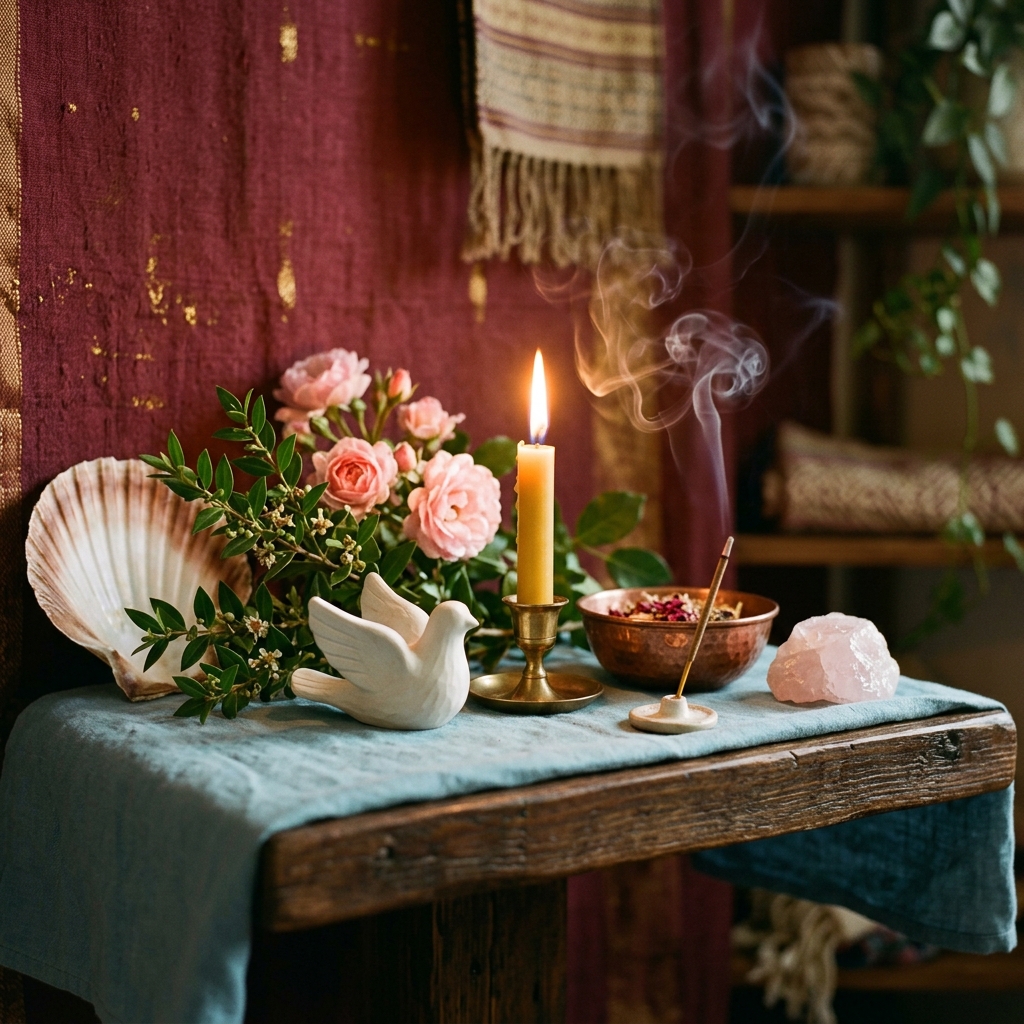
Setting up an Aphrodite altar is one of the most popular ways people begin working with the Greek goddess of love. Yet most guides hand you a shopping list of crystals and candles without saying where any of it comes from. In this guide, you’ll learn what the goddess’s oldest temple tells us about offerings. You’ll also see which Aphrodite altar items have ancient roots and which are modern additions. Finally, you’ll get simple steps for an altar for Aphrodite, plus a prayer you can use from day one.
- Born From Sea Foam: Who Aphrodite Is and Why She Gets an Altar
- What Her Oldest Temple Teaches About Aphrodite Altar Offerings
- Ancient Roots or Modern Additions? Sorting Aphrodite Altar Ideas
- Crystals for Aphrodite: Rose Quartz, Copper and Pearl
- Incense for Aphrodite and Other Gentle Offerings
- How to Set Up an Altar for Aphrodite, Step by Step
- A Simple Prayer to Aphrodite
- Common Aphrodite Altar Mistakes
- Frequently Asked Questions
- References
Born From Sea Foam: Who Aphrodite Is and Why She Gets an Altar
Aphrodite was the Greek goddess of sexual love and beauty, and the Romans knew her as Venus.[1] Her name is linked to the Greek word aphros, meaning “foam.” In Hesiod’s telling, she rose from the white foam of the sea.[1]
Where she came ashore matters for any Aphrodite altar. According to UNESCO, her legendary birthplace was on the island of Cyprus.[2] It adds that her temple there was built by the Mycenaeans in the 12th century BC. It also notes that Paphos was a center of her cult and of older fertility goddesses before her.[2] That is why two of her oldest names are Kypris, “the Cyprian,” and Kythereia, after the island of Cythera.

So an altar to her is not only about romance. It also honors the sea, beauty, pleasure and the island that kept her worship alive for over a thousand years. Keeping that bigger picture in mind helps you choose offerings that fit her, rather than generic “love” items.
What Her Oldest Temple Teaches About Aphrodite Altar Offerings
We have a rare eyewitness account of her great sanctuary at Paphos. The Roman historian Tacitus described it when the future emperor Titus visited. He wrote that no one could shed blood on the altar. Instead, worshippers offered only prayers and pure fire.[3]
Tacitus added two more surprising details. First, the altar stood in the open air, yet rain was said never to wet it. Second, the goddess was not shown in human form at all. Her sacred image was a rounded stone, broad at the base and narrowing to a point.[3]
These details are useful today. They suggest that gentle offerings, such as flame, fragrance and spoken prayer, suit her best. They also show that you don’t need an expensive statue. A smooth, cone-shaped stone was good enough for her most famous temple.
Ancient Roots or Modern Additions? Sorting Aphrodite Altar Ideas
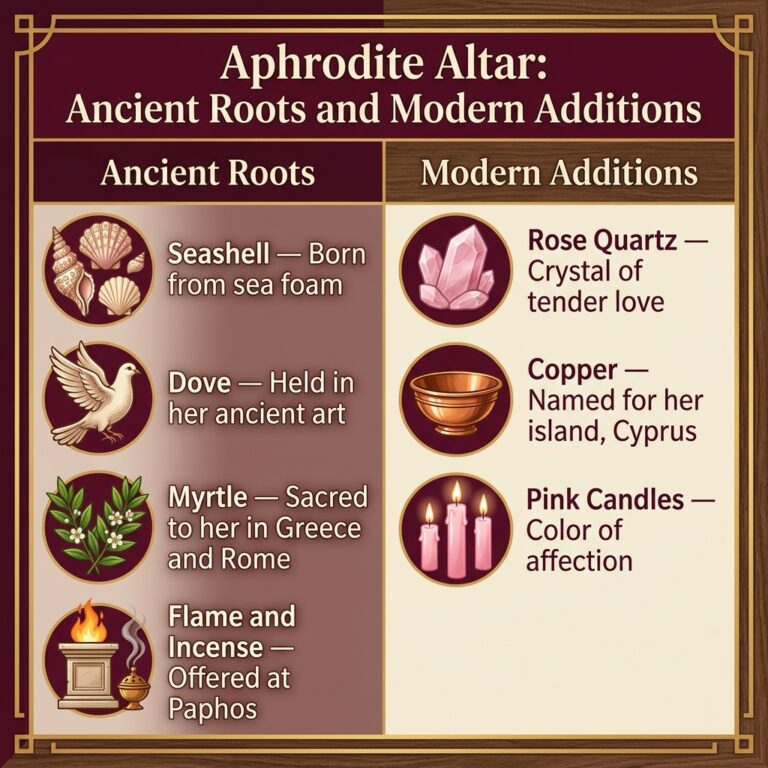
Many Aphrodite altar ideas online blend ancient symbols with modern crystal lore, without saying which is which. Put side by side, the items fall into two clear groups.
Items With Ancient Roots
Seashells and sea water point straight back to her birth from the foam.[1] Doves appear in her ancient art. For example, a Greek bronze from the mid-5th century BC shows her holding a dove in her right hand.[4] Myrtle, meanwhile, was held sacred to Venus in Greco-Roman times and used in wreaths as an emblem of love.[5] Finally, fire and prayer were the core offerings at Paphos.[3]
Items That Are Modern Additions
Rose quartz, pink candles and most crystal pairings come from modern practice, not ancient worship. Copper sits in between. Its name comes from Latin for “Cyprian metal,” because people mined copper on Cyprus in antiquity.[6] Much later, European alchemists paired copper with Venus, so the link grew over centuries.
Here is the same comparison as a quick reference:
| Aphrodite altar item | Where it comes from |
|---|---|
| Seashell or sea water | Ancient: her birth from sea foam |
| Dove | Ancient: Greek art shows her holding one |
| Myrtle | Ancient: sacred to Venus in Greco-Roman times |
| Flame and incense | Ancient: prayer and pure fire at Paphos |
| Copper | Grew over time: named for Cyprus, later tied to Venus |
| Rose quartz and pink candles | Modern: crystal and color correspondences |
Here is the practical insight. Build the heart of your altar from the ancient layer: something from the sea, a dove image, a sprig of myrtle and a flame. Then add modern items to your Aphrodite altar as a personal layer that speaks to you. That way, the altar stays rooted in how she was actually honored, while still feeling like yours.
Crystals for Aphrodite: Rose Quartz, Copper and Pearl
Crystals are the most searched part of any altar for Aphrodite, so it helps to know what each one is meant to express. Again, these crystals associated with Aphrodite come from modern correspondences, not from ancient temples.
Rose quartz is the most common choice, because its soft pink color suggests tenderness and self-love. Copper, in a bowl, coin or bracelet, nods to her Cyprian home. Pearls and mother-of-pearl echo her sea birth, since they grow inside shells. Some practitioners also use moonstone for its milky, sea-foam sheen.
Copper needs a little extra care. Over time it darkens and can grow a green crust called verdigris, especially near water or salt. Some people see that patina as part of its charm. Others polish it gently with lemon and salt before a new round of offerings, as a small act of devotion in itself.
You do not need all of them. In fact, one crystal chosen with care often feels more meaningful than a crowded pile. Cleanse it however your practice teaches, then place it near the flame.
Incense for Aphrodite and Other Gentle Offerings
Because her greatest temple accepted only prayer and pure fire, fragrant smoke is a natural fit. Frankincense and myrrh are both classic resins, traded across the ancient Mediterranean. Rose incense, meanwhile, is a popular modern choice for love work.
Other Aphrodite altar offerings follow the same gentle pattern. Fresh flowers, especially roses and myrtle, are common. Honey, ripe fruit and a splash of perfume are also traditional-feeling gifts. Many people offer an apple, a nod to the golden apple in the Judgment of Paris myth, where she won the prize for beauty.
Replace fresh offerings before they wilt or spoil. A tired altar sends the opposite message to the one you intend.
How to Set Up an Altar for Aphrodite, Step by Step
First, choose a spot that feels beautiful to you, such as a windowsill, dresser top or small shelf. Beauty is part of her nature, so the setting matters. Then clean the surface and lay a cloth in sea blue, white or soft pink.
Next, place your anchor items. Put a shell or a small bowl of salt water on one side. Add a dove image, a sprig of myrtle or a cone-shaped stone to represent her. Set a candle in the center, and place your incense nearby.

After that, add your personal layer. This could be a crystal, fresh flowers, perfume or an apple. Finally, light the candle and incense, and speak to her in your own words or with the prayer below. Afterward, visit the altar regularly, even briefly, so it stays alive.
When to Tend Your Aphrodite Altar
Friday is the traditional day for her. In many Romance languages, the day’s name still comes from Venus, such as vendredi in French and viernes in Spanish. The planet Venus also helps, because it shines brightly as the evening or morning star. So many people light their Aphrodite altar candle on Friday evenings, when that planet may be visible after sunset.
Belief, Intention & The Power of Magic
Witchcraft, spells, and manifestation are deeply rooted in belief, intention, and spiritual practice. If these practices do not resonate with you, this may not be the path for you, and that’s perfectly okay. But if you believe in divine powers, trust your intentions, and feel drawn to the mysteries of the unseen, we invite you to continue exploring with Madame Celestine and discover the magic that speaks to your soul.
A Simple Prayer to Aphrodite
Ancient hymns often open by calling a deity by several names, then praising her, then making a request. This short prayer to Aphrodite follows that same pattern:
Kypris, foam-born, lady of Paphos and Cythera,
you who rose from the sea in beauty,
accept this flame and this fragrance.
Teach me to love and be loved with an open heart.
Let beauty and kindness grow in my life.
Thank you, golden Aphrodite.
Say it slowly while the incense burns. Also feel free to change the request line to fit your own need. Whether you are hoping for new love, deeper self-love or more joy, an Aphrodite prayer works best when it is honest and specific.
Common Aphrodite Altar Mistakes
The first mistake is treating her only as a love-spell vending machine. She was a goddess of beauty, pleasure and the sea as well. So an altar that honors her whole nature tends to feel more balanced.
The second mistake is overcrowding. Aphrodite is linked with beauty, and a cluttered, dusty shelf is hardly beautiful. Instead, keep a few items and care for them well.
The third mistake is offering things her own tradition avoided. Her Paphos sanctuary banned blood on the altar, so gentle gifts fit her better. If you are drawn to beauty magic more broadly, this guide to the glamour spell explores that side of her energy.
Finally, remember that Aphrodite is still honored today by modern Hellenic polytheists, people who practice a revived form of ancient Greek religion. You don’t need to follow their customs to build an Aphrodite altar. Still, learning a little about how they approach her, with hymns, gentle offerings and respect, can deepen your own practice and keep it grounded.
Frequently Asked Questions
What do you put on an Aphrodite altar?
Common items include a seashell or salt water, a dove image, myrtle, a candle and incense. Many people also add rose quartz, fresh flowers or an apple as a personal touch.
What crystals are associated with Aphrodite?
Rose quartz is the most popular, along with copper, pearl and moonstone. These are modern correspondences rather than ancient ones, so choose the one that feels right to you.
What incense is good for Aphrodite?
Frankincense, myrrh and rose incense are all common choices. Fragrant smoke suits her well, because worshippers at her main temple in Paphos offered prayer and fire rather than blood.
What are good Aphrodite altar offerings?
Gentle offerings suit her best, such as flowers, honey, fruit, perfume and candlelight. Replace fresh offerings before they spoil.
How do you say a prayer to Aphrodite?
Call her by a few of her names, such as Kypris or foam-born, praise her, then make one clear request. Speak slowly while a candle or incense burns, and close with thanks.
References
- Aphrodite. Encyclopaedia Britannica. https://www.britannica.com/topic/Aphrodite-Greek-mythology
- Paphos. UNESCO World Heritage Centre. https://whc.unesco.org/en/list/79/
- Tacitus, Histories, Book II (trans. Clifford H. Moore). LacusCurtius, University of Chicago. https://penelope.uchicago.edu/Thayer/E/Roman/Texts/Tacitus/Histories/2A*.html
- Aphrodite Holding a Dove. Harvard Art Museums. https://harvardartmuseums.org/collections/object/303778
- Myrtle. Encyclopaedia Britannica. https://www.britannica.com/plant/myrtle
- Copper. Online Etymology Dictionary. https://www.etymonline.com/word/copper
Not sure where to start? You don’t have to do this alone.
Madame Celestine offers guided spellwork for beginners — real support for your first working, not just another guide to read.
Related reading: Commitment Spell vs Love Spell: How They Differ · Glamour Spell: Beauty and Attraction Magic Explained

About Wren Ashby
Wren Ashby is the pen name our editorial team uses for articles on sigils, Tarot and modern traditional witchcraft. Articles under this byline are researched from published sources and reviewed by Madame Celestine before publishing.