
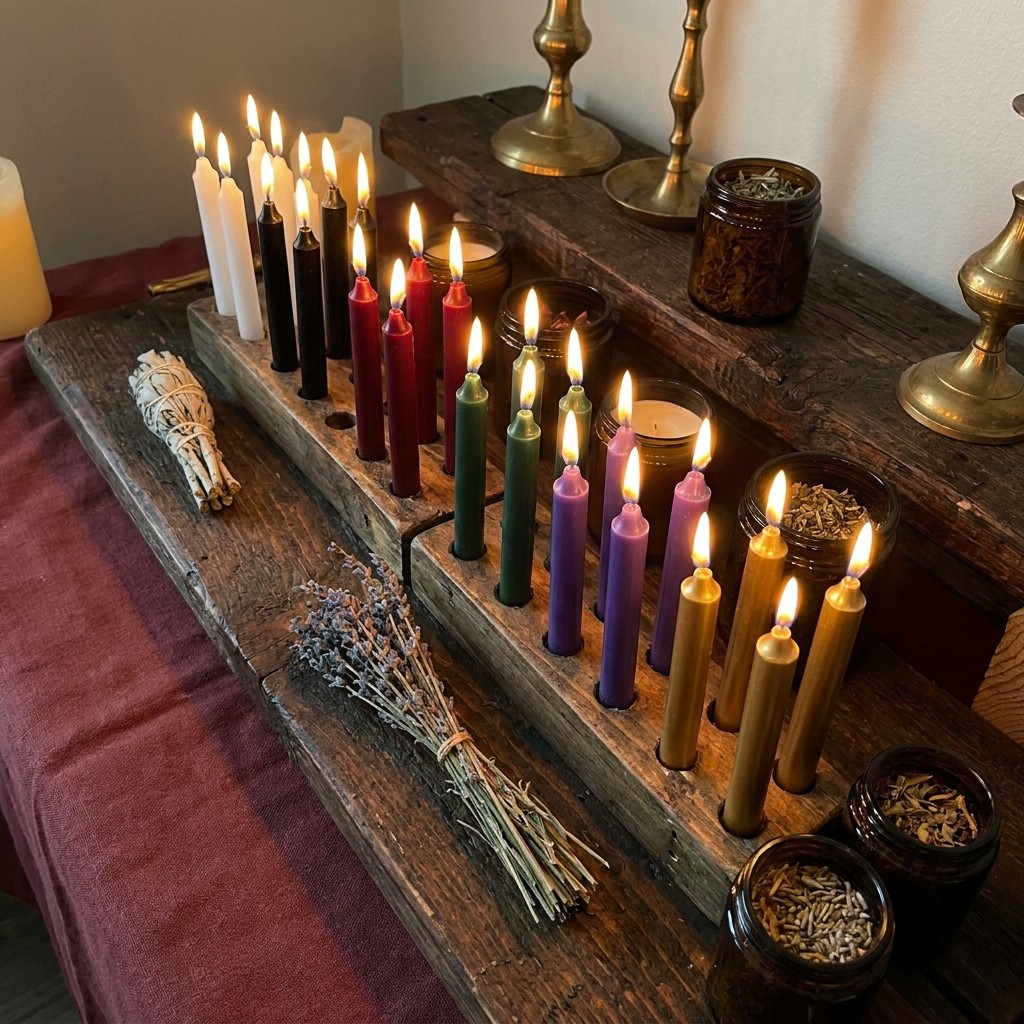
Candle color meanings are the first thing most people look up when a spell calls for “a green candle” and the drawer only holds white ones. So does the color really matter, and who decided green means money in the first place? This guide answers both. You’ll learn where color magic came from, what each candle color stands for, why different traditions disagree, and how to choose a color for your own intention, even with a limited supply.
- Where Candle Color Meanings Really Come From
- The Color Magic Chart: Candle Color Meanings for Every Intention
- Purple Candle Meaning: Why a Rare Dye Became the Spiritual Color
- One Color, Five Systems: How Traditions Read Candle Color Meanings
- Are Black Candles Bad? What Black Really Does in Witchcraft
- How to Choose a Candle Color for Your Spell
- Does Candle Color Matter If Intention Comes First?
- Only Have White Candles? How to Work Around Any Color
- Common Candle Color Mistakes Beginners Make
- Frequently Asked Questions
- References
Where Candle Color Meanings Really Come From
Most color charts online present their candle color meanings as ancient and fixed. In fact, the written roots are easy to trace. One of the clearest early sources is Heinrich Cornelius Agrippa’s Three Books of Occult Philosophy, first printed in the 1530s. Book One even has a chapter titled “Of Light, Colours, Candles, and Lamps.”
In that chapter, Agrippa ties colors to the seven classical planets. Black, leaden and brown belong to Saturn. Sapphire, airy shades and colors that stay green belong to Jupiter. Red and fiery colors go to Mars, while golden and saffron tones resemble the Sun. White, fair and green shades fall to Venus, Mercury and the Moon[1].
He also describes candles and lamps built from chosen substances and arranged by the stars, so that the light itself carries a planet’s quality[1]. That idea sits under modern candle magic. The candle is treated as a small, burning correspondence, so its color, its oil and its timing are all meant to point the same way.
Still, Agrippa’s list doesn’t match a modern chart line for line. For example, he gives Saturn brown, and many witches today use brown for steady, earthy work. Yet he also links purple to both Mars and the Sun, while modern charts tend to save purple for psychic and spiritual work. So the system of candle color meanings has kept changing for five centuries, and it is still changing now.
The Color Magic Chart: Candle Color Meanings for Every Intention
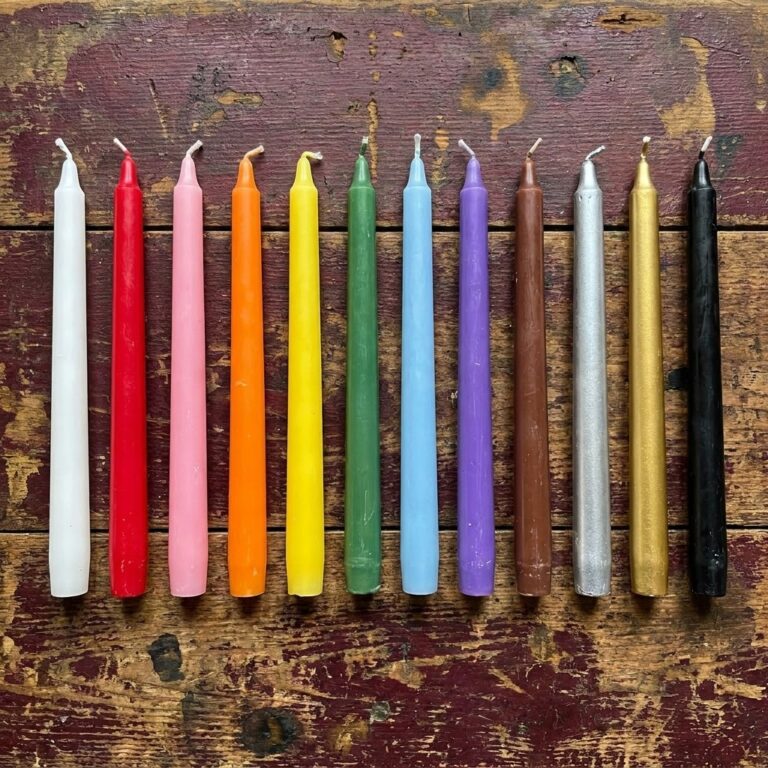
Here is the working list of candle color meanings most modern witches share, with the reason behind each pairing. These pairings are modern practice conventions passed between practitioners and books, not rules found in one ancient text. So treat the list as a starting map. Then adjust it to your own tradition and your own sense of what a color feels like.
White and Black: The Two Anchors
White stands for cleansing, peace, truth and new starts. It is also the all-purpose candle, because it holds every color of light at once. Black absorbs light instead, so practitioners use it to absorb, banish, bind and protect. Together they form the two anchors of most altars, and many witches place one on each side for balance.
Red, Pink and Orange: Heat and Heart
Red is the color of blood and fire, so it carries passion, courage, strength and fast action. In folk witchcraft, red meaning also includes protection, much like the red threads worn for protection in many folk traditions. Pink softens that heat into affection, self-love, friendship and healing a hurt heart. Orange sits between red and yellow, so practitioners use it for confidence, creativity, success and attracting opportunity.
Yellow and Green: The Mind and the Harvest
Yellow belongs to the sun, the intellect and clear speech. Students light it before exams, and many Wiccan traditions also use it for the element of air. Green is growth: money, fertility, luck, jobs and anything you want to rise like a crop. Agrippa’s “always green” Jupiter colors fit here too, since Jupiter is the planet of expansion in astrology. If your goal is prosperity, a green candle money ritual shows how that color is put to work.
Blue and Purple: Calm Water and Second Sight
Light blue brings calm, healing, sleep and gentle communication. Dark blue leans toward wisdom, truth, justice and deep focus. Purple is the color of psychic sight, spiritual power, dreams and authority. Indigo, between the two, is often used for meditation and intuition.
Brown, Gray, Silver and Gold: The Quiet Helpers
Brown grounds a working. It suits home, pets, stability and slow, practical goals. Gray is neutral, so it is used to cancel, to calm, or to stay unseen during a hard season. Silver belongs to the Moon, dreams and intuition, while gold belongs to the Sun, wealth and success. Many altars also use silver and gold to honor a goddess and a god.
Purple Candle Meaning: Why a Rare Dye Became the Spiritual Color
Among all candle color meanings, the purple candle meaning in witchcraft is power and spirit. That link has a very physical history. The famous Tyrian purple of the ancient world was made from the mucus of sea snails along the Mediterranean. The dye is believed to have started in Phoenicia, in modern Lebanon, as early as 1200 BC. Making it was expensive and slow, so purple cloth became a sign of royalty and high rank[2].
For most of history, then, purple was simply out of reach. That changed in 1856, when an 18-year-old chemist named William Henry Perkin made mauveine by accident while trying to produce quinine, a malaria drug. Mauveine was one of the first synthetic dyes, and it was also among the first to be mass-produced[3].
A color that once marked kings is now cheap to buy, yet it kept its old sense of rarity. That is why purple still reads as “set apart” and why witches reach for it for psychic work, spirit contact and personal power.
This also explains a common confusion. In Christian churches, violet carries a very different meaning, as the next section shows. Both readings use the same color for very different reasons.

One Color, Five Systems: How Traditions Read Candle Color Meanings
Put a single color in front of different traditions and you get different answers. Comparing them shows why candle color meanings never match from one chart to the next.
The Roman Catholic Church follows a calendar of colors. Violet is used in Advent and Lent, rose is an optional choice on the third Sunday of Advent, and red marks Pentecost. That color scheme had become fixed in Rome by the twelfth century, and the 1570 Missal of Pope Pius V reflected it[4]. Here, violet means waiting and penance, not psychic power.
Umbanda, the Afro-Brazilian religion, ties colors to the orixás, the deities of the tradition. Oxum is linked with yellow and gold, Iemanjá and Ogum with blue, Nanã with purple and Iansã with red. These links come from each orixá’s attributes, elements and clothing[5]. So in Umbanda, the candle colors and their meanings depend first on which orixá is being honored.
Hoodoo, the African American folk tradition, takes another path. Its tall glass candles often come labeled for a purpose, such as “Fast Luck” or “Love Drawing.” These colored, labeled jar candles reflect the influence of occultism and mysticism on the tradition[6]. The color and the printed label name the same goal.
| System | What decides the color | Purple or violet means |
|---|---|---|
| Agrippa (1530s) | The planet | Mars or the Sun |
| Catholic calendar | The season | Waiting and penance |
| Umbanda | The orixá | Nanã |
| Hoodoo jar candles | The labeled goal | Varies by label |
| Modern witchcraft | The intention | Psychic and spiritual power |
The Common Thread Behind Every Color System
Put side by side, these systems share one thing. Each color is tied to something outside the candle: a planet, a season, a deity or a written goal. The color never stands alone. In this author’s analysis, that is the most useful lesson for your own practice. Before you pick a color, decide what it points to. Then stay inside one system for that working, because mixing a church calendar color with a planetary one can send a single candle in two directions.
Are Black Candles Bad? What Black Really Does in Witchcraft
This is one of the most asked questions in beginner witchcraft spaces. People worry that lighting a black candle is “dark magic,” or that it invites something harmful. In most modern practice, it doesn’t. Among candle color meanings, black is simply the most misunderstood. Black is the color that absorbs, so it is used to soak up negativity, end bad habits, banish unwanted energy and guard a space.
For example, a witch might burn a black candle to absorb the heavy feeling after an argument at home. Then a white candle often follows, to fill the cleared space with peace. That pairing is common because it mirrors cleaning a room and then opening the window.
Black also links back to Saturn in Agrippa’s list, the planet of limits, endings and boundaries[1]. So pairing black with Saturn, the planet astrologers tie to limits and endings, is an old idea. If your main goal is safety, it helps to compare black with other shades in this guide to choosing a protection candle color, since other colors guard in different ways.
However, black is not the right tool for every hard feeling. If you want to heal after a loss, pink or light blue fits better than black. Black is used to remove, so it does little to comfort.
How to Choose a Candle Color for Your Spell
A chart tells you what candle color meanings are. It doesn’t tell you how to pick one when three colors seem to fit. These steps help you narrow it down.
- Name the goal in one short sentence. “I want a new job” is clearer than “I want things to get better.” The clearer the goal, the easier the color choice becomes.
- Decide if you are drawing in or sending away. Drawing in points to green, pink, orange or gold. Sending away points to black or gray. This one question removes half the chart.
- Pick the system you are working in. If you follow a deity, a planet or a tradition, use its colors first. Its logic should guide the candle, as the comparison above shows.
- Check how the color feels to you. Many practitioners believe a color you dislike will distract you during the ritual. So if red makes you anxious, a deep orange can carry courage instead.
- Match the color with oil, herbs and timing. A green candle for money is often dressed with basil or cinnamon and lit on a Thursday, the day named for Jupiter in Latin languages (jeudi in French). Each piece is meant to repeat the same message.
- Watch the candle as it burns. Many witches read the flame for signs, and learning about reading a candle flame adds another layer to color work.
Belief, Intention & The Power of Magic
Witchcraft, spells, and manifestation are deeply rooted in belief, intention, and spiritual practice. If these practices do not resonate with you, this may not be the path for you, and that’s perfectly okay. But if you believe in divine powers, trust your intentions, and feel drawn to the mysteries of the unseen, we invite you to continue exploring with Madame Celestine and discover the magic that speaks to your soul.
Does Candle Color Matter If Intention Comes First?
Beginners hear two messages that seem to clash. Spells list exact colors, yet experienced witches say “intention matters most.” So which is true?
Most practitioners answer with a simple picture. Intention is the engine, and color is the steering. You can drive without perfect steering, but it is harder to arrive where you meant to go. In other words, color gives your focus something to hold on to. Seeing green while you think about money keeps the mind on one track, and that is the job candle color meanings are meant to do.
That is also why the “rules” bend. Bright, cheap dyes are recent. Synthetic dyes such as mauveine only arrived in the 1850s[3], so earlier folk practitioners worked with whatever candles they could get. That history makes color a helpful tool rather than a test you can fail.

Only Have White Candles? How to Work Around Any Color
Yes, a white candle can stand in for almost any color. Many witches call white the universal candle, because white light contains the full spectrum. Still, there are simple ways to add the color you are missing without changing the candle itself.
First, tie a ribbon or thread of the right color around the base. Then place the candle on a piece of colored paper or cloth. You can also carve a symbol or a single word into the wax, or dress it with an oil that matches your goal. Each method keeps the color in view without burning anything unsafe.
Some beginners also ask about small chime candles. These thin candles come in every common color and burn out quickly, often within a single sitting. Chime candle color meanings follow the same chart as tapers, so a green chime and a green pillar carry the same message. The difference is only how long the working lasts.
Afterward, many people look at what is left on the holder. If you are curious, this guide on what leftover candle wax can show covers the shapes practitioners look for.
Common Candle Color Mistakes Beginners Make
The first mistake is treating one chart of candle color meanings as law. As the traditions above show, charts disagree, so pick one system and use it the same way each time.
The second mistake is choosing by fear. A black candle is not a curse, and a red one won’t “overheat” a love spell by itself. Instead, choose by the goal you named, then check how the color feels.
The third mistake is using too many colors at once. Five candles in five colors can blur the focus of a simple working. One clear color, or two that support each other, is usually enough.
Finally, many beginners skip safety. Never leave a burning candle alone. Keep it on a fireproof dish and away from curtains and pets.
Frequently Asked Questions
Can I color a white candle with a marker to change its color?
It isn’t a good idea, because marker ink and paint can release fumes when they burn. Instead, tie colored thread around the candle, set it on colored paper, or carve a symbol into the wax.
Do dipped or coated candles count as the right color?
Yes, most practitioners treat a dipped candle as its outer color. Solid-colored wax is nice to have, but the color you see during the ritual is what holds your focus.
What candle color is used for healing?
Light blue is the most common candle color for healing, because it stands for calm and recovery. Green is also used for physical health, and pink for emotional healing. A candle ritual is never a substitute for medical care.
What color candle is best for ancestors or a lost loved one?
White is the traditional choice for honoring the dead, since it stands for peace and spirit. Some practitioners also use purple, or a color the person loved.
Does the scent of a candle matter in color magic?
Scent is optional, but it can help when it matches the goal, such as cinnamon for money or lavender for calm. If a scent clashes with your intention, an unscented candle is the safer choice.
What candle color is used for manifestation?
Gold and green are the usual choices for manifestation, because they stand for success and growth. White also works well for a fresh start or a goal that is still taking shape.
References
- Three Books of Occult Philosophy, Book 1, Chapter 49. Heinrich Cornelius Agrippa, via Wikisource. https://en.wikisource.org/wiki/Three_Books_of_Occult_Philosophy/Book_1/Chapter_49
- Why Was Purple the Color of Royalty? And More Questions From Our Readers. Smithsonian Magazine. https://www.smithsonianmag.com/smithsonian-institution/why-purple-color-royalty-questions-readers-180980331/
- Mauveine. Wikipedia. https://en.wikipedia.org/wiki/Mauveine
- Liturgical colours. Wikipedia. https://en.wikipedia.org/wiki/Liturgical_colours
- A importância da mitologia dos orixás para a construção do imaginário umbandista. Giulia Cerqueira Mares Esposito and Sênia Regina Bastos, Religare, v.19, n.1, August 2022. https://periodicos.ufpb.br/index.php/religare/article/download/62312/37381/197564
- Hoodoo (spirituality). Wikipedia. https://en.wikipedia.org/wiki/Hoodoo_(spirituality)
Not sure where to start? You don’t have to do this alone.
Madame Celestine offers guided spellwork for beginners — real support for your first working, not just another guide to read.
Related reading: Candle Wax Reading: Shapes, Meanings and Old Traditions · Working with How to Read Tea Leaves: See the Future With Tasseography: Ritual Context, Meaning & Practice

About Wren Ashby
Wren Ashby is the pen name our editorial team uses for articles on sigils, Tarot and modern traditional witchcraft. Articles under this byline are researched from published sources and reviewed by Madame Celestine before publishing.