
Healing spells are some of the oldest magic people have written down, and some of the most misunderstood. When someone you love is sick, it is natural to want to do something more than wait. This guide looks at what healing spells meant to the folk healers who used them, what the old charm books actually say, and how a practitioner casts one today as spiritual support alongside medical care, never instead of it.
- What Healing Spells Are in Witchcraft
- The Oldest Healing Charms: From the Vedas to Merseburg
- Who Were the Folk Healers? Cunning Folk and Charmers
- What Old Folk Healers Knew That We Forgot
- Bone to Bone: One Healing Spell Across Four Traditions
- How to Cast a Healing Spell as Spiritual Support
- A Healing Spell for Someone Else: Consent and Distance
- Healing Spells for Grief and a Broken Heart
- When a Healing Spell Doesn’t Seem to Work
- Healing Spell Safety: What Not to Do
- Frequently Asked Questions
- References
What Healing Spells Are in Witchcraft
A healing spell is a ritual of words, objects and intention aimed at someone’s recovery, comfort or strength. In modern witchcraft, it usually means a spoken charm, a candle, a written petition or a small charm bag made for a person, a pet or yourself.
The key word is support. Practitioners describe healing spells as a way to focus hope, ask for help from a power they trust and keep a sick person in mind. They do not treat infections, set bones or replace a single pill. So the first rule of witchcraft healing is simple: the doctor, the nurse or the vet comes first, and the spell sits beside that care.
That rule is not a modern add-on. As the next sections show, the old folk healers almost always paired their charms with practical remedies. Words alone were rarely the whole cure, even in the books written by people who believed in them deeply.
The Oldest Healing Charms: From the Vedas to Merseburg
In 1841, the historian Georg Waitz found two short charms written on the flyleaf of a Latin Mass book kept in the cathedral library of Merseburg, in Germany. The manuscript dates to the ninth or tenth century. Jacob Grimm, of the fairy tale brothers, published the charms a year later[1].
The second Merseburg charm is a healing spell for a horse. In it, two gods ride into the woods, and Balder’s horse dislocates its foot. Then Wodan sings a charm over the injury: bone to bone, blood to blood, limb to limb[1]. The words name exactly what should rejoin what.
That same “joining” pattern shows up far from Germany. Scholars point to a hymn in the Atharvaveda, an ancient Indian text, that uses a very similar healing formula. Many accept that the two share a common Indo-European root, though some argue the match is a coincidence[1].
So when a modern practitioner writes a healing spell that names the hurt and asks it to mend, they are using one of the oldest shapes in written magic.
Who Were the Folk Healers? Cunning Folk and Charmers
For centuries, ordinary villagers in Britain did not call a physician when a child had a fever or a cow went lame. Physicians and apothecaries cost money. Instead, many went to the local cunning man or cunning woman.
Cunning folk healed people and livestock, broke curses, found stolen goods and told fortunes. Historian Owen Davies estimated that several thousand were working in England at any one time until the mid-1800s. Surprisingly, about two-thirds of the recorded cunning folk were men[2].
Their healing charms were often written on paper and sewn into a small bag or sealed in a bottle. The text usually held Christian words, such as names of God, angels or Bible verses, and sometimes “magic” words like Abracadabra[2]. Clients carried these charms or kept them at home, much as people today learn how to charge a talisman or amulet. So the modern charm bag for health has a long, plain history.
Clients also saw cunning folk as helpers and saw witches as the harmful ones. In Essex, for example, about 400 people were tried for witchcraft, yet only four of them can be identified as cunning folk[2]. Healing magic, in other words, was mostly treated as a useful local service.
What Old Folk Healers Knew That We Forgot
Read the old charm books side by side and a few habits repeat. These are the parts of magical healing that modern lists of healing spells often leave out.
They Named the Exact Hurt
Old healing spells were rarely “for good health.” Instead, each charm aimed at one complaint, such as a single bleeding wound or one sprained limb. The Gaelic sprain charm described below is a typical case. A narrow spell gave the healer a clear picture to hold.
They Used the Patient’s Name
The Long Lost Friend, a Pennsylvania German “powwow” book from the 1820s, gives a spoken charm to stop bleeding. It says the charm works even when the person is far away, as long as the patient’s first name is said correctly[3]. The name was the link. That is still the logic behind distance healing today.
The archive that hosts this book adds a sensible note. It doesn’t recommend trying the old remedies, and it values the book mainly as a window into the hardships of rural life[3].
They Repeated It, Close to the Body
Carmichael’s own field notebook, now held by the University of Edinburgh, records a Gaelic charm for a sprain. His note says it was repeated three times over the broken limb[4]. Repetition gave the charm rhythm, and saying it over the injury tied the words to the body.
They Paired Words With Real Remedies
This is the habit modern readers forget most. Old books of healing spells mix charms with salves, washes and diets on the same page. One famous example is an eye salve from Bald’s Leechbook, a tenth-century English medical book in the British Library. It called for garlic, onion or leek, wine and cow bile, brewed in a brass vessel and left for nine days[5].
In 2015, researchers at the University of Nottingham remade it. In lab tests, the mixture nearly wiped out the bacteria Staphylococcus aureus, and in a mouse wound test it did as well as or better than standard antibiotics against MRSA[5]. Those were early lab and animal results, not a treatment. Still, they show that old healers often worked with real materials, not just words. Please don’t try to make or use the salve yourself.
Bone to Bone: One Healing Spell Across Four Traditions
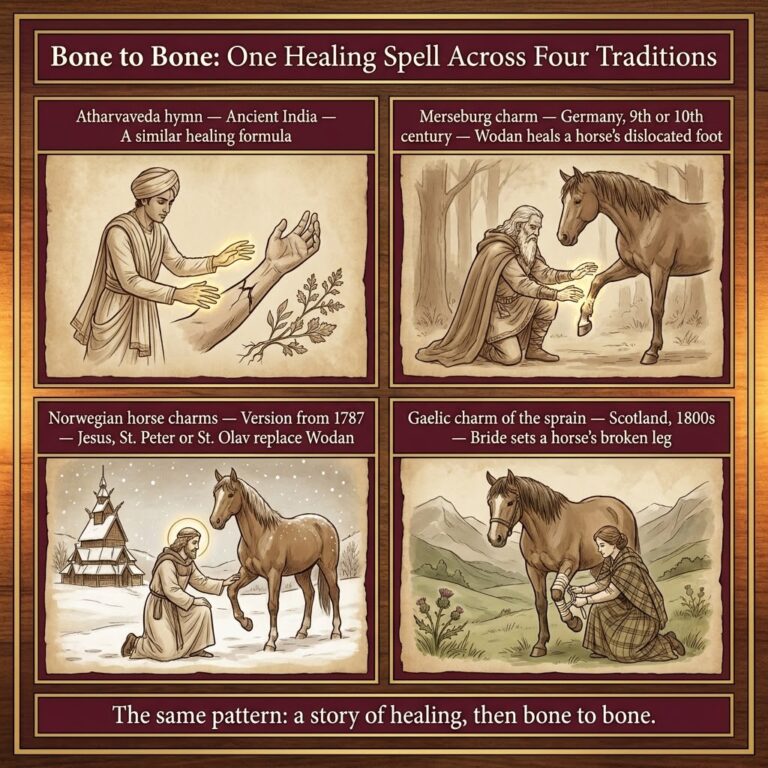
The “joining” charm from Merseburg turns out to be one of the most travelled healing spells in Europe. Laid side by side, its versions show what changes and what stays.
| Tradition | Who heals | What is healed |
|---|---|---|
| Atharvaveda hymn (ancient India) | Not covered here | A similar healing formula |
| Merseburg charm (Germany, 9th or 10th century) | Wodan | A horse’s dislocated foot |
| Norwegian horse charms (version from 1787) | Jesus, St. Peter or St. Olav | A horse’s or colt’s leg |
| Gaelic charm of the sprain (Scotland, 1800s) | Bride | A horse’s broken leg, then the sprain |
In Norway and Sweden, many horse spells keep the Merseburg wording but swap Wodan for Jesus, St. Peter or St. Olav. One Norwegian version from 1787 has Jesus healing a colt’s leg[1]. In the Scottish Highlands, Carmichael recorded a version where Bride sets a horse’s broken leg, joining bone to bone, flesh to flesh, sinew to sinew and vein to vein. The charm then asks that the same healing be done for the sprain in front of the healer[6].
The Pattern All Four Charms Share
Put side by side, these charms share a clear structure. First comes a short story in which a holy figure heals an injury. Then come lines that join each broken part to its like. Finally, the speaker asks for that same healing here and now. The name of the healer changed with each new faith, yet the story and the formula stayed almost untouched for centuries.
In this author’s analysis, that is the most useful lesson for modern healing spells. The power of these charms, as their users understood it, sat in the pattern: a remembered act of healing, applied to one named hurt. So you can keep the pattern and use whichever holy figure, ancestor or deity you trust.
How to Cast a Healing Spell as Spiritual Support
This simple ritual follows the folk pattern above. It is meant to sit alongside medical treatment, never to replace it.
- Confirm that real care is in place. The person should be seeing a doctor, or the pet a vet. If someone is in danger, call for medical help first. The spell can wait an hour; an emergency cannot.
- Ask for consent if you can. A short “Can I light a candle for you?” respects the person and lets them share in it.
- Name the person and the hurt. Write the full name and the specific problem on a small slip of paper, such as “Ana’s healing knee,” not “Ana’s health.”
- Light a candle that suits the work. Light blue is common for calm and recovery, and green for the body. This guide to candle colors for healing explains the choice.
- Tell a short story of healing. Choose a figure you trust, such as a saint, a goddess or an ancestor. Then say, in your own words, how they once healed someone.
- Say the joining lines three times. For example: “Bone to bone, sinew to sinew, strength to strength.” If you are near the person, hold your hand just above the area while you speak.
- Close and carry. Fold the paper and keep it in a small bag, as the cunning folk did, or place it under the candle. Let the candle burn while you can watch it, then put it out.
- Add a practical act. Bring soup, drive them to an appointment or simply sit with them. The old healers paired words with care, and this step keeps that habit alive.
Belief, Intention & The Power of Magic
Witchcraft, spells, and manifestation are deeply rooted in belief, intention, and spiritual practice. If these practices do not resonate with you, this may not be the path for you, and that’s perfectly okay. But if you believe in divine powers, trust your intentions, and feel drawn to the mysteries of the unseen, we invite you to continue exploring with Madame Celestine and discover the magic that speaks to your soul.
A Healing Spell for Someone Else: Consent and Distance
The most common question about healing spells is whether you can cast one for another person. Most practitioners say yes, with care. Opinions on consent differ, though. Some witches treat a healing spell like a prayer and see no need to ask. Others feel strongly that a person should agree before any magic is worked on their behalf.
A sensible middle path is to ask when you can. Many people are glad to hear “I’m lighting a candle for you.” If the person can’t answer, for example after surgery, some practitioners frame the spell as a blessing for “whatever is best for them” rather than a push toward one result.
Distance is less of a problem for healing spells than people expect. As The Long Lost Friend shows, folk healers already worked at a distance and used the person’s name as the link[3]. Today, a photo, a handwritten name or a small item they gave you plays the same role. So a healing spell for someone across the country follows the same steps as one at their bedside.
One more point comes up again and again in witchcraft communities. Spiritual help should never replace being present. A spell is a good companion to a visit, a call or a meal, yet it is a poor substitute for them.
Healing Spells for Grief and a Broken Heart
Not every healing spell is about the body. Many people look for emotional healing after a breakup, a loss or a hard year. The same folk pattern applies: name the specific hurt, tell a story of healing and repeat the words.
For example, a practitioner might write “the grief of losing my grandmother” on paper, light a pink or white candle and ask an ancestor to sit with them. Then, a few days later, the paper might be buried or burned as a sign of moving forward. Many readers pair this with the gentle work in this release ritual for heartache.
If the hurt feels heavy for weeks, or brings thoughts of harming yourself, please reach out to a doctor, a counsellor or a crisis line. Spiritual practice works best when you also have human support.
When a Healing Spell Doesn’t Seem to Work
This is the hardest part of magical healing, and it deserves an honest answer. Sometimes a person is very ill, a spell is cast with love, and they don’t recover. In witchcraft communities, people who go through this often ask if they did something wrong.
The answer most experienced practitioners give is no. Healing spells cannot stop every illness, and no spell causes a death. Most experienced practitioners treat a healing spell as a request, never a guarantee.
So, if a healing spell seems to fail, many practitioners shift its aim. Instead of recovery, they ask for comfort, less pain and a peaceful passing. Afterward, grief needs its own care, and talking with friends, family or a grief counsellor matters as much as any ritual. Some people also find comfort in turning to gods and goddesses of healing during that season.
Healing Spell Safety: What Not to Do
First, healing spells never replace medicine, so never stop or change a treatment because of a spell. Talk to the prescriber for any change.
Second, don’t swallow, drink or rub on anything from an old charm book. Many historical spell remedies used plants or materials that are unsafe, and even the Leechbook salve was only tested in a lab[5].
Third, keep fire safety in mind around a sickbed. Hospitals and care homes usually ban open flames, so a written charm or an LED candle works better there.
Finally, be wary of anyone who promises that a paid spell will cure an illness. A real practitioner will always send you back to your doctor first.
Frequently Asked Questions
Can a healing spell replace medicine?
No. Healing spells are spiritual support for comfort and focus, and they should always sit alongside care from a doctor or vet. Never stop a treatment because of a spell.
Can you cast a healing spell for a pet?
Yes, and it is one of the oldest uses of healing magic, since the Merseburg charm was made for a horse. Use the pet’s name, keep the candle away from fur and paws, and make sure the vet is involved.
How often can you repeat a healing spell?
Many practitioners repeat a simple healing spell daily or weekly while recovery continues. Folk charms were often said three times in one sitting, so repetition fits the tradition.
Can a healing spell make things worse before they get better?
Some practitioners believe emotional healing can feel harder at first, because old feelings come up. Any new or worsening physical symptom, though, is a reason to call a doctor, not a sign of a spell at work.
Do I need ingredients for a healing spell?
No. Many folk charms were only spoken words, a name and a story of healing. A candle, herbs or a charm bag can help you focus, but they are optional.
What should I do with the leftovers of a healing spell?
Many practitioners bury natural leftovers like herbs and paper, and throw away wax and candle stubs with household waste. Some keep the paper charm until the person has recovered.
References
- Merseburg charms. Wikipedia. https://en.wikipedia.org/wiki/Merseburg_charms
- Cunning folk in Britain. Wikipedia. https://en.wikipedia.org/wiki/Cunning_folk_in_Britain
- Pow-Wows; or, Long Lost Friend: Bleeding. John George Hohman, via Internet Sacred Text Archive. https://sacred-texts.com/ame/pow/pow005.htm
- Charm entitled ‘Eolas An t-Snaimh (Sprain)’, c1870. Carmichael-Watson Collection, University of Edinburgh Library Heritage Collections. https://archives.collections.ed.ac.uk/repositories/2/archival_objects/141665
- AncientBiotics: a medieval remedy for modern day superbugs. University of Nottingham, School of Life Sciences. https://www.nottingham.ac.uk/life-sciences/news/2018/a-medieval-remedy-for-modren-day-superbugs.aspx
- Charm of the Sprain (Eolas An T-Sniamh). Carmina Gadelica, Volume II, Alexander Carmichael, via Internet Sacred Text Archive. https://sacred-texts.com/neu/celt/cg2/cg2011.htm
Not sure where to start? You don’t have to do this alone.
Madame Celestine offers guided spellwork for beginners — real support for your first working, not just another guide to read.
Related reading: Imbolc and Brigid: Crosses, Candles and Spring Cleaning · Pendulum Yes or No: How to Calibrate and Trust Your Answers

About Wren Ashby
Wren Ashby is the pen name our editorial team uses for articles on sigils, Tarot and modern traditional witchcraft. Articles under this byline are researched from published sources and reviewed by Madame Celestine before publishing.