
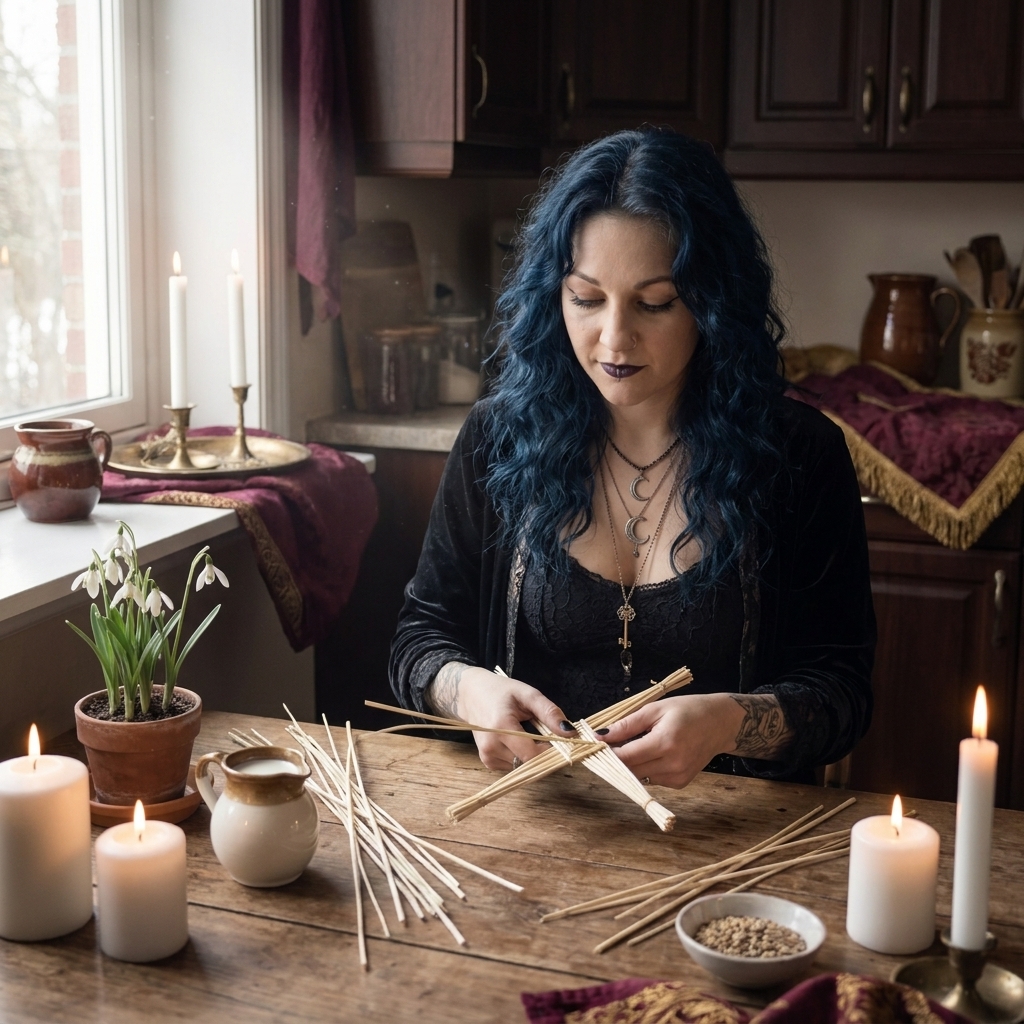
Imbolc traditions answer a question many of us feel by late January: how do you welcome spring when the ground still looks like winter? In Ireland, the answer was practical. People wove crosses from rushes, left cloth on the windowsill and got the house ready for a visitor. Below, you’ll learn where those customs come from and what the crosses, candles and colors mean. You’ll also see how to celebrate Imbolc at home, from the altar to the supper table.
- Milk, Fire and a Saint: Where Imbolc Traditions Begin
- The Brigid’s Cross: Imbolc Traditions You Can Weave
- Candles and Candlemas: Imbolc Traditions of Light
- Four Imbolc Traditions, One Thread: Light and an Open Door
- Spring Cleaning for Brigid: A House Blessing for Imbolc Eve
- An Imbolc Altar Built From the Old Symbols
- Imbolc Foods: Butter, Potatoes, Crêpes and Tamales
- Frequently Asked Questions
- References
Milk, Fire and a Saint: Where Imbolc Traditions Begin
Imbolc falls on February 1, roughly halfway between the winter solstice and the spring equinox. Britannica traces the name to a Middle Irish word that probably meant “milking.” It also notes that the day seems to have been a feast of purification for farmers[1].
The day also belongs to Brigid. Imbolc was linked with the goddess Brigid, and after Christianity spread, the date became the feast of St Brigit[1]. Folklorist Aoife Granville of University College Cork describes Brigid as a poet, a smith and a healer[2].
Fire ties these roles together. As Granville notes, the medieval writer Gerald of Wales recorded that 19 nuns took turns keeping a fire burning without a break at Kildare in her honour[2]. People still keep Brigid’s Day, and Ireland only made it an official public holiday in 2023[2]. In modern pagan practice, Imbolc is also one of the eight sabbats of the year, the first of the spring turns.
The Brigid’s Cross: Imbolc Traditions You Can Weave
Families traditionally made the cross on January 31 from rushes or straw[2]. The National Museum of Ireland fills in the scene. On St Brigid’s Eve, families ate a festive meal of potatoes and butter, and then everyone made crosses together[3]. Before a cross went up, it was often sprinkled with holy water, and a prayer was said to welcome the saint into the home[3].
Crosses went above the front door, in the kitchen and in the animal sheds, because people asked Brigid to guard the household and farm from illness and disease[3]. Families also scattered spare straw on the crops or used it as bedding for animals. A cross was also a common gift for someone moving into a new home[3].
If you can’t find rushes, other materials have plenty of precedent. Straw, rushes and reeds were most usual, but people also used grass, hay, wood, goose quills, wire and fabric[3]. The shapes varied as well. Designs could be diamond, woven or wheel-shaped, with two, three or four arms. In parts of the west coast, two strips of wood were simply tied together[3]. So a cross made from paper strips or pipe cleaners still belongs to the tradition.
For the familiar four-armed version, soak dry stems for an hour first so they bend without snapping. Fresh flower stems often split as they dry, so soaked straw, paper or pipe cleaners hold their shape better. Then fold each new stem around the last one, turning the cross a quarter turn each time. Finally, tie the four ends with thread so the weave holds.
Candles and Candlemas: Imbolc Traditions of Light
The day after Imbolc, the church calendar holds its own festival of light. Candlemas falls on February 2, 40 days after Christmas, and it was once called the Purification of the Blessed Virgin Mary[4]. Many churches still mark it by blessing the candles meant for use through the coming year[4]. You can borrow the idea by dedicating your household candles for the months ahead, instead of lighting one for a single evening.
Imbolc candle colors are a modern convention rather than an old Irish rule. Still, many practitioners today pick from a short list, and each of these Imbolc colors and symbols points back to the farm or the legend:
- White for milk, snow and snowdrops. It suits purification and fresh starts.
- Red or orange for Brigid’s fire and the Kildare flame. It fits courage, creative work and healing.
- Pale green for the first shoots. It suits wishes for growth.
- Gold or yellow for straw, butter and the returning sun. It works for warmth and household blessing.
A plain white candle, blessed with intention, fits Candlemas and older Imbolc traditions alike. Afterwards, you can watch how it burns; here is a short guide to reading a candle’s flame.
Four Imbolc Traditions, One Thread: Light and an Open Door
Imbolc traditions from Ireland, Candlemas customs from the Catholic calendar and weather lore from rural America all fall within the same three days, from January 31 to February 2.
| Tradition | At home | Light or weather |
|---|---|---|
| Gaelic Imbolc, Feb 1 | A farmers’ feast of purification[1] | Marks the start of spring[1] |
| St Brigid’s Eve, Jan 31 | Rushes at the door, doors left unlocked[2] | Brigid’s fire kept burning at Kildare[2] |
| Candlemas, Feb 2 | Once the feast of Mary’s purification[4] | Candles blessed for the year[4] |
| Groundhog Day, Feb 2 | German Candlemas lore carried to Pennsylvania[5] | A bright day means more winter[5] |
German settlers who reached Pennsylvania in the 1700s brought their Candlemas customs with them. In Germany a badger had played forecaster, so in America the groundhog took over the job[5]. The old lore also runs backwards from what you’d expect. A fair, bright Candlemas meant winter would return, while clouds and rain meant it was done[5].
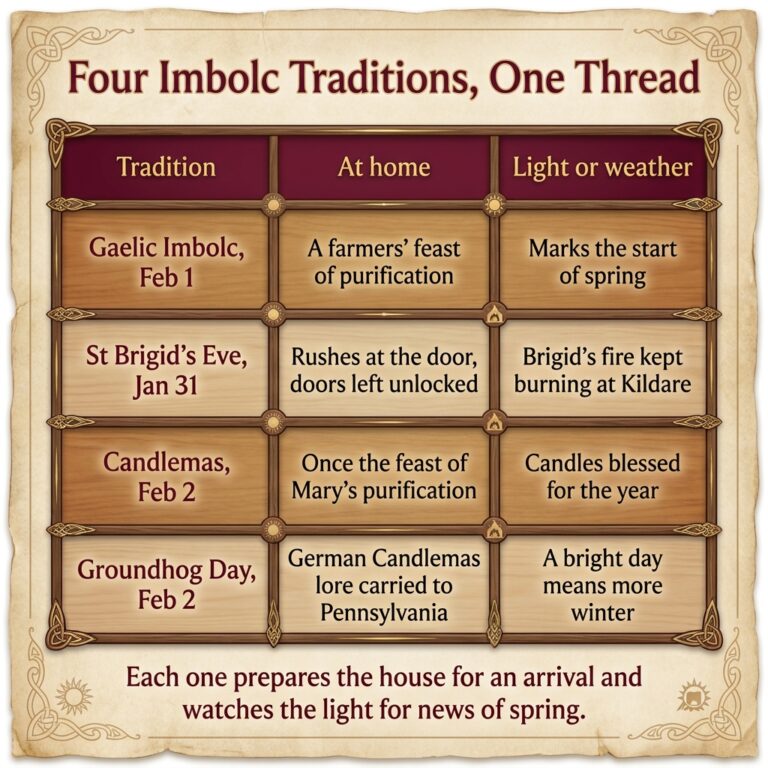
Put side by side, these traditions share two habits. First, each one prepares the house for an arrival, whether that’s a saint at the door or a year of blessed candles. Second, each one watches the light for news of spring, from the Kildare flame to a groundhog’s shadow. That suggests Imbolc spring cleaning was mainly an act of hospitality: you clear the threshold because someone is expected. So if you only have an hour, clean the entrance and light one candle, and you’ve honored both threads.
Spring Cleaning for Brigid: A House Blessing for Imbolc Eve
Many Imbolc traditions centered on the doorway. In Irish homes, rushes were strewn outside the house and doors were left unlocked so Brigid could enter[2]. A piece of cloth or ribbon, the Brat Bríde, was also left on the windowsill overnight. People believed the saint touched it on her travels. Afterwards, they used it for healing or sewed it into clothing for protection[3]. In some homes, the cloth hung on the door handle instead[2].
Here is a simple way to bring these Imbolc rituals into a modern home on the evening of January 31:
- Start cleaning at the back of the house and work toward the front door, so the work moves outward.
- Give the threshold the most care. Sweep the step, wipe the door and clear the clutter from the entrance.
- Lay a few stems of straw, reeds or dried grass by the door in place of strewn rushes.
- Hang a clean strip of cloth on the door handle or set it on a windowsill overnight, then keep it.
- Open the front door for a minute, light one candle near it, and say a short blessing.
Leaving a door unlocked all night isn’t wise today, so the open door stands in for the old custom. If you’d like words for this Imbolc prayer, here is a simple Imbolc blessing you can use or rewrite: “Brigid of the hearth, the step is swept and the light is lit. Bless this house, the hands that keep it, and the year coming in.” And if the past season was heavy, this pairs well with a deeper practice of cleansing a house after hardship.
Belief, Intention & The Power of Magic
Witchcraft, spells, and manifestation are deeply rooted in belief, intention, and spiritual practice. If these practices do not resonate with you, this may not be the path for you, and that’s perfectly okay. But if you believe in divine powers, trust your intentions, and feel drawn to the mysteries of the unseen, we invite you to continue exploring with Madame Celestine and discover the magic that speaks to your soul.
An Imbolc Altar Built From the Old Symbols
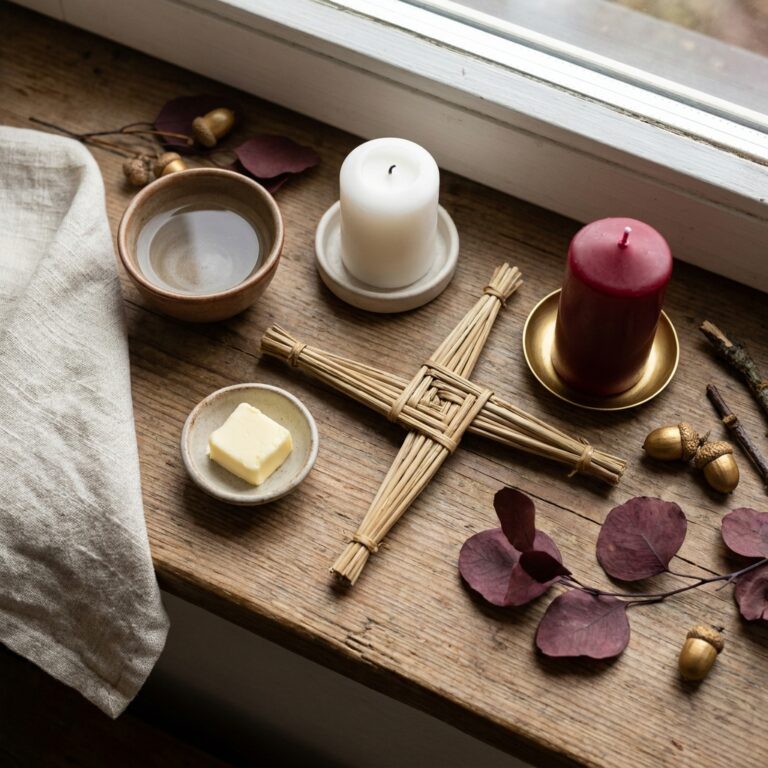
An Imbolc altar simply gathers Imbolc traditions in one place, so it doesn’t need much room. A windowsill or a corner of the kitchen table works well. Choose symbols of Imbolc that each carry part of the story:
- Brigid’s cross, for the protection of the household.
- A white, red or gold candle, for the Kildare flame and Candlemas.
- Milk or butter in a small dish, for the “milking” behind the festival’s name.
- A bowl of water. Brigid’s holy wells were often visited on the eve or the feast day, and water drawn then was thought to be especially blessed[3].
- Cloth, in a clean strip, to serve as your Brat Bríde.
The snowdrop is so tied to Candlemas that it earned the name Candlemas Bells, and it has long stood for hope[6]. Yet the same folklore warns that bringing one into the house was considered bad luck[6]. So you can honor both ideas by keeping a potted snowdrop on the doorstep, or by using a drawing of one on the altar. (Despite how old the custom feels, snowdrops aren’t even native to the UK[6].) For a fuller evening, these simple Imbolc ritual ideas build on the same altar.
Imbolc Foods: Butter, Potatoes, Crêpes and Tamales
The traditional supper on St Brigid’s Eve was potatoes and butter[3]. It sounds plain, yet it suits a festival whose name probably means “milking.” Candlemas adds more ideas to the table. Several European cultures mark the day with crêpes, and families in Mexico and elsewhere in Latin America eat tamales[4]. So foods for Imbolc, like other Imbolc traditions, travel well beyond Ireland.
For a simple menu, serve buttered potatoes or colcannon with fresh bread, then crêpes for dessert. Also set aside a small plate or a glass of milk as an offering for Brigid. That way, the meal itself becomes one of your Imbolc celebrations, and it costs almost nothing.
Frequently Asked Questions
When is Imbolc celebrated?
Imbolc is celebrated on February 1, and many people begin on the evening of January 31, known as St Brigid’s Eve. Some modern pagans mark the exact midpoint between the winter solstice and the spring equinox instead, which usually lands a few days later.
Was Brigid a goddess or a saint?
Both, in different eras. Brigid was a goddess linked to Imbolc, and after Ireland became Christian her festival became St Brigid’s Day. Historians still debate how much the two figures overlap.
Do Imbolc traditions need an altar?
No. A cross over the door, a swept entrance and one lit candle are enough. An altar gives you a focus if you have the space, but a windowsill works just as well.
What are the colours of Imbolc?
The usual colours of Imbolc are white, red, green and gold. White stands for milk and snow, red for Brigid’s fire, green for new growth and gold for straw and the returning sun.
Can anyone follow Imbolc traditions?
Yes. Plenty of people who mark the day aren’t Irish or pagan and simply enjoy a seasonal pause. Treat the customs with respect for their Irish roots, and keep the parts that feel meaningful to you.
References
- Imbolc. Encyclopaedia Britannica. https://www.britannica.com/topic/Imbolc
- Brigid’s Day: how a festival of fire and fertility connects Christian Ireland with its pagan past. Aoife Granville. The Conversation. https://theconversation.com/brigids-day-how-a-festival-of-fire-and-fertility-connects-christian-ireland-with-its-pagan-past-220974
- St Brigid’s Day. National Museum of Ireland. https://www.museum.ie/en-IE/Collections-Research/Folklife-Collections/Folklife-Collections-List-(1)/Religion-and-Calendar-Customs/St-Brigid-s-Day
- Candlemas. Encyclopaedia Britannica. https://www.britannica.com/topic/Candlemas
- Groundhog Day. National Weather Service, Louisville. https://www.weather.gov/lmk/groundhog_day_lmk
- Snowdrop (Galanthus nivalis). Woodland Trust. https://woodlandtrust.org.uk/trees-woods-and-wildlife/plants/wild-flowers/snowdrop
Not sure where to start? You don’t have to do this alone.
Madame Celestine offers guided spellwork for beginners — real support for your first working, not just another guide to read.
Related reading: Pendulum Yes or No: How to Calibrate and Trust Your Answers · Letting Go Spell: A Release Ritual for Heartache

About Madame Celestine
Madame Celestine has practiced and taught spellwork, divination, and seasonal ritual for over two decades, helping newcomers build a grounded, confident practice from their very first spell.