
What do Beltane symbols like the bonfire and the maypole actually mean, and do they still say anything to someone lighting one candle in a small apartment? They do, cher. But first you need to know where each symbol came from, because the fire and the pole grew up in different places. In this guide, you’ll learn why Gaelic farmers drove their cattle between two fires. You’ll also see how the maypole got its ribbons much later than most people assume, and what yellow flowers on a doorstep were meant to do. Then I’ll share the simple way I mark the first of May here in New Orleans, so you can plan a Beltane celebration that fits your own home.
- Beltane Symbols Begin With a Calendar: Summer’s First Day
- Two Fires and a Herd: The Oldest Beltane Symbols
- The Maypole’s Real Story: Village Greens, Bans and Victorian Ribbons
- Guard First, Then Grow: What Beltane Symbols Share
- Beltane Colors, Candles and Flowers: Reading the Symbols
- How to Celebrate Beltane at Home: A Simple Candle Ritual
- Fertility Beyond the Physical: Beltane Symbols in New Orleans
- Beltane Mistakes Worth Skipping
- Frequently Asked Questions
- References
Beltane Symbols Begin With a Calendar: Summer’s First Day
Beltane falls on the first of May. In Ireland and Scotland, it marked the start of summer and the start of open pasturing [1]. So the festival was practical before it was mystical. After a long winter near the farm, the herds were about to move out to summer grazing, and that move carried real risk.
Beltane was also one of the four main Gaelic seasonal festivals, alongside Samhain, Imbolc and Lughnasadh [2]. Samhain closed the bright half of the year, and Beltane opened it. To see where it sits among all eight modern festivals, this overview of the eight sabbats of the year lays out the full wheel.
What about the name? Medieval Irish writers said it meant “Bel’s fire,” after a god called Bel [2]. However, modern scholars suggest other origins. So treat the popular translation “bright fire” as a guess, not a settled fact.
One more practical note. South of the equator, the seasons run the other way. As a result, many practitioners there mark Beltane around the start of November instead.
Two Fires and a Herd: The Oldest Beltane Symbols
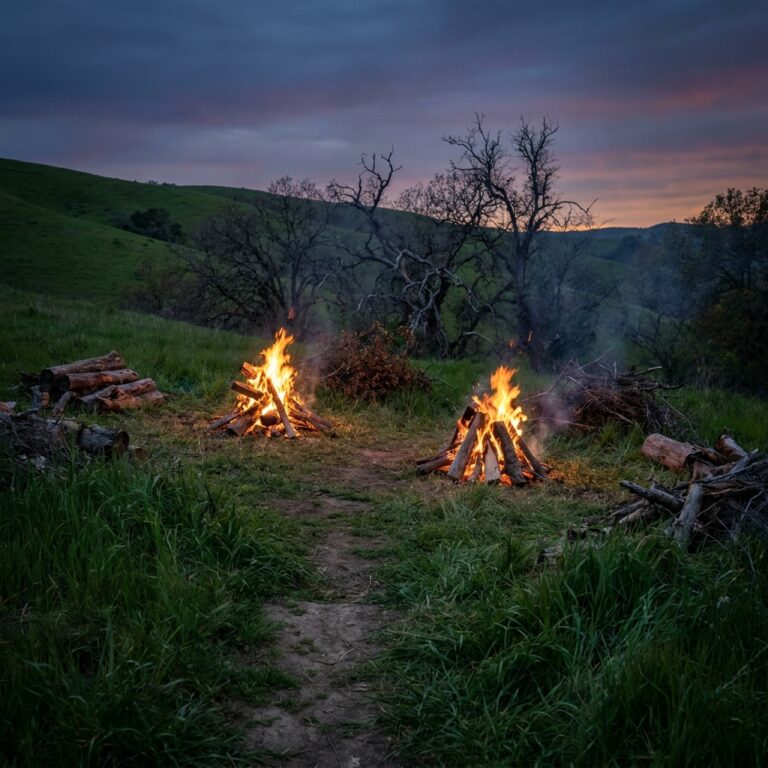
Picture a hillside on May Eve. Two fires burn a short distance apart, and a farmer walks his cattle through the gap. That image comes from Cormac’s Glossary, a medieval Irish text, which says people drove cattle between two fires lit at the start of summer [2]. Later, Irish farmers also drove cattle through the embers of May fires to keep them healthy for the year ahead [3].
Why cattle? Because the herd was the family’s wealth. Losing animals on the way to summer pasture could mean a hungry winter. So the fire worked as a blessing on the household’s most valuable possession, right at the moment it left the farm. That’s how fire became one of the oldest Beltane symbols.
Relighting the Hearth From One Flame
The fire also reached inside the house. According to folklore records, families put out their household fires and then relit them from the Beltane bonfire [2]. In other words, every hearth in the area began summer from the same flame. For this, some communities made a special “need-fire,” and they could only kindle it with a wooden drill, by friction [2].
People took part too. They walked around the bonfires or between them, and sometimes they leapt over the flames or embers [2]. Fire leaping carried the same idea as the cattle drive: pass through the flame, then take its protection into summer.
I’ve always found something powerful in that. Here, fire was never just something to admire. It stood for cleansing, renewal and the guarding of life. Not every fire is meant to destroy, darlin’. Some are meant to awaken. If open flame calls to you, these pagan bonfire traditions show how other paths work with it.
The Maypole’s Real Story: Village Greens, Bans and Victorian Ribbons
Now, the maypole is a curious thing. Most of us picture a tall pole, bright ribbons and dancers weaving them into a pattern. Yet that picture is younger than you might expect.
The earliest known mention of a maypole comes from a 15th-century poem credited to Geoffrey Chaucer [4]. After that, maypoles became a fixture of English village greens. They also drew enemies. Parliament banned maypoles in 1644, and they came back after the monarchy returned in 1660 [4].
And the ribbons? The first recorded plaited-ribbon maypole appeared on a London stage in 1836, not on a village green [4]. In fact, the ribbon dance most of us know was largely a Victorian creation.
Do Maypoles Belong Among Beltane Symbols?
Maypole dancing belongs to English and wider European May Day customs. Sweden, for example, raises its poles at Midsummer, not in May [5]. Some writers suggest Beltane as one possible root, but the record doesn’t clearly show a shared ancient origin [4]. Today, though, modern Pagan groups treat the maypole as one of the central Beltane symbols [5].
You’ll also hear that the pole is a phallic fertility symbol. The historian Ronald Hutton, who studied British seasonal customs, found no historical basis for that reading [5]. So if you use it that way, call it a modern meaning, not an ancient one.
Personally, I see something else in those woven ribbons. Every choice we make becomes a thread in the life we’re creating. Some threads cross. Some tangle. Others come together beautifully. Like the dance, life asks for movement, patience and a little trust in the rhythm.
Guard First, Then Grow: What Beltane Symbols Share
Lay the old Beltane symbols next to the newer ones, and a pattern shows up.
| Symbol | Where it comes from | What it was meant to do |
|---|---|---|
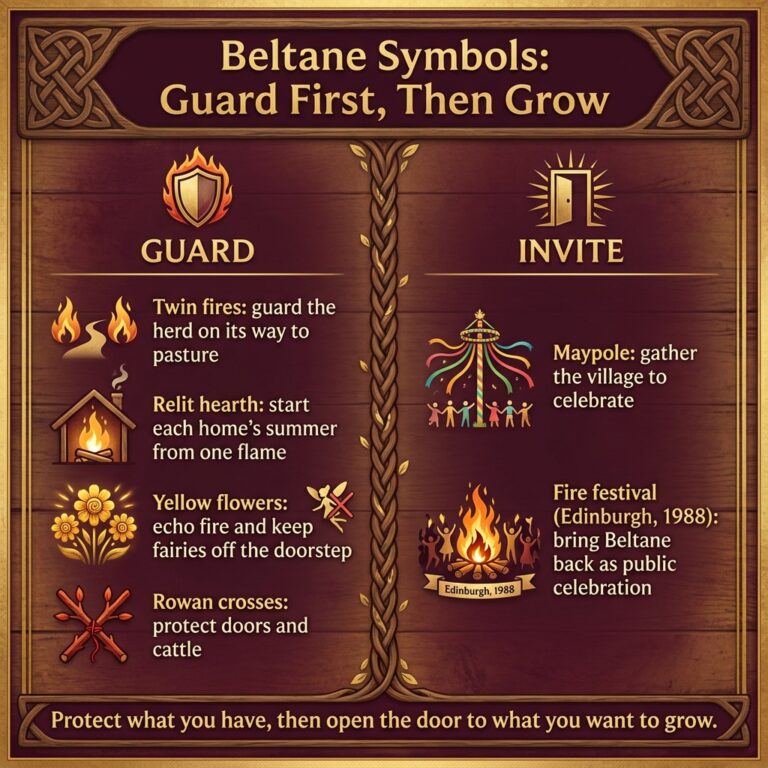
| Twin fires | Gaelic Ireland and Scotland | Guard the herd on its way to pasture |
| Relit hearth | Gaelic communities | Start each home’s summer from one flame |
| Yellow flowers | Irish and Scottish May customs | Echo fire and keep fairies off the doorstep |
| Rowan crosses | Isle of Man | Protect doors and cattle |
| Maypole | English and European May Day | Gather the village to celebrate |
| Fire festival | Edinburgh, since 1988 | Bring Beltane back as public celebration |
Households hung yellow May flowers on doors, windows and cattle because the color evoked fire [2]. In Ireland, people also believed fairies couldn’t pass the sweet-smelling flowers on a doorstep [3]. On the Isle of Man, people wore small rowan crosses and tied them to cattle for protection [2]. Meanwhile, the Edinburgh festival began in 1988 with a small group of enthusiasts, backed by scholars at the University of Edinburgh’s School of Scottish Studies [6].
What These Beltane Symbols Tell Us
Put side by side, these traditions split into two groups. The older Gaelic customs mostly guard. They protect herds, hearths and doorways at a risky turning point. By contrast, the maypole and the modern revivals mostly invite. They gather people and welcome growth.
That’s my own reading of the pattern, not settled scholarship. Still, it’s useful, because it suggests an order for your own Beltane rituals: protect what you already have, then open the door to what you want to grow. I believe there are seasons when we must protect what we have, and seasons when we must finally allow ourselves to receive. The old customs guarded first. May Day itself, to my mind, belongs to the second kind of season.
So pick your symbol by your intention. If you want to protect your home, set yellow flowers by the door. If you need to let something go, work with a flame. And if you want connection or new growth, choose the weaving symbolism of the ribbons.
Beltane Colors, Candles and Flowers: Reading the Symbols
Color is one of the easiest Beltane symbols to bring indoors. Yellow has the clearest folk record, thanks to those May flowers. In Ireland, primroses, buttercups and marigolds were especially popular [3]. Elsewhere in the Gaelic world, people also used gorse and marsh marigold [2].
Many modern practitioners add green for new growth, red for the fire, and white for blossom. These Beltane colors come from current practice rather than old records, so treat them as a shared language you can adapt. The same goes for Beltane candle colors. For example, many people burn a green candle for growth, a red one for passion and courage, and a yellow one for joy.
Beltane Symbols in Flowers and Herbs
For flowers, choose whatever blooms near you in late spring. A Beltane altar doesn’t need imported blossoms to carry meaning. Hawthorn is the exception that needs care, since old May customs often kept it outdoors. These old May Day luck customs explain why.
As for Beltane herbs, rowan has the strongest record as a protective plant, as the Manx crosses show. Beyond that, most herb lists you’ll find online reflect modern practice, so you’re free to choose plants that hold meaning for you.
How to Celebrate Beltane at Home: A Simple Candle Ritual
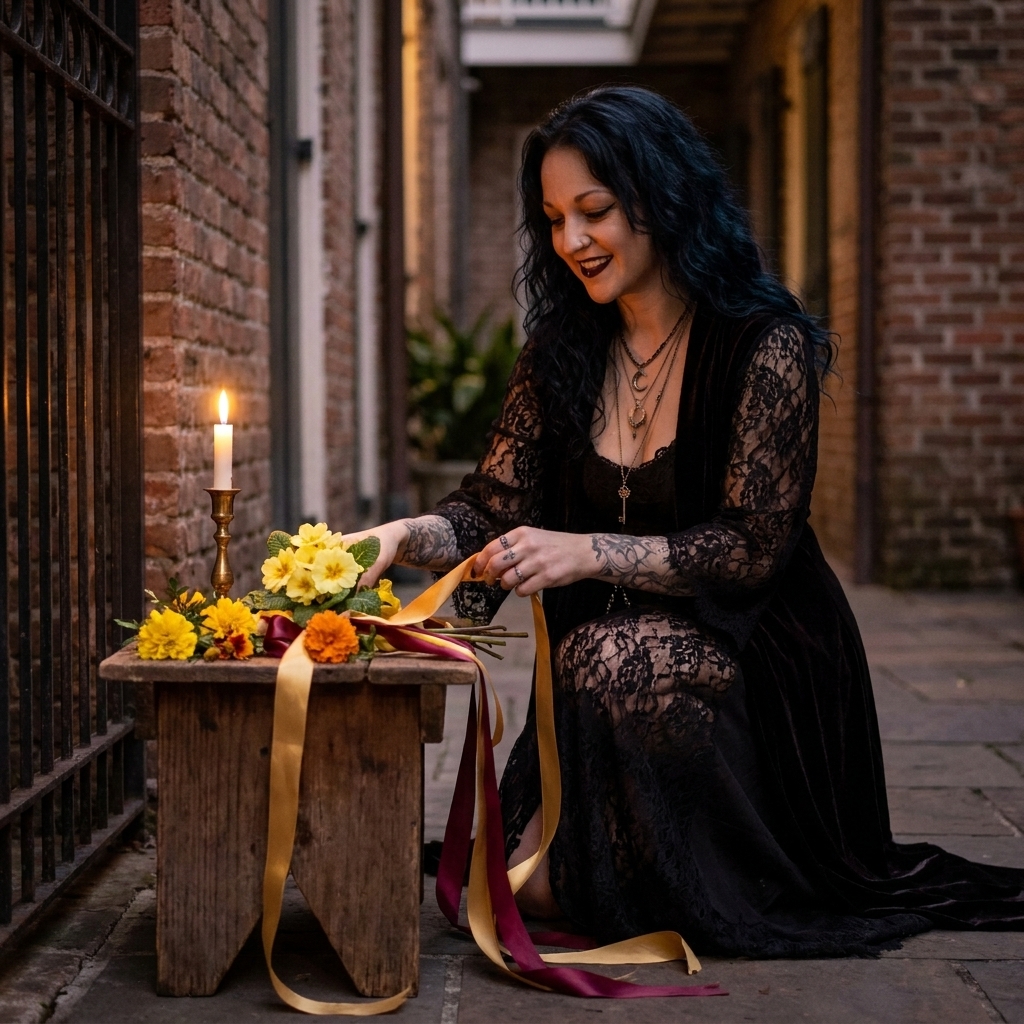
To celebrate Beltane at home, set a fresh flower on your altar, light a candle with a clear intention, and open a window to the warm air. Then spend a quiet moment naming what you’re ready to let grow. You don’t need a bonfire or a group.
When I reflect on Beltane, I like to keep things simple. A fresh flower on the altar. A candle lit with intention. An open window to welcome the warm air. Then a quiet moment to consider what deserves to grow in my life.
If you’d like more structure, the steps below build on that core. The release, offering and tarot steps are common modern practice rather than my own ritual, and each one borrows one of the old Beltane symbols:
- Dress a small altar. Lay down a cloth, add a fresh flower and set out a dish for offerings. The flower echoes the May blooms that once guarded doors.
- Release first. Write down one thing you’re done carrying, then set it aside or burn it in a fireproof dish. This mirrors the old custom of putting out the hearth before relighting it.
- Light your candle with intention. Choose its color by your goal. For a Beltane candle spell for healing, many people use white or green and focus on rest and renewal. Treat it as support for your spirit, never as a replacement for medical care.
- Open a window to welcome the warm air of the new season.
- Leave an offering. Bread, milk, honey or flowers are common Beltane offerings. Butter fits well too, since Irish households once added May butter to the churn for luck [3].
Finally, never leave a candle burning unattended. And if you plan an outdoor fire, check your local fire rules first.
A Three-Card Beltane Tarot Spread and Blessing
If you read tarot, draw three cards. Card one shows what you wish to welcome. Next comes what you need to protect. Your third card shows what you’re finally ready to let grow. Then close with a short Beltane blessing in your own words, such as: “I honor this new season, and I let what is good take root.”
Belief, Intention & The Power of Magic
Witchcraft, spells, and manifestation are deeply rooted in belief, intention, and spiritual practice. If these practices do not resonate with you, this may not be the path for you, and that’s perfectly okay. But if you believe in divine powers, trust your intentions, and feel drawn to the mysteries of the unseen, we invite you to continue exploring with Madame Celestine and discover the magic that speaks to your soul.
Fertility Beyond the Physical: Beltane Symbols in New Orleans
Down here in New Orleans, we know a thing or two about seasons changing and about old ways that refuse to die. Still, I must make one thing clear. Beltane is not a New Orleans tradition. Its history belongs to the Gaelic lands, and those roots deserve respect.
But this city is a crossroads. French, African, Caribbean and European spiritual influences have met here for generations. So I’ve always appreciated how different traditions can speak to similar human needs without becoming the same tradition. Protection. Renewal. Love. Prosperity.
Here in Louisiana, fire has its own language too. I think of a candle flickering on a quiet altar, or the heat rising from the earth after a spring rain. I think of the glow of a flame against an old courtyard wall.
What Fertility Means in Witchcraft
People hear the word fertility and think of romance, marriage and children. In witchcraft, though, fertility can mean much more. It can be a business that starts to prosper. It can be a wounded heart learning to love again. Or it can be an old dream finding its way back into your hands.
Beltane reminds me that creation takes many forms. To my mind, fire is the Beltane symbol that says it best: some things must be released before others can flourish.
Beltane Mistakes Worth Skipping
First, don’t present the ribboned maypole as one of the ancient Celtic Beltane symbols. The ribbons are Victorian, and the pole’s link to Beltane is modern. You can still love it as the newer custom it is.
Next, don’t repeat “bright fire” as the name’s proven meaning. Even medieval writers gave a different answer, and scholars still debate it.
Also, don’t turn the day into a performance. No grand ritual is necessary. Sometimes the most meaningful spiritual work begins when we become honest about what we’re ready to leave behind.
Finally, don’t wait for perfect conditions. You cannot spend your whole life preparing for spring and never allow yourself to bloom.
Frequently Asked Questions
What is a Beltane ritual?
A Beltane ritual is any ceremony that marks the start of summer around May 1. In the past, that meant bonfires to protect cattle and homes. Today, it often means a candle, fresh flowers and an intention for growth.
What are the colors of Beltane?
Yellow has the oldest folk record, from the yellow May flowers placed on doors and cattle. Modern practitioners also use green for growth, red for fire and white for blossom.
Can I celebrate Beltane without a bonfire?
Yes. A single candle lit with intention can stand in for the bonfire. It suits apartments and places with fire restrictions.
What offerings are traditional for Beltane?
Many practitioners leave bread, milk, butter, honey or fresh flowers. Butter has an especially long link to May Day in Irish custom.
Is Beltane the same as May Day?
They share a date, but they come from different roots. Beltane is the Gaelic festival of summer’s start, while maypole dancing grew from English and European May Day customs.
What do the main Beltane symbols mean?
The main Beltane symbols are fire, yellow flowers and the maypole. Fire stood for protection and renewal, and yellow flowers echoed that fire on doorsteps. The maypole, a later English custom, now stands for community and growth.
References
- Beltane. Encyclopaedia Britannica, Britannica Editors. https://www.britannica.com/topic/Beltane
- Beltane. Wikipedia. https://en.wikipedia.org/wiki/Beltane
- May Day. National Museum of Ireland. https://cms.museum.ie/en-IE/Collections-Research/Folklife-Collections/Folklife-Collections-List-(1)/Religion-and-Calendar-Customs/May-Day
- Where did maypole dancing originate? Caroline Roope, Who Do You Think You Are? Magazine, 25 June 2021. https://whodoyouthinkyouaremagazine.com/feature/how-maypole-dancing-became-an-english-tradition
- Maypole. Wikipedia. https://en.wikipedia.org/wiki/Maypole
- About Beltane Fire Festival. Beltane Fire Society. https://beltane.org/about-beltane/
Not sure where to start? You don’t have to do this alone.
Madame Celestine offers guided spellwork for beginners — real support for your first working, not just another guide to read.
Related reading: Waning Moon Spells: What to Release in Each Waning Phase · Full Moon Rituals: 13 Esbat Spells and Celebrations

About Madame Celestine
Madame Celestine has practiced and taught spellwork, divination, and seasonal ritual for over two decades, helping newcomers build a grounded, confident practice from their very first spell.