
What should you actually say during a Wiccan money spell, and does it matter whether the words rhyme? Most money spell guides spend their time on candles and herbs, then hand you a chant with no explanation. This guide works the other way round. You’ll learn where Wiccan spell language comes from, what psychology has found about rhyme, and how a 13th-century play and a 1960s ethical couplet shaped the way witches speak in ritual. Then you’ll get a simple four-part method for writing your own money chant, plus a short ritual to use it in.
- Why a Wiccan Money Spell Leans on Spoken Words
- Why Witches Rhyme: The Psychology Behind a Wiccan Money Spell
- From Bagahi to the Rede: Seven Centuries of Magic Words
- How to Write Your Own Wiccan Money Spell Chant
- How to Do a Spell for Money: A Simple Wiccan Ritual
- Wiccan Money Spell Variations for Debt, Work and Sales
- Timing Your Wiccan Money Spell
- The Harm-None Clause and the Rule of Three
- Common Mistakes With a Witch Money Spell
- Frequently Asked Questions
- References
Why a Wiccan Money Spell Leans on Spoken Words
Wicca is a tradition built on written and spoken ritual. Its early rites were kept in a Book of Shadows, a handwritten book of rituals, and much of that material took the form of liturgy and poetry. Doreen Valiente, one of the most influential early Wiccans, helped Gerald Gardner rewrite much of his Book of Shadows. Her own liturgies and poems still turn up regularly in Wiccan ritual today [1].
So when a practitioner casts a Wiccan money spell, the spoken chant carries the intention. The candle, the herbs and the timing support the words, and the words state what the witch wants to happen.
That’s also why the same candle and herbs can serve very different spells. A green candle on its own says “money” only loosely. However, a clear spoken line tells the working exactly what kind of money, from where, and on what terms.
Why Witches Rhyme: The Psychology Behind a Wiccan Money Spell
Rhyme can look like an old-fashioned habit. Yet researchers have found that it changes how people judge a statement. In a 2000 study published in Psychological Science, psychologists McGlone and Tofighbakhsh showed people sayings in rhyming and non-rhyming versions. People rated “What sobriety conceals, alcohol reveals” as more accurate than “What sobriety conceals, alcohol unmasks,” even though both say the same thing [2]. This is now called the rhyme-as-reason effect.
Rhyme also helps memory. In a 2017 study of how people remember rhyming verse, the rhyming words at the ends of lines stood out most, which suggests rhyme acts as a prompt for recall [3].
For a Wiccan money spell, both findings matter. Practitioners believe a spell works best when the caster speaks with conviction and without stumbling. A rhyme feels truer as you say it, and you can repeat it without reading from a page. As a result, you keep your attention on the intention rather than on the paper in your hand.
From Bagahi to the Rede: Seven Centuries of Magic Words
Ritual language in the West has a long paper trail. Around 1261, the poet Rutebeuf wrote a French miracle play, Le Miracle de Théophile, in which a cleric sells his soul and is later freed by the Virgin Mary. In it, the sorcerer Salatin calls the Devil with verse lines that begin “Bagahi laca bachahé.” Nobody knows what language those words are in [4]. In other words, those lines work purely through sound and rhythm.
Seven centuries later, Wicca gave its ethics the same musical treatment. In 1964, Valiente publicly promoted the Wiccan Rede, “An’ it harm none, do what ye will,” through the Witchcraft Research Association [1]. The “an” is an archaic word for “if,” and “rede” means advice [5]. By the mid-1970s, a longer version had appeared in print as a full poem in rhymed couplets [5].
What These Sources Teach a Wiccan Money Spell
| Source | What carries the words | Lesson for your chant |
|---|---|---|
| Bagahi lines, c. 1261 | Sound and rhythm | Give the chant a steady beat |
| Wiccan Rede, 1964 | A short rule with a condition | Add a harm-none clause |
| Rhyme study, 2000 | Rhymed lines feel truer | Put your main request in rhyme |
| Memory study, 2017 | End rhymes prompt recall | End each line on a rhyme |
Put side by side, these sources point to the same thing. A spoken charm tends to last when it has a beat, a rhyme, a clear request and a limit. None of them proves a spell brings money. However, together they explain why so many working chants share one shape, and they give you a sound template for writing a Wiccan money spell of your own.
How to Write Your Own Wiccan Money Spell Chant
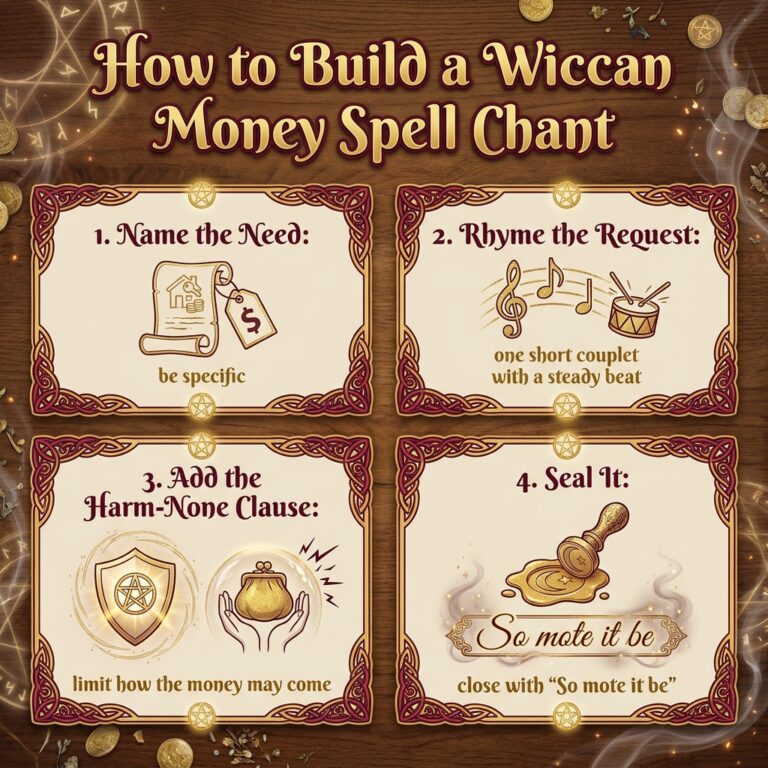
The template above turns into four parts. Each one does a different job, so it’s worth understanding the reason behind each before you write.
1. Name the Need
Be specific. “Money” is vague, but “steady pay for honest work” gives the spell a direction. Many practitioners also phrase the need as already arriving, because they believe present-tense words focus the mind better than wishes.
2. Rhyme the Request
Next, put your main request into a rhyming couplet. Keep it to two short lines with a steady beat, so you can say it without thinking about the next word.
3. Add the Harm-None Clause
Then add a line that limits how the money may come. This follows the spirit of the Rede. It also rules out the outcomes most people don’t want, such as money that comes from someone else’s loss.
4. Seal It
Finally, close with a fixed phrase. Many Wiccans use “So mote it be,” which simply means “so may it be.” A set closing tells you, and the ritual, that the working is complete.
Here’s an original example that follows all four parts:
Silver coin and honest pay,
find my door and come to stay.
As the moon grows, so will this,
harming none, in work and bliss.
So mote it be.
Feel free to change every word. In fact, a chant in your own voice usually comes out more naturally than one you’ve borrowed.

How to Do a Spell for Money: A Simple Wiccan Ritual
This money ritual spell uses only a candle, your chant and a few minutes of focus, so it works as a free money spell for anyone. If you’re new to spellwork, this guide on casting spells as a beginner covers the basics first.
- Clear your space. Tidy the area, then many practitioners walk around it once to mark a simple circle. This sets the ritual apart from ordinary time.
- Light a green candle. Green is the usual color for money, especially in American practice, because it suggests growth and paper money.
- State your need plainly. Say in ordinary words what you’re asking for, so your mind knows exactly what the chant stands for.
- Speak the chant three times. Repetition builds rhythm, and many witches feel the energy rise with each round.
- Sit quietly for a minute. Picture the need already met, then thank whatever powers you work with.
- Close the circle and let the candle burn safely, or snuff it and relight it on later nights. Never leave a flame unattended.
After that, act in the world. Practitioners treat a spell to gain money as a push behind real effort, so send the application or ask for the raise.
Belief, Intention & The Power of Magic
Witchcraft, spells, and manifestation are deeply rooted in belief, intention, and spiritual practice. If these practices do not resonate with you, this may not be the path for you, and that’s perfectly okay. But if you believe in divine powers, trust your intentions, and feel drawn to the mysteries of the unseen, we invite you to continue exploring with Madame Celestine and discover the magic that speaks to your soul.
Wiccan Money Spell Variations for Debt, Work and Sales
The four-part shape stays the same from one working to the next. What changes is the request, and often the timing that goes with it. Here’s how practitioners usually adapt a Wiccan money spell to three common needs.
For debt, the aim is to shrink something rather than to grow it. That’s why debt work usually runs on a waning moon, and the chant asks for the debt to leave instead of asking for money to arrive. An example couplet: “Debt grow small as the moon grows thin, / clear the way for good to come in.”
For a new job, many witches choose a Wednesday, since Mercury rules messages and trade. So the request names the work, not the paycheck: “Open door and steady hand, / bring me work where I can stand.”
For a small business, the focus shifts to customers who come back. For example: “Coins that cross my counter’s way, / come back often, glad to pay.”
Whatever the need, keep the harm-none line and the seal. A Wiccan money spell for debt still shouldn’t ask for anyone else to lose out, and a sales chant shouldn’t target a rival’s customers.
Timing Your Wiccan Money Spell
Most Wiccans cast a spell to attract money while the moon is waxing, since a growing moon matches a growing bank balance. Many also pick a day by its planet. Thursday belongs to Jupiter, linked with steady growth, and Wednesday belongs to Mercury, linked with trade and quick movement.
Timing has its own detailed guides here. For the day-by-day reasoning, see this guide to fast money spell timing. For candle work on a Thursday, the green money candle ritual walks through each step. Either way, you can keep the same chant.

The Harm-None Clause and the Rule of Three
Why add a limit to a money spell at all? Partly because of the Rede. Partly, too, because of a related idea many Wiccans hold, the Rule of Three. It says that whatever energy you send out, good or harmful, returns to you three times over [6].
The idea is younger than many people assume. A possible early version appears in Gerald Gardner’s 1949 novel High Magic’s Aid. Later, Raymond Buckland presented it as a formal ethical law, including in a 1968 magazine article [6]. Not every Wiccan accepts it, and some see it as an over-elaboration of the Rede [6].
That’s why most versions of a Wiccan money spell end with a limit. The practical lesson holds for any witch money spell. Ask for money that comes cleanly, through work, sales or fair opportunity. Don’t aim the spell at a particular person’s money, job or inheritance.
Common Mistakes With a Witch Money Spell
First, keep the request in a Wiccan money spell specific. A spell to attract money “somehow” gives your focus nothing to hold.
Second, keep the chant short. If you need to read it, it’s too long. Four lines plus a closing is plenty.
Third, don’t skip the harm-none line. Without it, the wording leaves the door open to outcomes you would never choose.
Finally, don’t cast and then wait. Practitioners see money magic as something that works alongside effort. This look at the money spell mistake that keeps you broke goes deeper into that point.
Frequently Asked Questions
Does a Wiccan money spell chant have to rhyme?
No. A chant can work for you without rhyme. However, rhyme makes words easier to remember and tends to make them feel more convincing, so many practitioners prefer it.
Can I do a free money spell at home?
Yes. A green candle, a short chant and a quiet space are enough. You don’t need to buy special tools to start.
Can I say the chant silently?
You can, but many witches prefer to speak it aloud. Hearing the words adds rhythm and helps keep your focus steady.
How many times should I repeat the chant?
Three repetitions is a common choice, because repetition builds rhythm. Some practitioners repeat it every night until the candle is gone.
Is money magic allowed in Wicca?
Many Wiccans practice money magic. Most add a harm-none condition, so the money comes without taking from anyone else.
References
- Doreen Valiente. Ethan Doyle White, preprint for the Dictionary of Contemporary Esotericism (Brill), archived by CRESARCH, 13 August 2018. https://contern.org/wp-content/uploads/2018/08/c-valiente-doyle-white.pdf
- Rhyme-as-reason effect. Wikipedia. https://en.wikipedia.org/wiki/Rhyme-as-reason_effect
- Study finds 4-year-olds are considerably better than adults at remembering rhyming verse. Christian Jarrett, BPS Research Digest, British Psychological Society, 27 April 2017. https://bps.org.uk/research-digest/study-finds-4-year-olds-are-considerably-better-adults-remembering-rhyming-verse
- Le Miracle de Théophile. Wikipedia. https://en.wikipedia.org/wiki/Le_Miracle_de_Th%C3%A9ophile
- Wiccan Rede. Wikipedia. https://en.wikipedia.org/wiki/Wiccan_Rede
- Threefold Law. Wikipedia. https://en.wikipedia.org/wiki/Threefold_Law
Not sure where to start? You don’t have to do this alone.
Madame Celestine offers guided spellwork for beginners — real support for your first working, not just another guide to read.
Related reading: Money Spells That Work Fast: What “Overnight” Really Means · Luck Herbs From the Old Country: Folk Herbs Used for Fortune

About Wren Ashby
Wren Ashby is the pen name our editorial team uses for articles on sigils, Tarot and modern traditional witchcraft. Articles under this byline are researched from published sources and reviewed by Madame Celestine before publishing.