
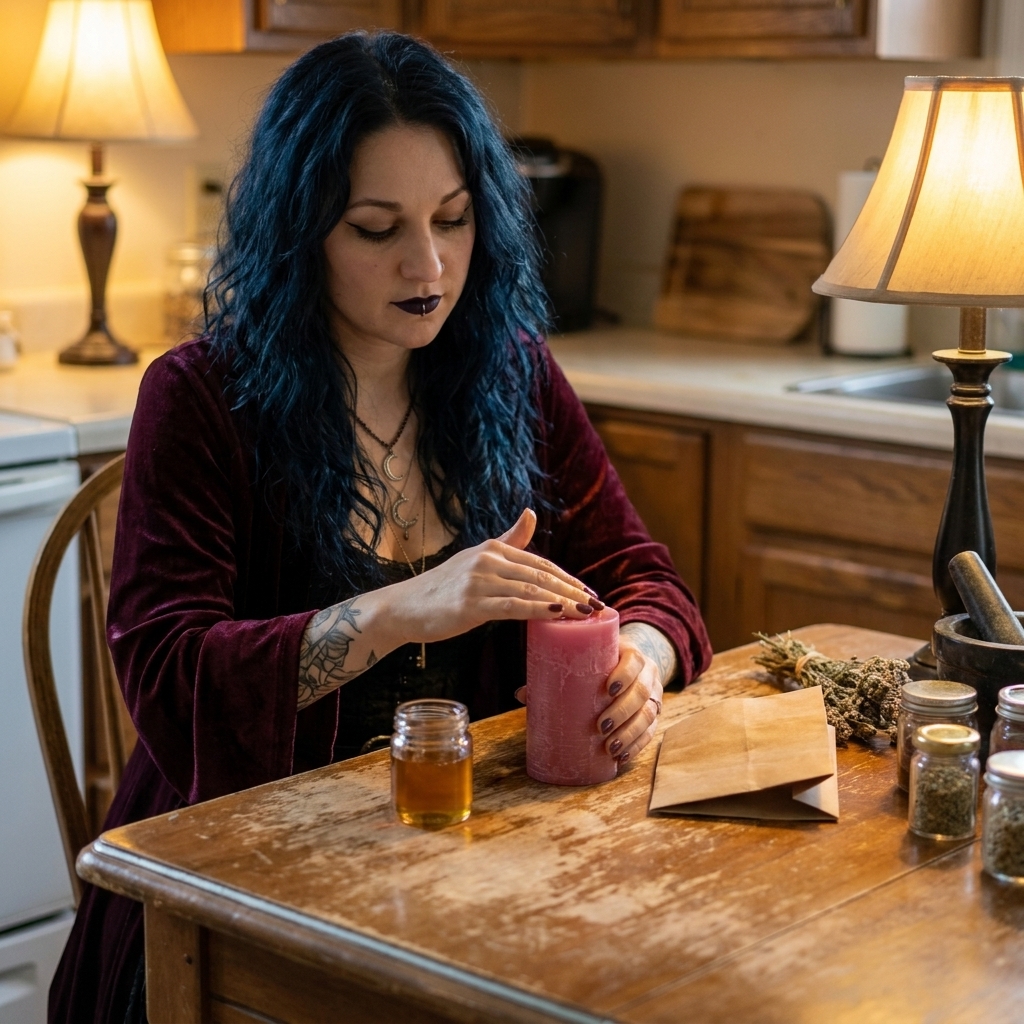
Hoodoo reconciliation work looks simple from the outside: a candle, a jar of honey, two names on a slip of paper. So why do people who try it from a Wiccan spell book so often feel they missed something? The answer is that hoodoo and Wicca start from different places. They disagree about where the power comes from, who should do the work and whether you may name a specific person at all. In this guide, you’ll learn where rootwork comes from, how a rootworker approaches a request to bring a lover back, and how that differs, step by step, from a Wiccan love spell.
- Where Hoodoo Reconciliation Work Comes From
- Hoodoo Is Not Voodoo, and the Difference Matters Here
- The Wiccan Love Spell and the Rule of “Harm None”
- Hoodoo vs. Wicca: Two Roads to Reconciliation
- How a Rootworker Approaches a Request to Bring a Lover Back
- When Hoodoo Reconciliation Stalls or Backfires
- Frequently Asked Questions
- References
Where Hoodoo Reconciliation Work Comes From
Hoodoo is a spiritual tradition created by enslaved African Americans in the United States. It blends Central and West African religious practice with Christianity, and it also goes by the names root work and conjure.[1] So a rootworker is simply a person who practices it, often for clients.
The religion scholar Yvonne Chireau lists the old names for these practitioners: hoodoo doctors, two-heads, root doctors, and conjure men and women. In her account, the community saw them as holding special knowledge of sacred arts. She also lists causing people to fall in love among the everyday things people asked of conjure.[2] So love and reunion work is not a modern add-on. A Smithsonian folklife essay makes the same point: hoodoo offers practical help with everyday problems, and it names love right beside jobs, legal trouble and health.[6] In hoodoo, a broken relationship is treated as a practical problem to solve, just like a lost job.
Hoodoo also has a special tie to New Orleans. The folklorist Zora Neale Hurston did her main hoodoo fieldwork there, from September 1928 to March 1929 and again from late 1929 into 1930. She called the city the “kingdom” of Marie Laveau.[3]

Hoodoo Is Not Voodoo, and the Difference Matters Here
People mix these up constantly. However, the Louisiana encyclopedia 64 Parishes draws a clear line. New Orleans Voudou was a religion with congregations, led by priestesses called queens, and Marie Laveau was the most famous of them. Hoodoo, by contrast, is a system of magic carried out by solitary practitioners.[4]
The same entry notes that Voudou’s magical side grew into a New Orleans form of hoodoo. It also says hoodoo practitioners make mojo bags and roots for individual clients.[4] That detail explains a lot about hoodoo reconciliation in particular. Hoodoo grew up as one person working on another person’s real problem, usually in private.
So when you read about hoodoo reconciliation, picture a kitchen table and a client with a broken heart.
The Wiccan Love Spell and the Rule of “Harm None”
Wicca is much younger. It grew out of mid-twentieth-century England, and its best-known guide is the Wiccan Rede: “An it harm none, do what ye will.” Many Wiccans pair the Rede with the Threefold Law. In one common wording, it says whatever you send out returns “three times bad and three times good.”[5]
Those two rules shape how many Wiccans treat love magic. For example, one witch interviewed by Dazed said she will not cast spells on specific people at all, because consent sits at the center of her ethics.[5] That’s why so many Wiccan love spells ask for “the right person” instead of naming anyone. A spell to get him back, aimed at one named man, sits uneasily with that ethic.
The shape of the ritual differs too. A typical Wiccan spell from a modern spell book starts by casting a circle and calling the four elements. Then the witch raises energy toward a goal and releases it. Many also add a closing line such as “for the good of all,” which leaves the outcome open. As a result, a Wiccan reconciliation spell usually asks for healing between two people. It rarely asks one person to come back.
Hoodoo has no Rede. Chireau describes a tradition where the harmful side of magic is always present, and where good and evil are not sharply divided.[2] Practitioners still disagree about what is acceptable. But the line is drawn by the rootworker’s judgment in each case, not by a single written rule.
Hoodoo vs. Wicca: Two Roads to Reconciliation
Put side by side, hoodoo reconciliation and a Wiccan love spell answer the same four questions in very different ways.
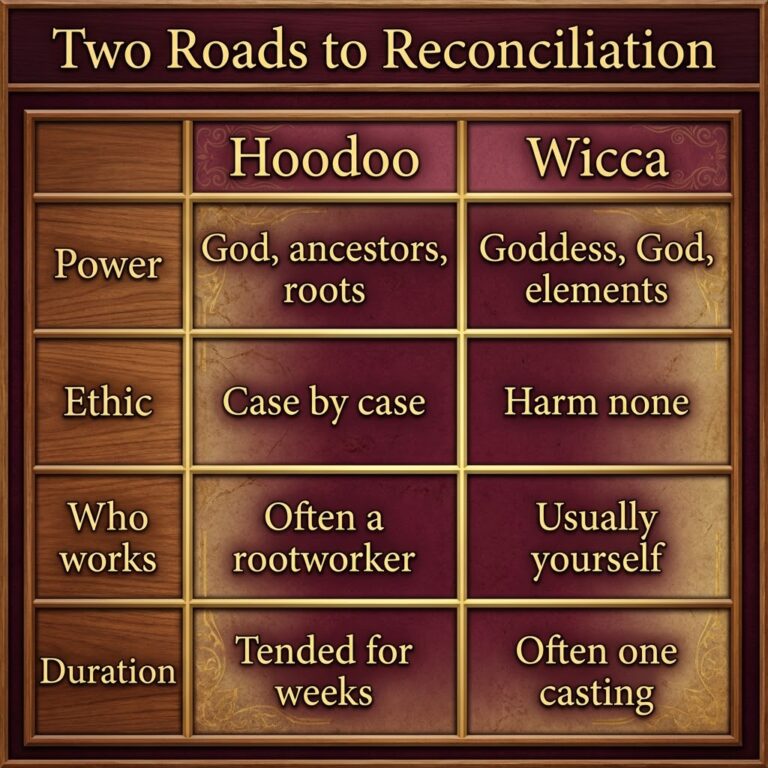
| Hoodoo | Wicca | |
|---|---|---|
| Power | God, ancestors, roots | Goddess, God, elements |
| Ethic | Case by case | Harm none |
| Who works | Often a rootworker | Usually yourself |
| Duration | Tended for weeks | Often one casting |
The bottom row is the one people miss. A Smithsonian folklife essay on hoodoo describes a feeling that herbs and roots are alive and need tending through the day.[6] That belief explains why hoodoo reconciliation is fed and kept up over time. A honey jar gets new candles. A mojo bag gets dressed again. Wiccan spells often work the other way: you cast once, then release it and let it go.
So here is my reading of the chart. The real choice comes down to two questions. Are you comfortable naming one specific person? And are you willing to tend the work for weeks? If the answer to both is yes, hoodoo reconciliation fits. If either answer is no, a Wiccan-style spell for love in general fits better.
How a Rootworker Approaches a Request to Bring a Lover Back
Rootworkers differ, and each one learned from someone. Still, most reunion work follows a recognizable shape. Also, remember who traditionally did this work. As 64 Parishes notes, hoodoo practitioners made roots for individual clients.[4] Many people now do hoodoo reconciliation for themselves, but the steps below come from that client tradition.
1. Read the situation first. Many rootworkers do a card reading or other divination before any work. The question is simple: is a lover’s return even possible, and is it wise? If the person left because of fear or abuse, the honest answer is no.
2. Write the names. A name paper, sometimes called a petition paper, carries both names. Practitioners often write one name, turn the paper, and write the other across it, so the names cross and touch. That crossing stands for two lives that have drifted apart being laid back over each other.
3. Sweeten the situation. This is where the honey jar comes in. Its job is to soften the other person’s feelings toward you, not to force anything. For the details, read these honey jar mistakes to avoid.
4. Dress and burn candles over days. A rootworker rubs a candle with oil and burns it on or beside the jar, often across several days. Each candle is one round of feeding the work. Because the roots are treated as alive, letting the work go cold is seen as a real mistake.
5. Act in the world. Hoodoo is practical. Rootworkers expect the client to send one honest message or make one real repair. If you prefer a simpler ritual you can do yourself, see this reconciliation candle and photo ritual.
Belief, Intention & The Power of Magic
Witchcraft, spells, and manifestation are deeply rooted in belief, intention, and spiritual practice. If these practices do not resonate with you, this may not be the path for you, and that’s perfectly okay. But if you believe in divine powers, trust your intentions, and feel drawn to the mysteries of the unseen, we invite you to continue exploring with Madame Celestine and discover the magic that speaks to your soul.
When Hoodoo Reconciliation Stalls or Backfires
The most common complaint goes like this: the honey jar has been running for weeks, and the other person’s mind is still made up. In rootwork terms, sweetening softens a heart that is open to softening. It is not built to overturn a firm decision.
Another frequent worry is a sudden, strong urge to text the ex right after the work. Practitioners usually read that as your own feelings stirred up by the ritual, not as a sign to send ten messages. One honest message is the hoodoo way. A flood of them usually pushes the person further off.
A third trap is mixing frameworks halfway through. For instance, some people start a honey jar and then add a “harm none, if it’s meant to be” clause out of guilt. Then the jar says one thing and the words say another. Practitioners generally advise choosing one road per working and staying on it. Also, keep your expectations honest. For a clear look at why some people return and others don’t, read why some exes come back.
Sometimes the better answer is to let go. If you’re unsure which road you’re on, this guide to choosing reconciliation or release walks through the signs.
Finally, respect where the tradition comes from. The National Park Service notes that hoodoo was taken up by people outside the African American community and used to profit from it.[1] If you work in this tradition, learn its history and credit the people who built it.
Frequently Asked Questions
What is hoodoo reconciliation work?
It is rootwork aimed at softening a rift and reopening the way back to a partner. It usually combines a name paper, a honey jar and candles tended over several days, plus one real step toward repair.
Is hoodoo reconciliation different from a Wiccan love spell?
Yes. Hoodoo commonly names a specific person and tends the work over weeks, while many Wiccans avoid naming anyone because of the “harm none” principle.
Can I use love spells to bring back a lover who left because of abuse?
No. Reunion work is the wrong tool when someone left out of fear. In that case, the healthier work is protection and release.
How long does hoodoo reconciliation take?
There is no set timeline, and no practitioner can promise a lover’s return. Most rootworkers tend the work for several weeks and watch for small shifts in tone or contact.
Can anyone practice hoodoo?
Views differ. Hoodoo comes from African American history, so many practitioners ask newcomers to learn that history first and to learn from teachers within the tradition.
References
- Hoodoo in St. Louis: An African American Religious Tradition. U.S. National Park Service, last updated November 23, 2021. https://www.nps.gov/articles/000/hoodoo-in-st-louis-an-african-american-religious-tradition.htm
- Video: Black Magic Matters: Hoodoo as Ancestral Religion (Yvonne Chireau). Center for the Study of World Religions, Harvard Divinity School, November 10, 2021. https://cswr.hds.harvard.edu/news/magic-matters/2021/11/10
- Hunting Hoodoo and Telling Lies. Sondra Bickham Washington. Beyond NOLA: Exploring Zora Neale Hurston in Bogalusa, University of Illinois (Publishing Without Walls). https://iopn.library.illinois.edu/scalar/beyondnola/hunting-hoodoo-telling-lies
- Voudou. Carolyn Morrow Long. 64 Parishes, October 31, 2016. https://64parishes.org/entry/voudou
- Is it ever ethical to cast a love spell? Witches weigh in. Isabella Greenwood. Dazed, February 14, 2023. https://dazeddigital.com/beauty/article/58140/1/is-it-ethical-to-cast-a-love-spell-witches-weigh-in
- Ginseng, Hoodoo, and the Magic of Upholding African American Earth-Based Traditions. Asia Smith. Smithsonian Center for Folklife and Cultural Heritage, February 24, 2021. https://www.si.edu/object/ginseng-hoodoo-and-magic-upholding-african-american-earth-based-traditions:posts_3967a1cda5b71d041942b9487a92017a
Not sure where to start? You don’t have to do this alone.
Madame Celestine offers guided spellwork for beginners — real support for your first working, not just another guide to read.
Related reading: Love Runes in Witchcraft: Meanings, Bind Runes and Breakups · Reconciliation Spell: A Candle and Photo Ritual

About Madame Celestine
Madame Celestine has practiced and taught spellwork, divination, and seasonal ritual for over two decades, helping newcomers build a grounded, confident practice from their very first spell.