
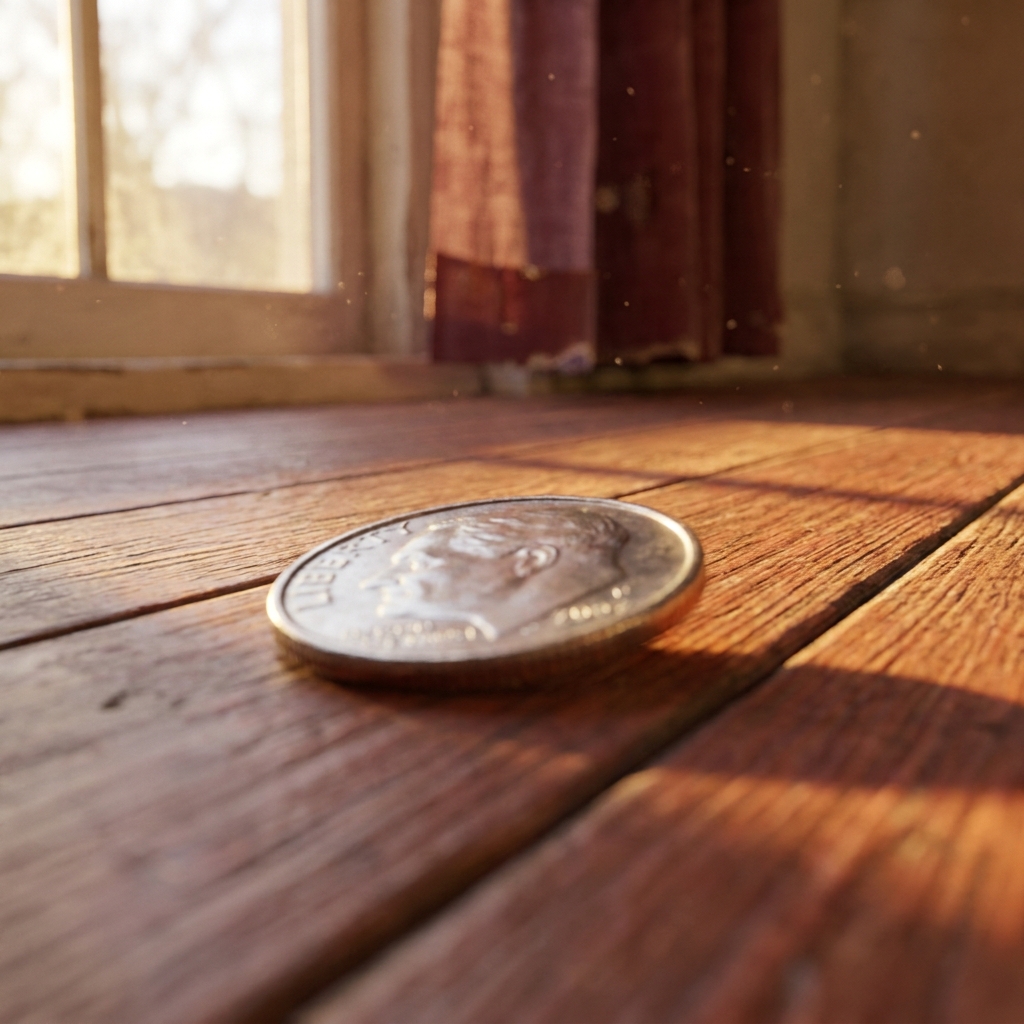
Finding a dime on the ground can stop you in your tracks, especially when it turns up at a strange moment or in a place you just cleaned. So what does it mean when you find a dime, and why do so many people call them “dimes from heaven”? In New Orleans, I’ve always believed the smallest things can carry the deepest spiritual meaning, even something as simple as a dime. In this article, I’ll walk you through the spiritual meaning of finding dimes and the history stamped on the coin itself. I’ll also cover the old Southern folk beliefs about silver dimes and how to read the moment when one finds you.
- Finding a Dime: What It Means Spiritually
- Finding a Dime and the Spiritual Meaning of Ten
- The Symbols Stamped on Every Dime
- Silver Dimes in Southern Folk Magic
- Dimes From Heaven and Signs From Loved Ones
- Reading the Moment: What Finding a Dime Might Mean
- Why Do I Keep Finding Dimes Everywhere?
- What to Do After Finding a Dime
- Heads, Tails and Other Dime Superstitions
- Frequently Asked Questions
- References
Finding a Dime: What It Means Spiritually
In spiritual traditions, finding a dime is often seen as a little message from the universe. People read it as a sign of protection, of reassurance, or of a loved one reminding you they’re near. That last reading is the one most people mean when they say “dimes from heaven.” The idea is that someone who has passed chose the smallest, most ordinary object possible to say, “I’m still here.”
Most of the meanings people attach to dimes fall into a few groups. Some see a dime as a sign of good fortune on its way. Others see it as a nudge to trust their instincts, much like other signs from your spirit guides. And many, especially after a death, see it as contact from someone they’ve lost.
But here’s what I always tell people: pay attention to what you were thinking or feeling when you found it. The moment may hold more personal meaning than the coin itself. Because of that, the same dime can mean comfort to one person and courage to another.

Finding a Dime and the Spiritual Meaning of Ten
The dime is, quite literally, a tenth. Its name comes from the Old French disme, from the Latin decima, meaning “tenth part.” In fact, when Congress created the coin in the Coinage Act of 1792, the law spelled it “disme.”[1] So every dime carries the number ten in its name.
That matters when you think about finding a dime spiritually. In numerology, the number 10 symbolizes completion and new beginnings. It closes one cycle of single digits and opens the next. As a result, finding a dime when life feels uncertain can be a beautiful reminder to keep moving forward.
The reverence for ten is far older than any coin. The ancient Pythagoreans drew a sacred triangle called the tetractys: ten points set in four rows of one, two, three and four. Because 1 + 2 + 3 + 4 equals 10, they treated ten as a higher unity and called it the “holy ten.” They even swore their oath on this figure.[2] So when people ask what finding 4 dimes means, this old figure offers a lovely answer. Four rows build the sacred ten, just as small, steady steps build something whole.
The Symbols Stamped on Every Dime
Before you read a dime’s message, it helps to look at the coin itself. Its designs carry meanings most people walk right past.
The “Mercury” Dime That Isn’t Mercury
From 1916 to 1945, the United States minted a dime designed by sculptor Adolph Weinman. Collectors call it the Mercury dime, but the figure is not the Roman god at all. Instead, it shows a young Liberty wearing a winged cap, and Weinman said the wings stood for “liberty of thought.” On the back, a bundle of rods called a fasces stood for unity and strength, wrapped by an olive branch for peace. The coin was also 90% silver.[3] If you ever find one of these old silver dimes, you’re holding a small emblem of free thought, unity and peace.
Roosevelt and the March of Dimes
The dime in your pocket today carries Franklin D. Roosevelt. He was chosen partly for his role in founding the National Foundation for Infantile Paralysis, later renamed the March of Dimes, which raised money for polio research.[1] In other words, the modern dime honors a charity whose very name asked people to give dimes to help heal others. For a coin many people read as a sign of comfort, that history feels fitting.
From Silver to Clad
Then, in 1965, the Coinage Act removed silver from the dime. Dimes made before that year were 90% silver.[1] That change matters for the folk beliefs below, because most of them concern silver.
Silver Dimes in Southern Folk Magic
Long before anyone spoke of dimes from heaven, people in the American South carried dimes for protection and luck. Writing in the numismatic newsletter The E-Sylum, Carol Bastable noted that the dime was considered an emblem of good fortune. In the early 1900s, postcards even carried holed dimes printed with the words “Emblem of Good Fortune.” The dime was also the coin most often engraved as a love token.[4]
Archaeology shows how serious this belief could be. In burials at Freedman’s Town in Dallas, used from 1869 to 1907, researchers found pierced coins lying at the neck or ankle of the dead. Archaeologist James Davidson, drawing on folklorist Newbell Niles Puckett’s 1926 study of Southern folk belief, explained that such coins were worn to ward off illness and witchcraft.[4]
The practice lasted well into the twentieth century. Photographer Dorothea Lange described a Mississippi sharecropper in the 1930s who wore holed dimes around her ankles to prevent headaches. Whitman Publishing later included that story in its guide Search & Save: Old U.S. Dimes and Quarters.[5]
So when someone in the South says finding a dime is lucky, they are drawing on a long line of people who wore silver against harm. A found dime, in that light, can read as a small piece of protection placed in your path.

Dimes From Heaven and Signs From Loved Ones
The most common reason people search for the meaning of finding a dime is grief. Someone dies, and soon afterward, dimes start turning up: in a coat pocket, beside the bed, on a freshly mopped floor. Many people find them in small piles or in places they’re sure were empty an hour before. Often, the year on the coin matches a birthday, an anniversary or the year someone died.
These stories fit a larger pattern that researchers have studied. In their book Hello from Heaven!, Bill and Judy Guggenheim spent seven years interviewing 2,000 people and collected more than 3,300 firsthand accounts of what they call after-death communication. From that research, they described twelve major types of contact people report.[6] Finding a dime is one of the simplest forms these signs can take, and one of the easiest to keep.
If you’ve felt a loved one close in other ways too, you may find comfort in this story about feeling guided by a grandmother long after she passed.
Reading the Moment: What Finding a Dime Might Mean
Because a dime gathers so many meanings, the question is never just “what does finding a dime mean?” Instead, it’s “what did this dime mean right then?” The guide below pulls together the traditions above into a simple way to read it.
| When you found it | Tradition behind it | Question to ask |
|---|---|---|
| Soon after a loss | Signs from loved ones | Who was on my mind? |
| During money worries | Emblem of good fortune | What small step can I take? |
| At an ending or crossroads | Ten as completion | What is finishing, and what begins? |
| When you feel unsafe or unwell | Silver worn for protection | What needs guarding? |
| Several dimes together | Four rows make the holy ten | What am I building step by step? |
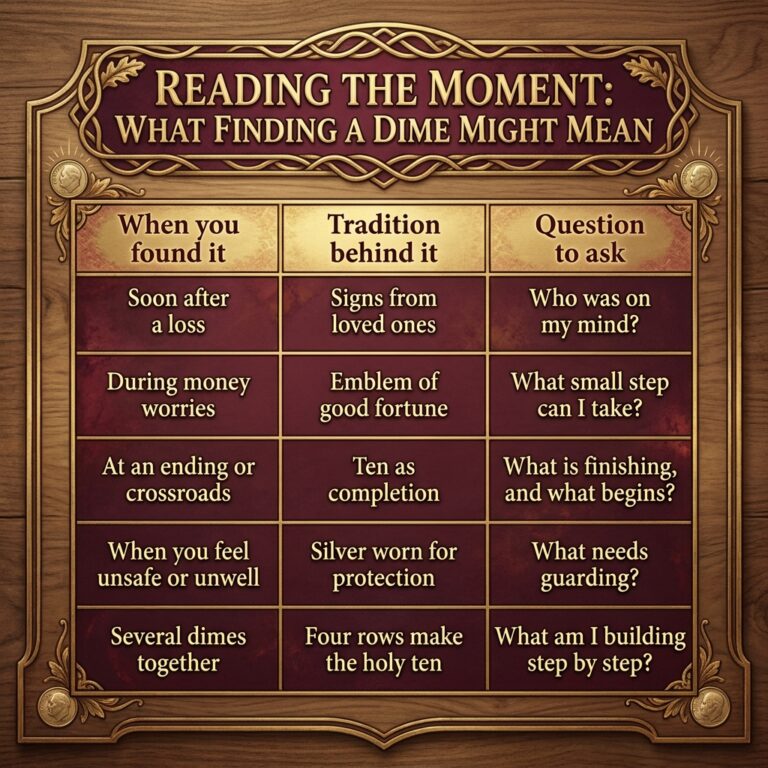
Put side by side, these traditions point to one idea. Each culture attached the dime to whatever its people needed most at the time. Southern families needed protection from illness, so they wore silver.[4] Grieving people needed proof of love, so they read dimes as visits. The Pythagoreans needed order, so ten became holy.[2] My reading is that the meaning of a dime has always followed the need of the person holding it. That’s why your own feelings in that moment are the best key you have.
Why Do I Keep Finding Dimes Everywhere?
Finding a dime once can feel like chance. When dimes keep appearing, though, people tend to feel the message is getting louder. Many practitioners believe repetition means a sign wants your attention, especially if the dimes keep turning up in the same room or at the same time of day. So if you keep finding dimes, it may be worth slowing down and asking what you’ve been avoiding thinking about.
At the same time, not every dime is a spiritual sign. Dimes are small, common and easy to drop. Also, once something matters to you, you naturally notice it more often. None of that makes the comfort less real. Sometimes an ordinary discovery brings exactly the comfort we need, whatever brought it there.
Seasons matter too. Many people notice dimes more in late autumn, when memories of the dead feel closer. If that’s when they find you, this piece on what it means when the veil is thin may speak to what you’re feeling.
What to Do After Finding a Dime
There’s no rule you must follow. Still, a few simple steps can help you honor the moment.
Pause and Notice
First, stop for a breath before you pick it up. Ask yourself what you were thinking about, who was on your mind, and how you felt. This is the heart of reading a dime, so don’t rush it.
Check the Year
Next, look at the date. Many people find years that match a birthday, an anniversary or a year that changed their life. If the year means nothing, that’s fine too. The moment still counts.
Say Thank You
Then, say a quiet thank you, out loud or in your head. Whether you believe it came from a loved one, your guides or plain good luck, gratitude closes the moment kindly.
Keep It Somewhere Meaningful
Finally, decide where the dime belongs. Some people keep it in a wallet for luck. Others place it on a shelf beside a photo or on an ancestor altar for honoring loved ones. A small jar of found dimes can become a quiet record of every time you felt someone near.
Belief, Intention & The Power of Magic
Witchcraft, spells, and manifestation are deeply rooted in belief, intention, and spiritual practice. If these practices do not resonate with you, this may not be the path for you, and that’s perfectly okay. But if you believe in divine powers, trust your intentions, and feel drawn to the mysteries of the unseen, we invite you to continue exploring with Madame Celestine and discover the magic that speaks to your soul.
Heads, Tails and Other Dime Superstitions
Finding a dime also comes with its own coin superstitions. These beliefs travel together, and many penny beliefs have rubbed off on dimes. The best known is that a coin found heads-up brings good luck, while one found tails-up should be left where it lies or flipped over for the next person. So a dime on tails isn’t bad luck in most traditions. Instead, many see it as luck meant for someone else, and they turn it heads-up as a small kindness.
The dime also lives in everyday speech. “If I had a dime for every time” is how people talk about something that keeps happening. Meanwhile, “Brother, Can You Spare a Dime?” became one of the best-known songs of the Great Depression, when a single dime could matter a great deal. In both cases, the dime stands for something small that adds up. That idea sits close to its spiritual meaning too.
Frequently Asked Questions
Does the year matter when finding a dime?
Many people believe it can. If the year matches a birthday, an anniversary or the year a loved one died, they read it as a personal message rather than chance.
What does finding 4 dimes mean?
Many practitioners link four dimes to building something step by step. The old Pythagorean figure of ten points in four rows gives this reading a long history.
Is finding a dime on tails bad luck?
In most coin superstitions, no. A tails-up coin is often seen as luck meant for someone else, so many people flip it heads-up and leave it for the next finder.
What is the difference between finding a penny and finding a dime?
Both are read as signs from loved ones. Dimes add the meaning of the number ten, which numerology ties to completion and new beginnings.
Do dimes from heaven only come from loved ones who have died?
Not always. Some people read them as signs from spirit guides or as simple reassurance from the universe, especially during hard times.
Should I keep a dime I find?
That’s up to you. Many people keep it in a wallet, a jar or on an altar as a reminder of the moment it appeared.
References
- Dime (United States coin). Wikipedia. https://en.wikipedia.org/wiki/Dime_(United_States_coin)
- Tetractys. Wikipedia. https://en.wikipedia.org/wiki/Tetractys
- Mercury dime. Wikipedia. https://en.wikipedia.org/wiki/Mercury_dime
- “More on Holed Coins as Slave Charms.” The E-Sylum, Volume 21, Number 21, May 27, 2018. Numismatic Bibliomania Society. https://www.coinbooks.org/v21/esylum_v21n21a14.html
- “Superstitions About Money.” The E-Sylum, Volume 21, Number 22, June 3, 2018. Numismatic Bibliomania Society. https://coinbooks.org/v21/esylum_v21n22a19.html
- Bill Guggenheim and Judy Guggenheim, Hello from Heaven! Book description. Tantor Media. https://tantor.com/hello-from-heaven-bill-guggenheim-judy-guggenheim.html
Not sure where to start? You don’t have to do this alone.
Madame Celestine offers guided spellwork for beginners — real support for your first working, not just another guide to read.
Related reading: The Veil Is Thin: What It Means Spiritually · Lilith: Symbols, Offerings and Her Place in Modern Witchcraft

About Madame Celestine
Madame Celestine has practiced and taught spellwork, divination, and seasonal ritual for over two decades, helping newcomers build a grounded, confident practice from their very first spell.