
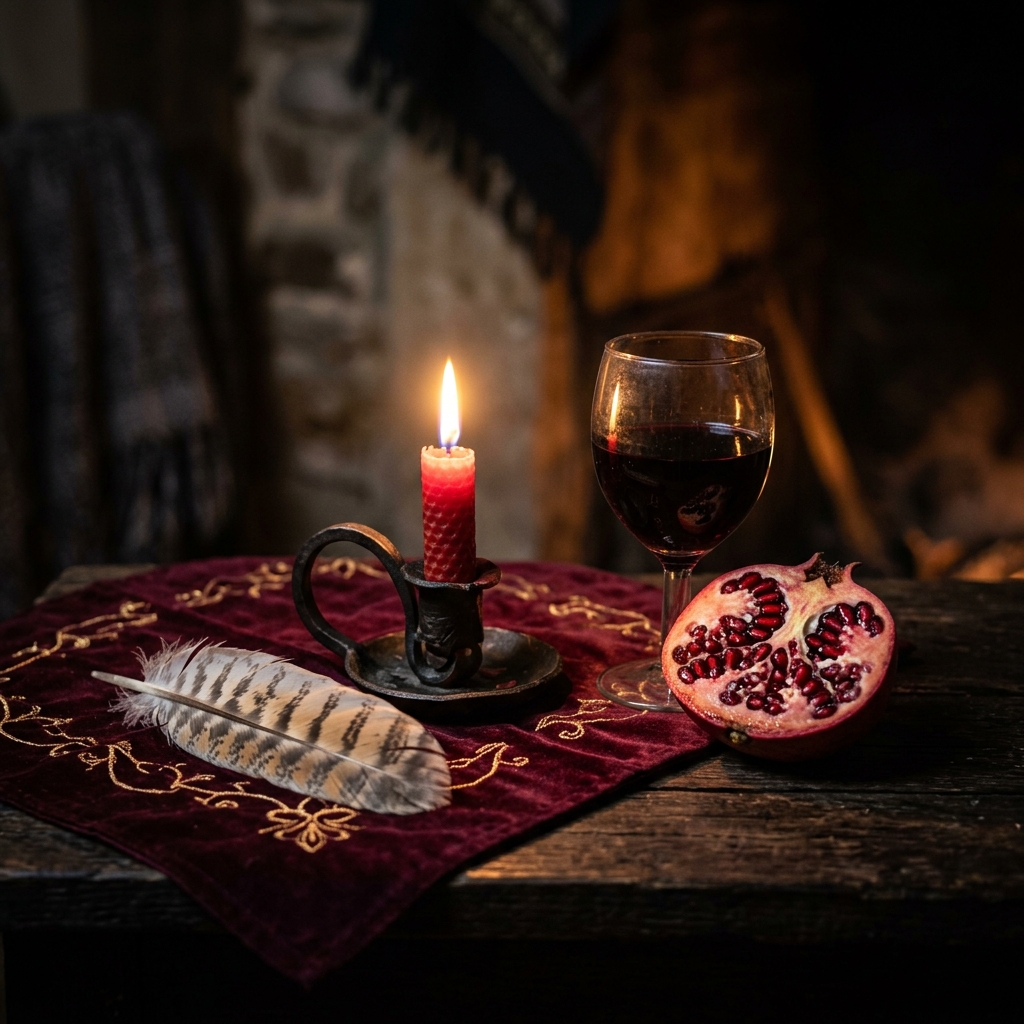
Lilith symbolism is everywhere in modern witchcraft, from owl tattoos to crescent-moon altars. Yet most people who light a candle for her have never seen the texts those images come from. So what does Lilith actually represent, and where did her symbols begin? This guide traces her from Mesopotamian night spirits to Jewish folklore and Kabbalah, then to the way modern witches honor her. It also covers common offerings, a simple invocation, and why many of her best-known symbols were first meant to keep her away.
- What Does Lilith Represent? The Roots of Lilith Symbolism
- The Owl, the Wings and the Night: Core Lilith Symbolism
- Amulets Made to Keep Lilith Away
- How Lilith Symbolism Flipped: From Warning to Emblem
- Lilith in Kabbalah: The Consort of Samael
- Lilith in Witchcraft and Wicca Today
- Offerings for Lilith and a Simple Invocation
- Signs of Lilith: Reading Lilith Symbolism in Daily Life
- Frequently Asked Questions
- References
What Does Lilith Represent? The Roots of Lilith Symbolism
Lilith did not start out as a goddess. Her name and character are thought to come from a class of Mesopotamian demons called lilû, with the female form lilītu. The term is usually understood as “night monster.”[1] In other words, the oldest layer of Lilith symbolism is about darkness and danger.
Her best-known story came much later. The Alphabet of Ben Sira is a Hebrew text dated to the eighth century CE. In it, Lilith is Adam’s first wife, and she claims equality with him. Her argument is simple: both of them were made from the earth. When Adam refuses, she speaks God’s name and flies away.[2]
That single scene explains most of her modern meaning. So when people ask what Lilith is the goddess of, today’s answer is usually independence, refusal and self-ownership. However, it helps to know that this reading is recent. For most of her history, Lilith was feared rather than honored.
The Owl, the Wings and the Night: Core Lilith Symbolism
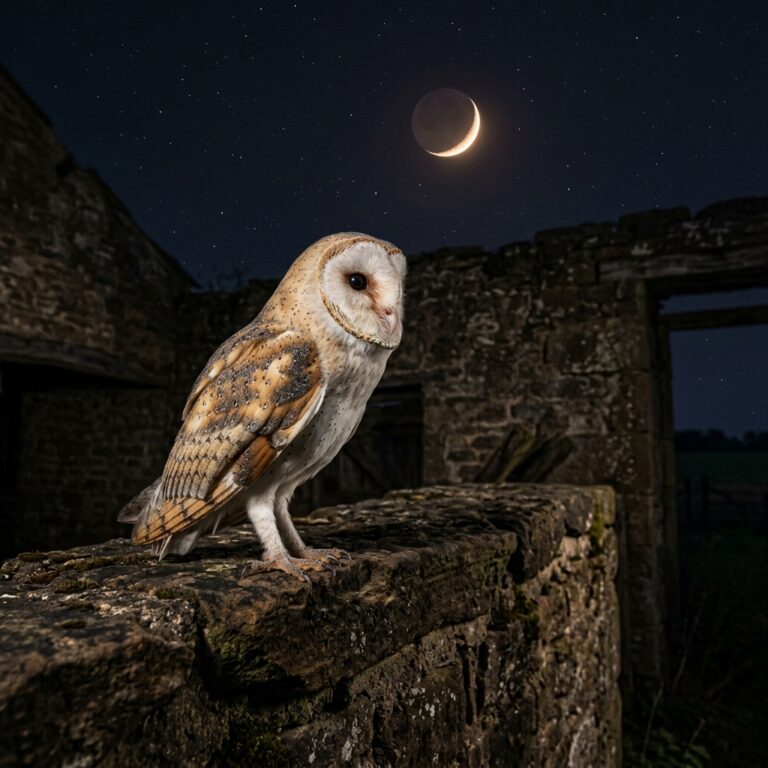
The owl may be the most familiar Lilith symbol, and it entered English through a translation choice. Isaiah 34:14 names “the lilith” among the creatures that haunt a ruined land. The King James Bible rendered the word as “the screech owl.” This was probably a nod to the demon’s flights through the night in search of prey.[3]
An older image adds to the picture. The British Museum holds a fired clay plaque from Mesopotamia, made around the 19th or 18th century BCE. It is often called the Queen of the Night or the Burney Relief. It shows a nude female figure with feathered wings and taloned feet, standing between two owls.[4] Some scholars have suggested she is Lilith. Others prefer Ishtar or Ereshkigal, and the question is still open.[4]
Wings also appear in the Talmud. One passage describes a miscarried fetus shaped like a lilith, with wings. Another warns that a man should not sleep alone in a house, because a lilith might seize him.[2] Night, wings and solitude therefore sit at the center of Lilith symbolism, long before any modern altar.
Amulets Made to Keep Lilith Away
Ben Sira’s story does not end with Lilith’s escape. Three angels go after her, named Senoy, Sansenoy and Semangelof. They fail to bring her back. Instead, they extract a vow that she will not harm the children of Adam and his second wife, Eve.[5]
That vow shaped centuries of Jewish folk practice. Families wrote the three angels’ names, and sometimes drew their images, on amulets for new mothers and babies. According to the National Library of Israel, some women still use these charms after childbirth.[5] The idea of an amulet working through written names is still common in magic today, as this guide to how a protection talisman works explains.
Protective objects against Lilith are older than Ben Sira, too. A limestone plaque found at Arslan Tash in Syria, from the seventh or eighth century BCE, served as an amulet. One translation of its text orders Lilith to be off “this instant, this instant.”[3]
How Lilith Symbolism Flipped: From Warning to Emblem
Put side by side, these sources point to a pattern. Almost every symbol modern witches use for Lilith first appeared in a text or object meant to drive her off. The owl comes from a verse about ruin. The wings come from warnings about birth and sleep. Even the three angels’ names were written to stop her, not to call her.
Modern practice keeps the imagery but reverses its purpose. As a result, an owl on a Lilith altar is a quiet act of reclaiming. It takes a sign of fear and treats it as a sign of freedom. Understanding Lilith symbolism this way lets a practitioner choose symbols with open eyes, instead of treating them as ancient devotional emblems.
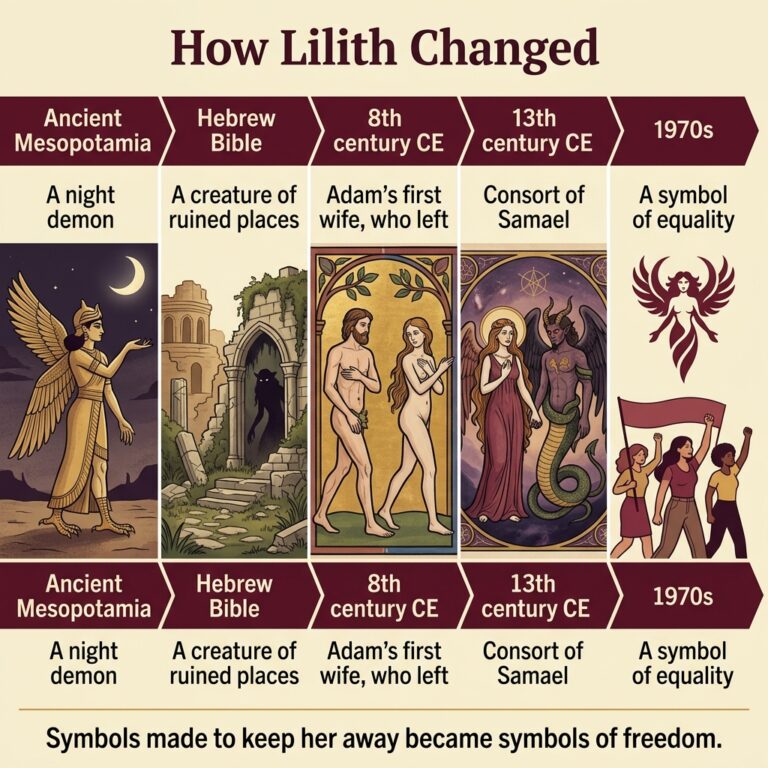
| Era | Source | How Lilith appears |
|---|---|---|
| Ancient Mesopotamia | Lilītu spirits | A night demon |
| Hebrew Bible | Isaiah 34:14 | A creature of ruined places |
| 8th century CE | Alphabet of Ben Sira | Adam’s first wife, who left |
| 13th century CE | Kabbalah and the Zohar | Consort of Samael |
| 1970s | Jewish feminist writing | A symbol of equality |
Lilith in Kabbalah: The Consort of Samael
Kabbalah gave Lilith a much larger role. In the 13th-century “Treatise on the Left Emanation,” she becomes the female partner of Samael. She then appears often in the Zohar, the central text of Kabbalah, as a seductive demonic force.[2] Britannica also notes traditions in which Samael fathers her demonic offspring. Some of these stories cast her children as incubi and succubi.[1]
The word “left” in that title points to the shadow side of Kabbalistic thought. Readers who want the wider picture can explore the Qliphoth, Kabbalah’s shadow side.
Within Jewish mysticism she was never a goddess to approach. Instead, she was a force to understand and guard against. Respectful practice keeps that history in view.
Lilith in Witchcraft and Wicca Today
The modern Lilith took shape in the 1970s. Judith Plaskow’s story “The Coming of Lilith,” published in 1974, reshaped her image for feminist readers. Then, in the fall of 1976, a Jewish feminist magazine launched under her name to honor her fight for equality.[2]
Pagan and witchcraft communities picked up this reading. Today many practitioners treat Lilith as a pagan goddess of autonomy, boundaries and the parts of the self that refuse to be tamed. Wicca has no fixed place for her, so her role differs from one tradition or coven to the next. Some witches work with her only through symbols. Others build a full altar, and some use a sigil, as described in this guide to working with a Lilith sigil.
Her name also lives on in astrology. Black Moon Lilith is the point in the Moon’s orbit farthest from Earth, and astrologers read it as a marker of the untamed self. That modern use adds one more layer to Lilith symbolism, even though it has no link to the old texts.
She is often grouped with other dark or night figures, too. This overview of other goddesses of darkness shows where she fits among them.
Offerings for Lilith and a Simple Invocation
No ancient text lists offerings for Lilith, since she was warded off rather than worshipped. So every offering in use today is a modern choice. Practitioners tend to pick items that echo her symbols: night, independence and the untamed.
Common offerings to Lilith include red wine, pomegranates, dark chocolate and apples. Many witches burn myrrh or dragon’s blood resin. Black and red candles are the usual choices. Herb offerings for Lilith often include mugwort and dried rose petals, and some witches seal these herbs into a small Lilith spell jar. For crystals, practitioners often name obsidian, garnet and moonstone, because they link these stones with shadow, passion and the moon.
A simple ritual follows a clear order:
- Prepare the space at night. Many practitioners choose the dark moon, because Lilith is tied to the night.
- Set out one symbol and one offering. An owl image and a glass of red wine are enough. Keeping it small helps the focus stay on intention.
- Light a black or red candle. Then sit quietly for a minute before speaking.
- Speak a short invocation. For example: “Lilith, first to say no, I honor your freedom. Help me guard my own.” Practitioners usually keep the words personal and brief.
- Close the ritual. Thank her, put out the candle, and pour the offering onto the earth the next day.
Belief, Intention & The Power of Magic
Witchcraft, spells, and manifestation are deeply rooted in belief, intention, and spiritual practice. If these practices do not resonate with you, this may not be the path for you, and that’s perfectly okay. But if you believe in divine powers, trust your intentions, and feel drawn to the mysteries of the unseen, we invite you to continue exploring with Madame Celestine and discover the magic that speaks to your soul.
Signs of Lilith: Reading Lilith Symbolism in Daily Life
Practitioners who work with Lilith often talk about signs that she is near. These are matters of personal belief. Still, the signs they describe tend to follow her old symbols closely.
The most common is the owl, whether seen, heard at night or met again and again in images. Some people also mention vivid dreams, waking often in the small hours, or a sudden urge to set a boundary they have avoided. Each one reflects part of the story: the night, the owl, and the woman who refused. In that sense, these signs are Lilith symbolism read in everyday life.
Experienced practitioners usually advise caution here. A single owl is just an owl. A pattern that repeats while someone is already reflecting on Lilith is what they take seriously. Even then, the useful question is what the sign asks of the person, not what it predicts.
Frequently Asked Questions
Is Lilith a goddess?
Not in her original sources, where she is a night demon. Many modern witches and pagans now honor her as a goddess, mainly of independence and personal boundaries.
What is Lilith the goddess of?
In modern practice, Lilith is linked with autonomy, refusal, the night and the untamed parts of the self. These meanings grew mostly from her story as Adam’s first wife.
What does Lilith symbolism mean in witchcraft?
Her main symbols are the owl, wings, the night and the dark moon. Modern witches use them as signs of freedom, even though many first appeared in texts meant to keep her away.
What offerings does Lilith like?
No ancient source lists any, so offerings are a modern choice. Practitioners commonly give red wine, pomegranates, dark chocolate, apples and myrrh, with black or red candles.
Is Lilith part of Wicca?
Lilith has no fixed role in Wicca. Some Wiccans and other pagans work with her personally, while many traditions leave her out entirely.
References
- Lilith: Definition & Mythology. Britannica Editors. Encyclopaedia Britannica. https://www.britannica.com/topic/Lilith-Jewish-folklore
- Rebecca Lesses, “Lilith.” Shalvi/Hyman Encyclopedia of Jewish Women. Jewish Women’s Archive. https://jwa.org/encyclopedia/article/lilith
- Janet Howe Gaines, “Lilith.” Bible History Daily. Biblical Archaeology Society. https://www.biblicalarchaeology.org/daily/people-cultures-in-the-bible/people-in-the-bible/lilith/
- The Queen of the Night (Burney Relief). The British Museum Collection. https://www.britishmuseum.org/collection/object/W_2003-0718-1
- Chen Malul, “Who Are You, Senoy, Sansenoy and Semangelof?” (February 12, 2020). The National Library of Israel. https://blog.nli.org.il/en/djm_sen-san-sem/
Not sure where to start? You don’t have to do this alone.
Madame Celestine offers guided spellwork for beginners — real support for your first working, not just another guide to read.
Related reading: Wolf Goddesses and Gods: What the Wolf Teaches in Myth · Bee Goddesses and Gods: The Sacred Bee in Mythology

About Yitzchak Meir
Yitzchak Meir is the pen name our editorial team uses for articles on Kabbalah and Jewish mystical traditions. Articles under this byline are researched from published sources and reviewed by Madame Celestine before publishing.