
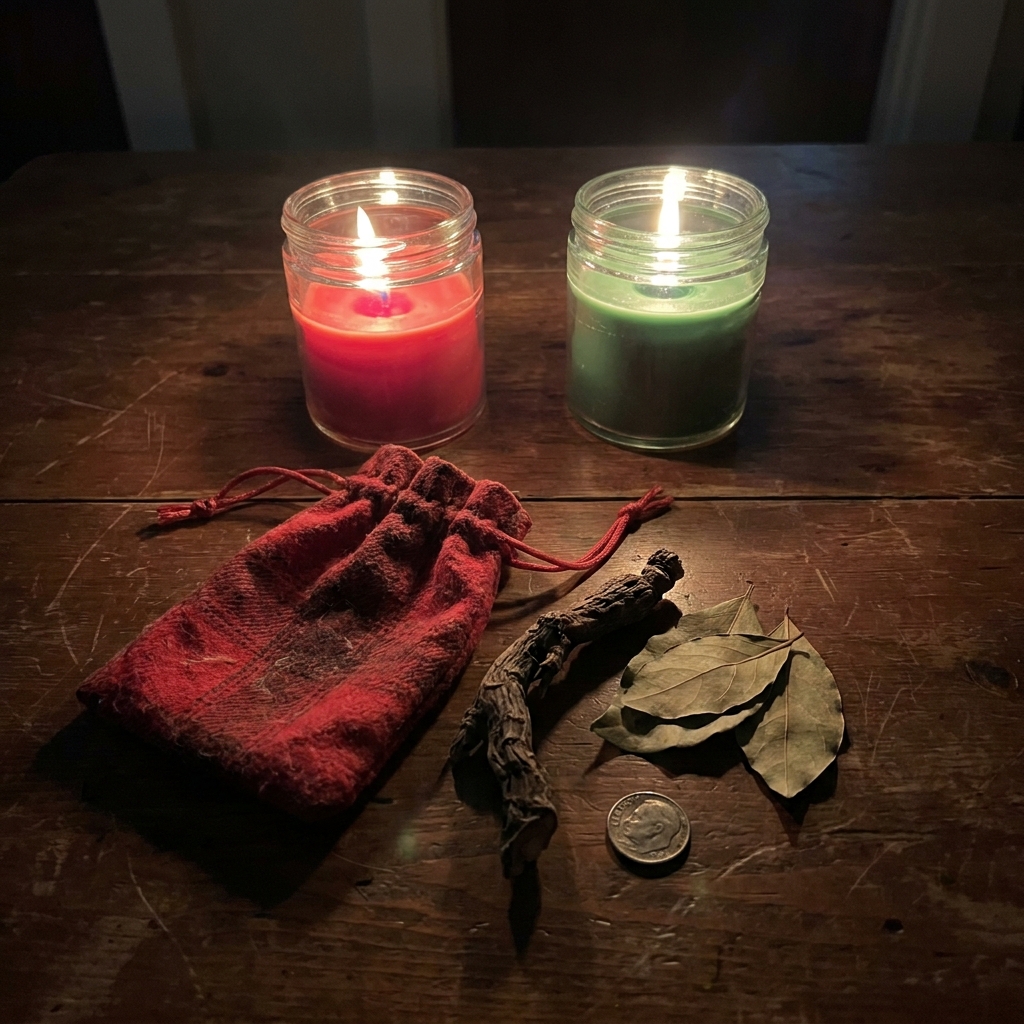
Hoodoo spells for love and money are some of the most practical charms in American folk magic. They use bay leaves, red flannel, roots and coins, and most of them fit in a pocket or a purse. But where did these recipes come from, and what does it actually mean to “put roots on someone”? This guide answers both. First, you’ll see what hoodoo is and how it differs from Voodoo. Next comes the paper trail of interviews and books that preserved the old recipes. Then you’ll find traditional rootwork recipes for love and for money, a step-by-step money bag and the mistakes that weaken the work.
- What Hoodoo Really Is, and Why It Isn’t Voodoo
- 13,458 Entries From One Minister: How Hoodoo Spells Were Saved
- Putting Roots on Someone: What the Old Phrase Really Means
- Hoodoo Love Spells: Three Rootwork Recipes
- Hoodoo Money Spells: Recipes for Prosperity and Wealth
- How to Make a Hoodoo Money Mojo Bag, Step by Step
- Why Hoodoo Spells Live in Your Pocket: The Carry-and-Feed Pattern
- From the Congo River to a Southern Pocket: Where Hoodoo Spells Got Their Bags
- When to Work Hoodoo Spells for Love and Money
- Five Mistakes That Weaken Hoodoo Spells
- Why People Still Go to a Root Doctor
- Frequently Asked Questions
- References
What Hoodoo Really Is, and Why It Isn’t Voodoo
Hoodoo is a set of spiritual traditions and magical practices developed by enslaved African Americans in the Southern United States. It draws on several African spiritualities, along with Indigenous North American plant knowledge. Honoring the dead, seeking justice and working with roots sit at its heart.[1]
It also goes by other names. “Rootwork” and “conjure” are regional words for the same practice, and its workers are called root doctors, conjure doctors, or conjure men and women.[1] Interestingly, Black communities also called the scientist George Washington Carver a root doctor because of his deep knowledge of plants.[1]
The word itself is a puzzle. It first appears in English in 1870, and nobody knows its exact origin. One theory says it’s an altered form of “Voodoo,” a word from the Gbe languages of West Africa meaning divinity. Another links it to an Ewe word, hudu, meaning “spirit work.”[1] Either way, hoodoo spells are not the same as Voodoo religion. Hoodoo is a system of folk magic, usually worked by individuals, while Voodoo and Vodou are religions. The site’s guide to hoodoo reconciliation work covers that difference in more detail.
13,458 Entries From One Minister: How Hoodoo Spells Were Saved
Much of what we know about old hoodoo spells comes from a few remarkable collectors. The biggest was Harry Middleton Hyatt, an Episcopal minister and folklorist. In 1936, he began traveling through Southern states including Alabama, Arkansas, Georgia, Louisiana, South Carolina and Tennessee. Nearly all of the people he interviewed were Black.[2]
The result was enormous. Hyatt recorded about 1,600 interviews. He then published them as five volumes, almost 5,000 pages, holding 13,458 remedies and stories, under the title Hoodoo, Conjuration, Witchcraft, Rootwork.[2] The volumes came out in 1970.[3] To this day, his collection is one of the richest records of hoodoo money spells, love spells and protection work in existence.
Zora Neale Hurston came first, though. Her 1935 book Mules and Men, with a preface by the anthropologist Franz Boas, devotes its second half to hoodoo. Its chapters include “Ritual to Get a Man,” “Routine to Keep a Husband True,” “To Make Love Stronger” and “To Rule the Man You Love.”[4] In other words, love work was at the center of the practice she recorded.
There’s a third source as well. Between 1936 and 1938, the Federal Writers’ Project gathered more than 2,000 interviews with formerly enslaved people, now held by the Library of Congress.[5] Some of those narratives describe mojo bags carried for protection.[6]

Putting Roots on Someone: What the Old Phrase Really Means
“Putting roots on someone” is one of the most searched hoodoo phrases, and it’s often misunderstood. In Southern speech, a “root” is a piece of conjure work, and being “rooted” means someone believes a root has been placed on them.[2] The phrase covers love work as well as harmful work, which is why it carries such weight.
The belief was serious enough to reach medicine. In 1994, the American Psychiatric Association listed rootwork among its culture-bound syndromes. It described rootwork as a set of cultural explanations for illness blamed on hexing, witchcraft, sorcery or the evil influence of another person. The manual placed the belief in the American South and in Caribbean societies.[2]
Hyatt’s interviews show what these roots looked like in daily life. In one account, a woman said a neighbor buried a bottle of sulfur, hair, bluestone and roots near her home. She believed it kept her from staying up past ten o’clock at night. After she destroyed it, she said, she could stay up late again.[3] Another person described carrying sulfur and fireplace ashes in a bag to guard against anyone who meant harm.[3]
So how do practitioners approach a request to put a root on a person today? Most draw a clear line. A love root, meant to draw or sweeten a willing person, is common work. A root meant to harm or control someone is a different matter, and many practitioners today turn it down. That’s partly ethics and partly experience. Harmful work tends to tie the client to the very person they want gone. If a love root is what you’re after, the site’s guide to casting a love spell on someone walks through the consent questions first.
Hoodoo Love Spells: Three Rootwork Recipes
Hoodoo love spells tend to use three tools: a carried bag, a candle and a sweetener. Here’s how each of these hoodoo spells traditionally works.
The love-drawing candle
Spiritual shops sell glass-jar candles labeled for specific jobs, and “Love Drawing” is one of the classics.[1] A practitioner writes their own name on a slip of paper, places it under the candle and dresses the top with a few drops of oil. Then they burn the candle a little each night over several days. Because it names no one else, this is the gentlest of the three hoodoo love spells.
The love hand
A “hand” is another name for a mojo bag, a small flannel charm filled with a chosen mix of ingredients. A bag made for love holds different things than one for gambling luck or protection.[6] Love hands are sometimes said to be worn right against the skin.[6] A typical modern love hand holds rose petals, a small root and a folded petition with the caster’s wish, sewn into red flannel.
The sweetening jar
The third recipe names a specific person. The caster writes both names on a slip of paper, folds it toward themselves and seals it in a jar of honey or sugar. Then they burn a small candle on the lid once a week. The aim is to sweeten someone who’s already interested, so this is the recipe practitioners treat with the most care.
Hoodoo Money Spells: Recipes for Prosperity and Wealth
Most hoodoo money spells are simple and cheap, and people carry them every day. These hoodoo spells are the classics.
A bay leaf beside a dollar
One of the simplest hoodoo money spells needs only a bay leaf. People placed one beside a dollar bill in a wallet or purse to attract money.[1] Many practitioners write their money goal on the leaf first, then fold the bill around it.
The fast luck candle
Alongside “Love Drawing,” shops sell candles labeled “Fast Luck.”[1] Practitioners burn one before a job interview, a sale or a payday they’re worried about. They often set a coin and a written goal beneath it.
The gambler’s root
High John the Conqueror root is linked to luck, strength and victory, and it’s considered especially lucky for gambling. It’s carried in mojo bags, and an amulet root should be whole and unblemished.[7] In fact, the mojo’s other name, “hand,” may come from the lucky hand root that gamblers favored.[6]
The money bowl
A bowl of rice, coins and money herbs, with a green candle in the center, is a home version of the same idea. For the herbs that suit it best, see this guide to money herbs witches use.
How to Make a Hoodoo Money Mojo Bag, Step by Step
The money mojo is the heart of hoodoo prosperity recipes. Here’s a traditional-style version, with the reason behind each step.
1. Choose the cloth
Most Southern-style mojo bags use red flannel, a color tied to protection and spiritual power. When red cloth wasn’t available, people simply used what they had.[6] Many modern practitioners pick green flannel for money, though red remains the classic.
2. Pick an odd number of ingredients
Practitioners usually choose three, five or seven items. For money, a common set is a small High John root, a bay leaf with your goal written on it and a coin. Practitioners believe odd numbers keep the work moving rather than settled.
3. Add a coin with a hole
Coins are among the most common mojo ingredients. One documented bag held a dime with a hole in it.[6] Many practitioners prefer a silver dime, and some carry a second one in a shoe.
4. Pray over it and tie it shut
The mojo is often called a “prayer in a bag.”[6] So before tying it, the practitioner holds the open bag, speaks their money goal aloud and breathes into it. Then they tie it tightly with a cord.
5. Feed it
A mojo is “fed” or “dressed” with a liquid such as alcohol, perfume or water to keep it alive and working.[6] Most practitioners feed a money mojo once a week, often on a Thursday or a Sunday.
6. Keep it close and private
Finally, carry the bag on your body or keep it hidden near where money comes in. Tradition says no one else should touch it. If someone does, many practitioners feed it again right away.
Belief, Intention & The Power of Magic
Witchcraft, spells, and manifestation are deeply rooted in belief, intention, and spiritual practice. If these practices do not resonate with you, this may not be the path for you, and that’s perfectly okay. But if you believe in divine powers, trust your intentions, and feel drawn to the mysteries of the unseen, we invite you to continue exploring with Madame Celestine and discover the magic that speaks to your soul.
Why Hoodoo Spells Live in Your Pocket: The Carry-and-Feed Pattern
Look across the love and money recipes, and one habit keeps showing up. People rarely cast hoodoo spells once and forget them. Instead, they’re carried, burned in stages or fed.
The records back this up. Mojo bags are worn on the body and fed with liquid to stay “alive.”[6] Labeled candles are burned for jobs like love drawing and fast luck.[1] Even the protective bag of sulfur and ashes in Hyatt’s interviews was something a person carried every day.[3]
Put side by side, these sources suggest a practical rule for anyone trying hoodoo spells at home. Hoodoo spells work less like a single event and more like a relationship. You carry it, you check on it and you feed it. That has a useful side effect. Because the charm is always with you, your goal stays in front of you too. So if a home spell seems to fade, the first question in this tradition is whether it’s been tended, not whether the recipe was wrong.
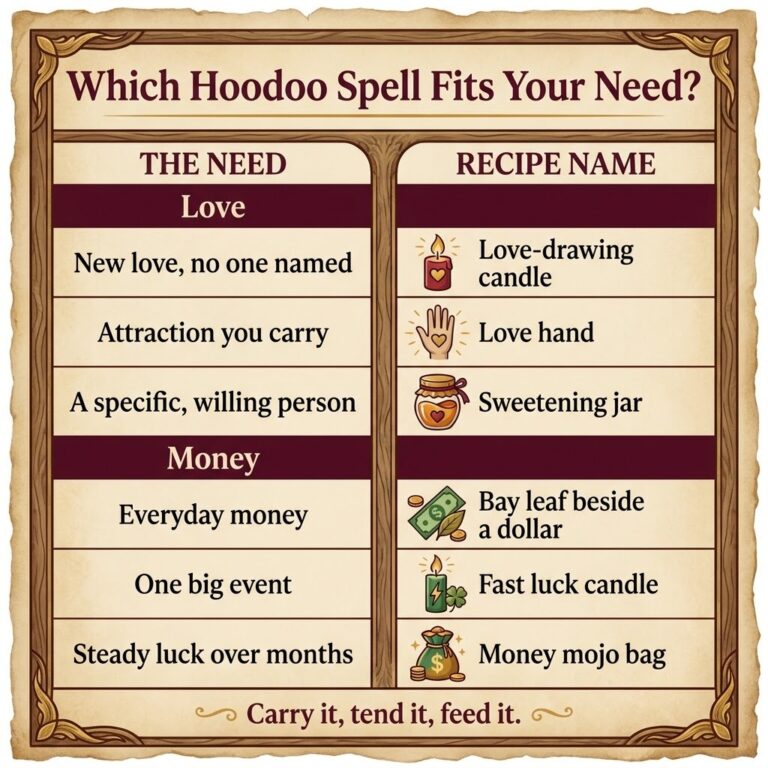
The same pattern also helps you choose a recipe. If you want quick help for one event, a candle fits. If you want steady luck over months, a mojo bag fits. And if the goal involves one specific person, the sweetening jar is the traditional tool, used with care.

From the Congo River to a Southern Pocket: Where Hoodoo Spells Got Their Bags
The mojo bag at the center of so many hoodoo spells has a long journey behind it. The word “mojo” likely comes from the Kikongo word mooyo, linked to the spirits living inside magical charms. It refers to the hollow in a nkisi, a Kongo power object, where medicines were stored.[6]
The Bakongo people of the Congo River region made medicine bags of leather or cloth, and enslaved people carried the practice to North America. West Africa had its own versions, too. Hausa speakers called such charms juju, and Mande communities called them gris-gris. Enslaved Muslims also made gris-gris for protection.[6] Archaeologists have even linked Kongo-related objects at the African Burial Ground in New York to these traditions.[6]
That history explains what goes into the bags. Ingredients can include roots, herbs, bones, graveyard dirt, coins, crystals, Bible verses and petition papers, and personal items are said to add power.[6] So when you build a money mojo or a love hand today, you’re using a design that crossed an ocean and survived centuries.
When to Work Hoodoo Spells for Love and Money
Timing in hoodoo spells is usually practical rather than astrological. Many practitioners start money work at the start of a week, on payday or on the first of the month, so the spell lines up with when money actually moves. Love work often starts on a Friday evening.
Some people also follow the moon. They begin drawing work, such as love-drawing candles and money mojos, while the moon grows. Then they save the waning moon for work that removes or ends something. Either way, consistency matters more than the date. In this tradition, a mojo fed every Thursday for months counts for more than one perfectly timed candle.
Five Mistakes That Weaken Hoodoo Spells
Treating a mojo like a souvenir
A bag left in a drawer for months, never fed, is thought to go quiet. A weekly feeding keeps it working.
Letting other people handle it
Tradition says a mojo is personal. Practitioners believe showing it off or letting friends touch it drains it.
Mixing love and money in one bag
Ingredients change with the goal, and a bag for one purpose holds different things than a bag for another.[6] One clear purpose per bag works best.
Writing a vague petition
“More money” or “love” gives the work nothing to aim at. Something specific, such as “three new clients this month,” gives it a target.
Skipping the real-world step
Root doctors have always paired the work with action. A money mojo goes with a sent invoice or a job application. A love hand goes with actually showing up.
Why People Still Go to a Root Doctor
Hoodoo has always had professionals. Conjurers made and sold mojo bags as a full-time business.[6] During the Jim Crow era, rootworkers helped Black clients with love, money, work and protection from the police.[1] Clients came to them for a simple reason. A skilled worker knew which roots to use, how to word the petition and how to keep the work alive.
It also helps to be clear about what hoodoo spells can and can’t do. Practitioners describe them as tools that support a goal, open a door or keep you steady while you work toward something. They don’t describe them as guarantees. A money mojo won’t replace a budget, and a love hand won’t make an unwilling person stay. Seen that way, the recipes in this guide are most useful when they sit beside real effort, which is exactly how root doctors have always used them.
That reason still holds. When money is tight or a relationship feels shaky, it’s hard to think clearly about which recipe fits. A practitioner brings two things that are hard to supply alone. The first is perspective, so the work matches the real problem. The second is method, from building the bag or candle to tending it over weeks.
If that’s what you’re looking for, the spells offered on this site include love and money work built around your own situation. Each request starts with a conversation about what you need and what’s been in the way. No spell can promise a specific result. Still, carefully made rootwork gives your intention a clear form and the steady care hoodoo has always asked for.
Frequently Asked Questions
What is the difference between hoodoo and Voodoo?
Hoodoo is a system of folk magic developed by enslaved African Americans in the American South, usually worked by individuals. Voodoo and Vodou are religions with their own priests and communities.
What does it mean to put roots on someone?
In Southern speech, a “root” is a piece of conjure work, and someone who believes a root was placed on them is said to be “rooted.” The phrase can refer to love work or to harmful work.
What is the easiest hoodoo money spell?
The simplest is a bay leaf placed beside a dollar bill in your wallet. Many practitioners write their money goal on the leaf first.
How do you keep a mojo bag working?
Practitioners feed it about once a week with a few drops of alcohol, perfume or water. They also keep it close to the body and don’t let others touch it.
Are hoodoo love spells safe to do at home?
Love-drawing candles and love hands that name only the caster are the gentlest to try at home. Practitioners treat work aimed at a specific person with much more care.
References
- Hoodoo (spirituality). Wikipedia. https://en.wikipedia.org/wiki/Hoodoo_(spirituality)
- Rootwork and the DSM. Ashley Okwuosa, Popula. https://popula.com/2018/10/02/rootwork-and-the-dsm/
- Halloween Hoodoo. University of Missouri Libraries, Special Collections. https://library.missouri.edu/news/special-collections/halloween-hoodoo
- Mules and Men, Zora Neale Hurston (1935; Perennial Library edition, 1990). Louisiana Anthology, Louisiana Tech University. https://www2.latech.edu/~bmagee/louisiana_anthology/303_download/texts/hurston–mules_and_men/Mules%20and%20men.pdf
- WPA Slave Narrative Collection. Wikipedia. https://en.wikipedia.org/wiki/WPA_Slave_Narrative_Collection
- Mojo (African-American culture). Wikipedia. https://en.wikipedia.org/wiki/Mojo_bag
- John the Conqueror. Wikipedia. https://en.wikipedia.org/wiki/John_the_Conqueror
Not sure where to start? You don’t have to do this alone.
Madame Celestine offers guided spellwork for beginners — real support for your first working, not just another guide to read.
Related reading: Types of Witches: Which Kind of Witch Are You? · Wiccan Healing Spells: 7 Herbal Rituals With Old Roots

About Valentine
Valentine is the pen name our editorial team uses for articles on West African spiritual traditions, protection and herbal lore. Articles under this byline are researched from published sources and reviewed by Madame Celestine before publishing.