

An obsession spell is usually the first thing people search for when someone they love has gone quiet. You want that person to think about you as much as you think about them. I understand that pull. In my 20 years of practicing witchcraft in New Orleans, obsession spells have always been among the workings I approach with the greatest caution. So before you light a single candle, this article walks you through what these spells are, where they come from and how they are traditionally built. It also covers the warning I give every person who asks me for one.
- What an Obsession Spell Is Really Asking For
- Ancient Obsession Love Spells Burned on Purpose
- How an Obsession Spell Is Traditionally Put Together
- Four Traditions, One Shared Detail
- Do Obsession Spells Work, or Do They Backfire?
- Obsession Spell Mistakes People Make Online
- Already Cast an Obsession Spell? How Practitioners Undo One
- The Obsession Spell Warning I Give Every Client
- Before You Cast a Spell to Make Him Obsessed With You
- Frequently Asked Questions
- References
What an Obsession Spell Is Really Asking For
An obsession spell is a working meant to make one specific person fixate on you. It is traditionally intended to create intense fixation, and that word matters. Fixation is not the same as genuine affection. Devotion grows from choice. Obsession, by contrast, grips a person whether they want it or not.
The word itself tells the story. “Obsession” comes from the Latin obsidere, “to besiege.” In the 1510s, it meant the act of laying siege to a city. Then, around 1600, it took on a darker meaning: the hostile action of an evil spirit on a person, close to possession but working from outside the body. Only in 1901 did it gain its modern sense of an idea that pushes into someone’s mind against their will.[1]
So when you ask for an obsession love spell, the language already says what you want. You want to lay siege to another person’s thoughts.

Ancient Obsession Love Spells Burned on Purpose
Spells to make someone obsessed with you are far older than social media. Ancient Greek magic had a whole category for them, called agoge spells, from a word meaning “leading” or “drawing.” In his study Ancient Greek Love Magic, classicist Christopher Faraone describes them as charms meant to pull a woman away from her home and family toward the person casting the spell.[2]
These spells tortured the target first. One example, spoken over burning myrrh, orders the spell to burn the woman’s insides until she comes to the speaker. As one review of his book sums it up, men used these spells almost exclusively to force women to their will, though widows, sex workers and other women with some power sometimes used them too. Most women turned to a different kind, philia spells, which aimed to win back or strengthen a partner’s affection.[2] In other words, the old world already split love magic into one kind that compels and another that warms.
Archaeology tells the same story. The Kelsey Museum at the University of Michigan holds a rough clay figure of a woman from Karanis, Egypt, from the 3rd or 4th century AD. The back of its head is burned, and three bone pins lay beside it. One pin tip fits the figure’s eye holes. According to the museum, the figure may have served in a love spell, because the magical papyri say burning gives the victim pain that only the person who ordered the spell can ease.[3]
How an Obsession Spell Is Traditionally Put Together
Modern versions use softer words, but the structure has barely changed. Most practitioners build an obsession spell from five parts. I describe each one here so you understand what you would be setting in motion.
Name Papers, Hair and Other Personal Items
Most workings start with a name paper, often called obsession spell paper. First, the caster writes the target’s full name, often several times. Then they write their own name across it so the two names cross. The crossing is meant to tie one person’s thoughts to the other.
Next come personal items: hair, nail clippings, a worn shirt or a photo. The belief is that a piece of a person still carries a link to them. This idea runs deep in African American folk magic. For example, archaeologists in Virginia and Maryland have found spirit bundles, tied to Hoodoo’s Kongo roots, holding fingernail clippings alongside beads, iron and bones. These were made for protection and healing rather than love.[4]
Candles, Colors and Carved Names
Candle work sits at the center of most versions. Red stands for passion, while pink is the softer pick for affection. Some casters use a figure candle shaped like a man or woman. They carve the target’s name into the wax, dress it with oil and burn it in stages over several nights. In fact, shops selling occult goods in Black communities have sold colored candles in glass jars labeled for set purposes, such as “Love Drawing” or “Fast Luck.”[4]

The Obsession Spell Jar and Its Ingredients
An obsession spell jar is usually a sweetened jar. The name paper and personal items go into honey or sugar, and a small candle burns on the lid. Common obsession spell ingredients include rose petals, cinnamon and damiana. Many conjure practitioners also add licorice root or calamus root, which they treat as “commanding” roots. If you have worked with sweetening jars before, you may already know the common honey jar mistakes that stall them.
Those commanding roots are also why the same jar shows up in domination spells. Domination magic goes one step further than obsession. It aims to steer a person’s choices, not only their thoughts.
Sigils and Chants: The Modern Shortcuts
Some modern witches skip the jar and draw an obsession sigil instead. The method most people follow comes from the English occultist Austin Osman Spare. You write your intention as a sentence, shrink its letters into a single monogram and charge it in a focused state. After that, you try hard to forget it.[5] The word sigil itself comes from the Latin sigillum, meaning “seal.”[5]
Obsession spell chants, on the other hand, work through repetition. Most are short rhymes that name the target and command their thoughts, said again and again as the candle burns. They echo the old Greek charms closely, swapping burning insides for “think of me, night and day.”
Belief, Intention & The Power of Magic
Witchcraft, spells, and manifestation are deeply rooted in belief, intention, and spiritual practice. If these practices do not resonate with you, this may not be the path for you, and that’s perfectly okay. But if you believe in divine powers, trust your intentions, and feel drawn to the mysteries of the unseen, we invite you to continue exploring with Madame Celestine and discover the magic that speaks to your soul.
Four Traditions, One Shared Detail
One at a time, these traditions seem unrelated. Put side by side, they share a pattern worth seeing before you choose any working.
| Tradition | Method | What the target goes through |
|---|---|---|
| Greek agoge spell | Words spoken over burning myrrh | Burning inside until she comes |
| Clay figure, Roman Egypt | Burned figure, bone pins | Pain only the client can ease |
| Conjure jar and candle | Name paper, personal items, commanding roots | Thoughts and choices steered by the caster |
| Modern sigil and chant | Condensed glyph, repeated rhyme | Thoughts that return unasked |
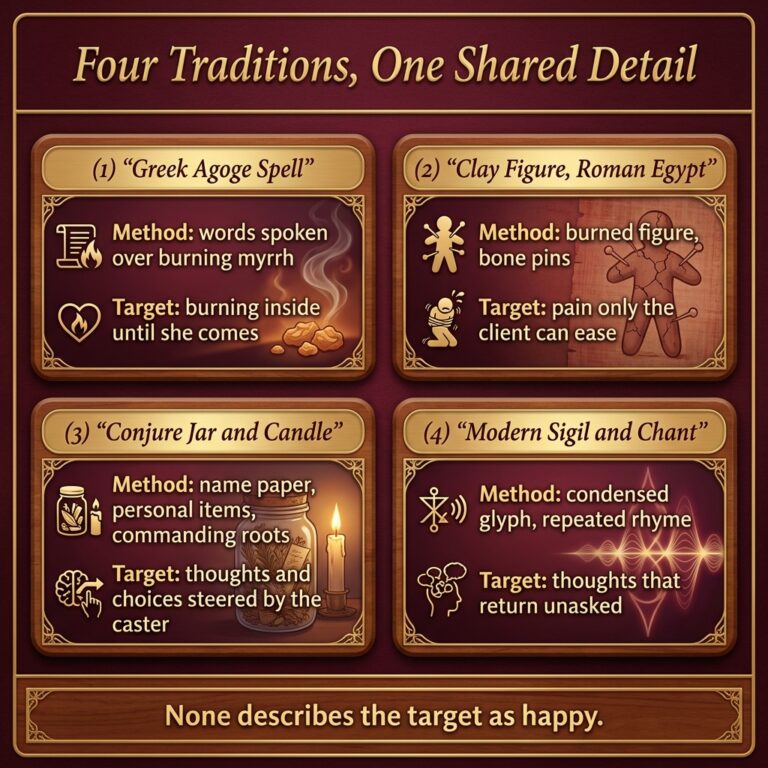
Each one describes the result as something done to the target. The Greek charm burns. The clay figure aches until the client lifts the pain. Even the word obsession first meant a siege, and later the attack of a hostile spirit.[1] Meanwhile, none of these sources describes the target as happy.
My reading is simple. The tradition has always known what fixation feels like from the inside, and it never called that feeling love. So when you choose between workings, ask what the person on the other end would go through. If the honest answer is “they couldn’t stop thinking about me even if they wanted to,” you are reaching for the compelling kind of magic, not the warming kind.
Do Obsession Spells Work, or Do They Backfire?
Practitioners disagree. Many believe a spell can strengthen feelings that already exist but cannot create them from nothing. Others believe energy sent to control someone comes back to the sender, which is the old idea of a backfire. Either way, no spell comes with a guarantee. That includes mine. So be wary of anyone selling obsession spells that work immediately, because that is a promise nobody can keep.
Psychologist Dorothy Tennov coined the word limerence for the state of being intensely infatuated when you are unsure the feeling is returned. Its marks include intrusive thoughts about the other person, an aching need for them to feel the same, and moods that rise and fall with their actions.[6]
That list describes what an obsession spell asks for. Quite often, it also describes the person who wants to cast it, because the obsession already lives in the caster. And if you have cast before and felt nothing shift, the reasons a love spell stalls are usually closer to home than the spell itself.
Obsession Spell Mistakes People Make Online
Most obsession spells people try at home come from a forum post or a short video. That is where the same mistakes show up again and again.
- Copying a stranger’s spell word for word. Many practitioners say obsession work is built around one person and one situation. So a copied free spell carries none of your own intent.
- Using gifts as personal items. A present he gave you passed through his hands, but he chose it for you. Traditional practitioners usually want something that was truly his, such as hair or a worn shirt.
- Checking for signs every hour. Many witches believe constant checking ties you tighter to the outcome. On a practical level, it also keeps your own fixation fed.
- Stacking spell on spell. When nothing happens in a week, people often layer a jar on a candle on a sigil. As a result, they lose track of what they asked for and why.
- Casting from anger. A working meant to punish someone for leaving sits closer to a curse than a love spell, and most practitioners treat it that way.
In all five, the spell has become a way to avoid sitting with the hurt.
Already Cast an Obsession Spell? How Practitioners Undo One
Sometimes the regret comes after the candle has burned down. If that is you, take a breath. Practitioners have long-standing ways to close a working, and none of them calls for fear.
First, most witches take apart whatever they built. They open the jar, take out the name paper and get rid of the contents away from home, often by burying them or placing them in running water. Then they burn or tear the name paper while stating plainly that the working is over. Some follow this with a cleansing bath or a cord-cutting ritual, which is meant to release both people from the tie.
Finally, the everyday side matters as much as the ritual. Stop the contact you were using the spell to force. Give the other person room to choose, or to walk away. That space matters because it hands back the choice the spell tried to take.
The Obsession Spell Warning I Give Every Client
People come to me heartbroken, desperate for someone to call, return or love them the way they once did. Before I consider any such working, I always ask one question. Do you truly want love, or do you want control?
That question is far older than my practice. It is the same line the Greeks drew between agoge magic, which compels, and philia magic, which warms. I simply ask it out loud before anything gets lit.
Then I warn them about the emotional consequences. An unhealthy attachment can become exhausting, possessive and painful for everyone involved. That includes you. Picture getting exactly what you asked for: a partner who can’t stop texting, can’t bear you being away and can’t explain why. That is fixation, and living inside it wears both people down.
My rule is simple. Never confuse someone’s inability to let you go with their ability to truly love you.
If you can’t yet tell which one you want, start by telling love, obsession and closure apart. That one answer changes which working, if any, makes sense.
Before You Cast a Spell to Make Him Obsessed With You
Most people who search for a spell to make him obsessed with them want something else underneath. So match the working to the real wish:
- He went quiet, but the bond was real. A communication or reconciliation working focuses on opening the road between you, not on seizing his thoughts.
- You want someone new to notice you. Attraction or glamour work focuses on you, so it asks nothing of a person who hasn’t chosen you yet.
- You keep going back to someone who left. In this case, a release or cord-cutting working is usually the kinder choice, because the fixation you want to end is your own.
- You want him to feel exactly what you feel. That is the obsession wish itself. Sit with the question above first, and then decide.
If you want to know where the limits sit, read what a love spell can actually do before you choose. True power in witchcraft begins with understanding your intentions, not blindly chasing the outcome you desire.
Frequently Asked Questions
Do I need a personal item for an obsession spell?
Traditional rootwork often uses hair, nail clippings or a photo as a link to the person. Many modern practitioners believe a clear written intention can stand in for these, though most still treat personal items as the stronger link.
Are there free obsession spells that work immediately?
You will find plenty of free obsession spells online, usually a candle, a name paper and a chant. However, no spell, free or paid, can promise an instant result, and honest practitioners won’t claim one.
Can an obsession spell backfire?
Many witches believe it can. The most common worry is not cosmic payback but getting the fixation you asked for and finding it exhausting, possessive or one-sided.
What moon phase do practitioners use for an obsession spell?
Many practitioners choose the full moon for passion work and the waxing moon for drawing something toward them. Timing is a matter of tradition and preference rather than a fixed rule.
Is an obsession spell the same as a love spell?
No. A love spell usually aims to open or warm a connection, while an obsession spell aims to create fixation in one specific person. Older traditions drew this same line between compelling magic and affection magic.
References
- Obsession: Etymology, Origin and Meaning. Online Etymology Dictionary. https://www.etymonline.com/word/obsession
- Edward Kadletz, review of Christopher A. Faraone, Ancient Greek Love Magic (Harvard University Press, 1999). Bryn Mawr Classical Review 2000.02.19. https://bmcr.brynmawr.edu/?p=21908
- The Art and Science of Healing: Clay Doll and Hairpin. Kelsey Museum of Archaeology, University of Michigan. https://exhibitions.kelsey.lsa.umich.edu/art-science-healing/magic1.php
- Hoodoo (spirituality). Wikipedia. https://en.wikipedia.org/wiki/Hoodoo_(spirituality)
- Sigil. Wikipedia. https://en.wikipedia.org/wiki/Sigil
- Limerence. Wikipedia. https://en.wikipedia.org/wiki/Limerence
Not sure where to start? You don’t have to do this alone.
Madame Celestine offers guided spellwork for beginners — real support for your first working, not just another guide to read.
Related reading: Hoodoo Love Reunion Work: How Rootworkers Approach Reconciliation · Love Runes in Witchcraft: Meanings, Bind Runes and Breakups

About Madame Celestine
Madame Celestine has practiced and taught spellwork, divination, and seasonal ritual for over two decades, helping newcomers build a grounded, confident practice from their very first spell.