
Search for powerful love spells and you’ll find a flood of promises: overnight results, guaranteed returns, “real love spells that work immediately.” So what actually makes one love spell stronger than another? This guide skips the hype. Instead, it looks at the evidence that survives: Egyptian papyri, a clay figure in the Louvre, English folk customs and modern witchcraft. You’ll learn which ingredients of a spell practitioners have treated as the source of its strength for nearly two thousand years. You’ll also see why many of today’s witches define a powerful spell very differently from the ancient ones.
- Why Some Love Spells Feel Stronger Than Others
- The Oldest Powerful Love Spells: Egyptian Papyri and a Pierced Clay Figure
- Words Were the Engine: Why a Charm Was Once a Song
- Lovers Magic and the Personal Link
- Timing: Friday, Venus and the Moon
- The Common Thread Behind Powerful Love Spells That Work
- A Powerful Love Spell to Do at Home, Built on Those Elements
- Where Powerful Love Spells Go Wrong: Force, Doubt and Impatience
- Frequently Asked Questions
- References
Why Some Love Spells Feel Stronger Than Others
Ask ten witches for the best love spells and you’ll hear ten recipes. Some use rose petals, some use honey, and some use only words. Yet the question behind “love spells that actually work” is usually the same, whatever the wording. People want to know what separates a spell with real weight from a ritual that feels like going through the motions.
Practitioners rarely credit powerful love spells to a single secret ingredient. Instead, they point to structure. A spell, in most traditions, is a set of parts that work together. There are words that state the purpose, and something that links the work to a person. There’s a chosen time, and there’s repetition. Finally, there’s the intention of the person casting it. When one of those parts is missing, practitioners say the work feels thin. When all of them are present, people describe it as a love spell that works, or at least one that feels real.
That idea isn’t new. In fact, the oldest written records of powerful love spells show the same building blocks.
The Oldest Powerful Love Spells: Egyptian Papyri and a Pierced Clay Figure
Some of the earliest surviving powerful love spells come from Roman-era Egypt. The British Library holds a Greek magical handbook known as Papyrus 121, probably written in the 4th century. It was once a roll more than two metres long, and it covers healing, protection and success as well as love [1].
Its love spells are anything but gentle. Many belong to a type called agōgē, from the Greek verb meaning “to lead.” Their goal was to bring the desired person to the caster’s door [1]. One spell asks the caster to write the names of seven gods in myrrh on seven lamp wicks. The target, so the text claims, would find no sleep until arriving at the caster’s house, by the time the seventh wick flickered [1]. Another charm in the same papyrus promised to act “in the same hour” [1].
The Louvre holds physical evidence from the same era: a small group of objects catalogued as E 27145. It includes a terracotta figurine pierced with copper needles and a lead plaque engraved with a Greek magical text, kept together with a clay vase. The museum dates the set to roughly 200 to 399 CE and acquired it in 1975 [2].
These casters seem to have located a spell’s strength in sacred names, specific materials, exact timing and repetition. However, there’s another side to these powerful love spells. Much of this ancient magic was openly coercive. It aimed to bind a person who hadn’t chosen the caster, and that is exactly where modern witchcraft parts ways with its ancestors.
Words Were the Engine: Why a Charm Was Once a Song
The English word “charm” comes from the Latin carmen, which meant song, verse or enchantment. English took it from Old French around 1300, first meaning an incantation [3]. In other words, a charm was first something you said or sang, not something you wore.
The papyri show the same belief. One spell asks the caster to repeat magical words seven times over a cup. The text calls those words the “holy names of Cypris,” another name for Aphrodite [1]. Other spells end with strings of strange syllables, known as voces magicae, which means “magical words” [1].
Modern witchcraft love spells keep this habit, even in plain English. In fact, the words are where many powerful love spells get their weight. A practitioner might write a short rhyming chant and say it while a candle burns. The rhyme has a practical job: rhythm is easier to remember and repeat, so it helps the caster stay focused. That’s why so many witch spells for love are written as verses rather than instructions.
So when people ask what makes a love spell that truly works, words are the first answer tradition gives. A clear statement of intention, repeated with attention, is the backbone of nearly every version.
Lovers Magic and the Personal Link
The second building block is a link. Much folk magic works by what scholars call sympathy, the idea that like affects like, or that a part stands for the whole. Lovers magic leans on this heavily.
The British Library papyrus gives a vivid example. One “excellent love charm” was engraved on a thin sheet of tin, using a copper nail taken from a shipwreck. Then the tin was wrapped around something belonging to the target, such as hair or clothing, and thrown into the sea [1]. The hair and cloth were the link. The sea and the shipwreck nail added symbolic force.
Modern practitioners use gentler versions of the same idea. A name written on paper, a photograph or a small keepsake often takes the place of hair. Many powerful love spells today use a link to the caster instead of another person. For example, a caster might anoint their own candle or carry a sachet against their skin. That shift, from linking to someone else to linking to yourself, is one of the biggest changes in how love spells to do at home are taught today.
Timing: Friday, Venus and the Moon
The third building block is time. Many witches cast love work on a Friday, and the reason is older than most people realise. The English name comes from Frigg, a Germanic goddess of married love. It was also a translation of the Latin dies Veneris, “day of Venus,” which in turn translated the Greek “day of Aphrodite” [4]. So the Friday habit carries three cultures’ love goddesses in a single word.
The moon matters too. One love spell in Papyrus 121 addresses Selene, the Moon, as “mistress of the entire world” [1]. Today, many practitioners time powerful love spells for a waxing moon, because a growing moon suits drawing something in. For more on each phase, see this guide to working with moon cycles.
Folk custom adds its own dates. St Agnes’s Eve, January 20, is one of them. In a version recorded by a University of Southern California folklore archive, a young woman puts rosemary under her pillow that night. Then she hopes to dream of her future husband. The custom traces back to England [5].
What about Venus retrograde? People often ask whether it ruins a spell. There’s no single rule. Some astrologically minded witches avoid it for new love, while others ignore it entirely. If timing helps you focus, use it. However, most practitioners treat timing as something that supports focus rather than something that decides the outcome.
The Common Thread Behind Powerful Love Spells That Work
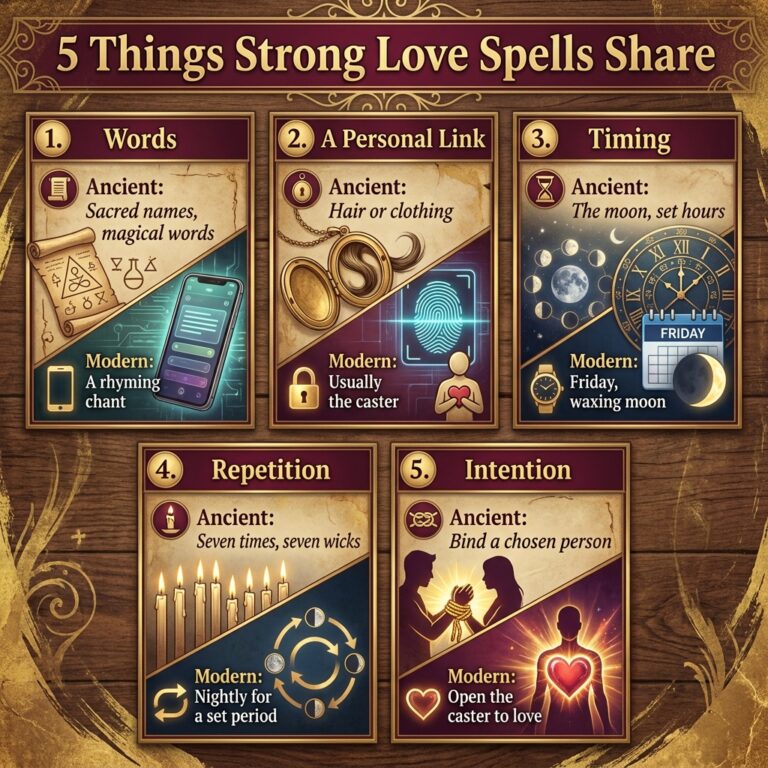
Put side by side, these traditions share more than their surface details suggest. Here are the five building blocks across the three sources discussed above.
| Element | Egyptian papyri | English folk custom | Modern witchcraft |
|---|---|---|---|
| Words | Sacred names, magical words | A short prayer before sleep | A rhyming chant |
| Personal link | The target’s hair or clothing | The dreamer herself | Usually the caster |
| Timing | The moon, set hours | St Agnes’s Eve | Friday, waxing moon |
| Repetition | Seven times, seven wicks | Once a year | Nightly for a set period |
| Intention | Bind a chosen person | Glimpse a future partner | Open the caster to love |
Read across the rows and a pattern appears. The first four elements barely change in two thousand years. Words, a link, timing and repetition show up in every column. What changes is the last row. The ancient spells aimed at control. The folk custom aimed at knowledge. Modern practice mostly aims at the caster’s own openness.
When people ask for extremely powerful love spells, they usually mean “forceful.” But by the standard most witches use today, strength comes from how well the four steady elements are done. Force is the part tradition has largely dropped. So if you want effective love spells, the craft lies in clear words, a meaningful link, a chosen time and patient repetition, all pointed at your own life.
A Powerful Love Spell to Do at Home, Built on Those Elements
Good love spells don’t need to be elaborate. Here’s a simple attraction ritual that follows the pattern above. It’s self-focused, so it doesn’t try to bend anyone else’s will. Treat it as a framework, and adjust the details to your own path.
- Pick a Friday during a waxing moon. The day links to Venus, and the growing moon suits drawing something toward you.
- Write your own name on a small square of paper. Under it, write three qualities you want in a partner, such as kindness or humour.
- Rub a pink or red candle with a little olive oil, working from the middle out. Many practitioners see this as charging the candle with purpose.
- Write a short rhyming line that names what you’re opening yourself to. Then say it aloud seven times as the candle burns, echoing the papyri’s sevens.
- Burn the candle for a short while on seven nights, saying your words each time. Finally, fold the paper and keep it somewhere private.
Never leave a lit candle unattended. Also, if you prefer a version with no tools at all, there are love spells without any ingredients that rely on words and intention alone.
Belief, Intention & The Power of Magic
Witchcraft, spells, and manifestation are deeply rooted in belief, intention, and spiritual practice. If these practices do not resonate with you, this may not be the path for you, and that’s perfectly okay. But if you believe in divine powers, trust your intentions, and feel drawn to the mysteries of the unseen, we invite you to continue exploring with Madame Celestine and discover the magic that speaks to your soul.
Where Powerful Love Spells Go Wrong: Force, Doubt and Impatience
Even well-made, powerful love spells can feel flat. Practitioners tend to name the same three causes, and the first is ethical.
The first is force. The writer Mike Nichols wrote an essay on the ethics of love spells, now kept in the Internet Sacred Text Archive. He argued that a spell aimed at a specific person puts “a straightjacket on another’s free will” [6]. He also weighed love magic against the Rede, the traditional witches’ guideline, “An it harm none, do what thou will” [6]. Many witches still follow that reasoning. As a result, they redirect requests aimed at one person toward self-love or general attraction. For a closer look at the limits, see what a love spell can and can’t do.
The second is doubt. Practitioners often say that checking a witch love spell every day drains it. Constant worry keeps attention on the gap instead of the goal. So many witches cast, then deliberately set the work aside.
The third is impatience, because people judge too soon. A common view is that a love spell needs at least one full lunar cycle before anyone reads the signs. If yours seems stuck, these notes on why a love spell stalls cover the usual fixes.
Frequently Asked Questions
Do real love spells actually work?
Practitioners believe love spells that really work do so by focusing intention and opening the caster to connection, not by forcing feelings. Results are a matter of belief and personal experience, so no honest practitioner can promise an outcome.
Are there love spells that work overnight?
Ancient texts claimed spells that acted “in the same hour,” but modern practitioners generally reject overnight promises. Most suggest allowing at least a full lunar cycle before judging any love spell.
What are the most powerful love spells?
Most witches say the most powerful love spells are the ones done with clear words, a meaningful personal link, chosen timing and steady repetition. Strength comes from the care put into those parts, not from rare or exotic ingredients.
Can you cast a love spell on a specific person?
Some traditions did, but many modern witches refuse because it overrides another person’s free will. Instead, they recommend attraction or self-love work that focuses on the caster.
Is there a wife spell to strengthen a marriage?
Many practitioners use sweetening or commitment rituals for an existing marriage, and some couples perform them together. These rituals focus on shared intention, communication and renewed attention rather than control.
How long does a love spell last?
There’s no fixed answer, because practitioners see a love spell as a starting point rather than a permanent effect. Many repeat their work each year or refresh it at a new moon.
References
- Love spells in the Greek magical papyri. Federica Micucci, British Library Medieval Manuscripts Blog, 13 February 2021. https://www.bl.uk/stories/blogs/posts/love-spells-in-the-greek-magical-papyri
- Objet magique ; figurine ; plaque ; vase (E 27145). Musée du Louvre Collections. https://collections.louvre.fr/en/ark:/53355/cl010044394
- Charm. Online Etymology Dictionary. https://www.etymonline.com/word/charm
- Friday. Online Etymology Dictionary. https://www.etymonline.com/word/Friday
- Seeing my future husband. University of Southern California folklore archive (folklore.usc.edu). https://folklore.usc.edu/?p=30354
- Charmed, I’m Sure: The Ethics of Love Spells. Mike Nichols, Internet Book of Shadows, Internet Sacred Text Archive. https://sacred-texts.com/bos/bos122.htm
Not sure where to start? You don’t have to do this alone.
Madame Celestine offers guided spellwork for beginners — real support for your first working, not just another guide to read.
Related reading: Sexual Spells: What Nobody Tells You Before You Cast One · Obsession Spell: Why I Refuse to Cast One Without This Warning

About Wren Ashby
Wren Ashby is the pen name our editorial team uses for articles on sigils, Tarot and modern traditional witchcraft. Articles under this byline are researched from published sources and reviewed by Madame Celestine before publishing.