
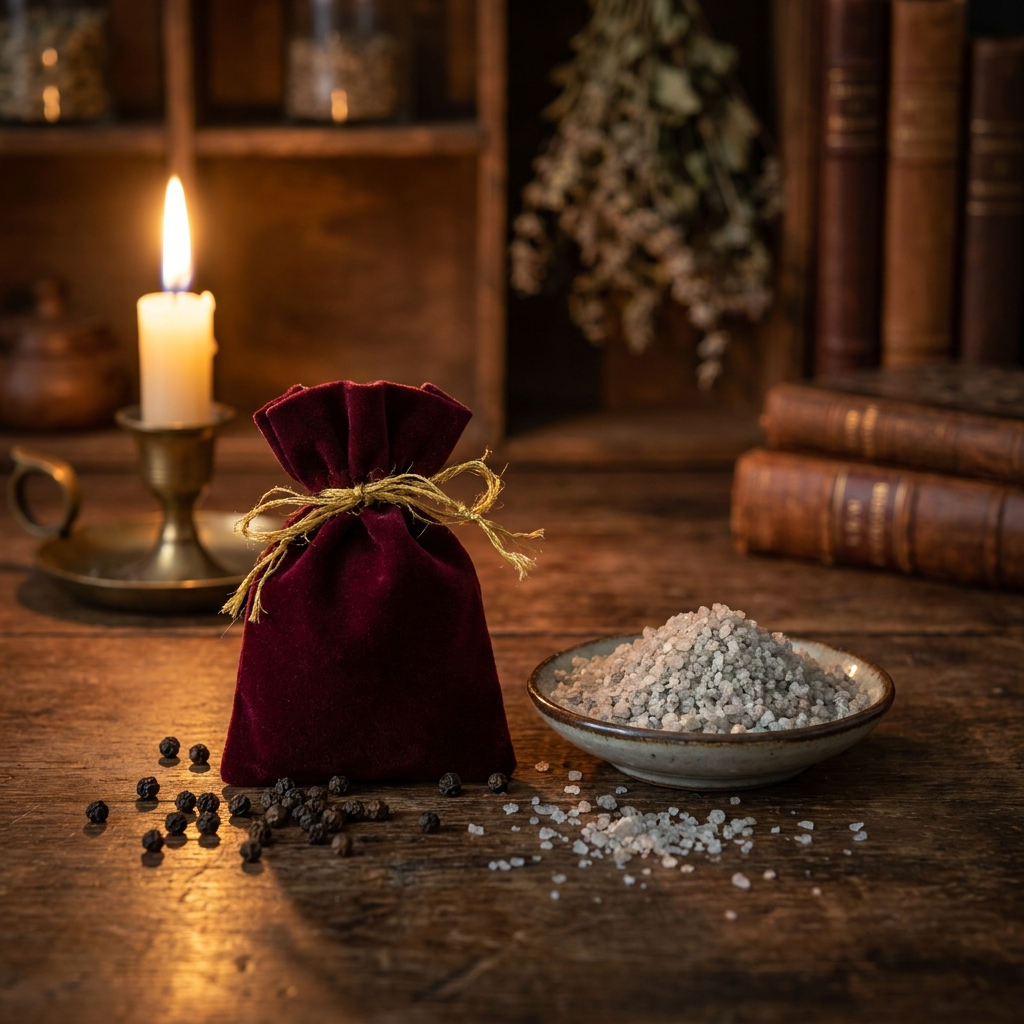
Black pepper magical properties start with something you already know: pepper bites. That sharp heat on the tongue is the whole reason people have prized it for thousands of years, and it’s also why practitioners reach for it in protection and banishing work. In this guide, you’ll learn where black pepper comes from, how it ended up stuffed in a pharaoh’s nose and demanded as ransom for Rome, and what it means in hoodoo and modern witchcraft. You’ll also learn why black pepper and red pepper come from different plants, which changes how you read old pepper magic. For me, darling, black pepper brings a little fire to protection work.
- Black Pepper Magical Properties at a Glance
- From Ancient Egypt to Rome: The Story Behind the Spice
- Black Pepper vs. Red Pepper: Two Different Plants
- Pepper Magic in Hoodoo and Southern Folk Magic
- Why Pepper Magic Works Through Heat
- How to Use Pepper Magic at Home
- Common Mistakes With Pepper Magic
- Pepper Inside a Pepper: Spiritual Meaning
- Using Pepper Magic Safely
- Frequently Asked Questions
- References
Black Pepper Magical Properties at a Glance
In modern pepper magic, black pepper is used for protection, banishing and breaking through obstacles. In pepper magic, practitioners believe its heat drives away what you don’t want and puts a sharp edge around what you want to keep. It is also one of the cheapest and most available ingredients in any kitchen, which makes it a natural tool for everyday witchcraft.
Here is what pepper magic most often uses black pepper for in black pepper witchcraft today:
- Protection: a sharp boundary around a person or a home.
- Banishing: sending away an unwanted influence or habit.
- Courage: a little heat when you need to speak up.
- Clearing obstacles: getting stuck energy moving again.
From Ancient Egypt to Rome: The Story Behind the Spice
To understand the black pepper spiritual meaning, it helps to know how precious this spice once was. Black pepper is the dried fruit of Piper nigrum, a climbing vine native to the Malabar Coast of India. According to Encyclopaedia Britannica, it is one of the earliest known spices. The berries are picked as they start to turn red, dipped in boiling water and sun-dried until they turn black [1]. Its bite comes mainly from a compound called piperine [1].

Peppercorns in a Pharaoh’s Nose
One of the oddest facts about pepper comes from ancient Egypt. Peppercorns were found in the nostrils of the mummy of Ramesses II, who died around 1213 BCE [2]. No one knows exactly why they were placed there. Still, it means pepper had traveled from India to Egypt more than three thousand years ago.
Pepper Worth Its Weight in Gold
Later, Rome developed a serious pepper habit. Roman ships sailed to India’s Malabar Coast, picking up most of their pepper at a port called Muziris [3]. The Roman writer Pliny the Elder grumbled about it. He complained that people wanted pepper only for its bite, yet it was valued like gold and silver [3].
Then, in 408 CE, the Visigoth king Alaric besieged Rome. Among his ransom demands, alongside gold, silver and silk, was 3,000 pounds of pepper. The historian J. B. Bury records this in his History of the Later Roman Empire [4]. In other words, pepper was treasure, valuable enough to buy a city’s safety.
Pepper as Money and Tribute
Pepper’s value didn’t end with Rome. Britannica notes that it sometimes served as currency and was used for tribute in ancient Greece and Rome. In the Middle Ages, Venetian and Genoese merchants controlled its trade in Europe, and that grip helped push explorers to look for a sea route east [1]. The Australian Museum goes further, describing pepper’s trade as tangled up with the very origins of capitalism [2].
So for most of history, a handful of peppercorns was a small fortune. That’s worth remembering the next time you drop a few into a charm pouch. In pepper magic, you’re working with something people once guarded as carefully as coins.
Why That History Matters for Pepper Magic
Pepper was also a medicine for centuries. Records of its medical use in India go back at least 3,000 years, and Romans and medieval Europeans used it in remedies too [3]. So when pepper magic treats black pepper as powerful, they’re drawing on a very long history of people treating it as precious, healing and worth protecting.
Black Pepper vs. Red Pepper: Two Different Plants
Many guides blur one detail: black pepper and red chili pepper aren’t related at all. Chili peppers belong to the genus Capsicum, which was first domesticated in Central and South America. Columbus thought chilies resembled black pepper, so he called them “pepper,” and the name stuck [5].
That matters for reading old pepper magic. Any tradition from before the 1500s that mentions “pepper” in Europe, Africa or Asia means black pepper or one of its relatives. Red pepper charms, by contrast, are newer.
The Red Pepper Charm Against the Evil Eye
Red peppers have their own protective folklore. For example, the University of Southern California’s folklore archive records an Italian-American student’s family custom. Her relatives hang red peppers from their car mirrors and wear pepper pendants to guard against the evil eye [6]. It’s a lovely charm. However, it belongs to red pepper, not black.
What About White Pepper?
White pepper comes from the very same plant. To make it, growers soak the berries until the dark outer layer loosens, then rub it off. According to Britannica, the result is less pungent than black pepper [1]. Since pepper magic leans on heat, most practitioners reach for black pepper first. White pepper can still suit gentler work, when you want a softer boundary.
Pepper Magic in Hoodoo and Southern Folk Magic
In African American hoodoo, pepper turns up in one famous preparation: hot foot powder. It almost always includes black pepper, red pepper and salt, and sometimes sulfur. Its purpose is to drive an unwanted person away [7].
Its history is more interesting than its recipe, though. Katrina Hazzard-Donald, a Rutgers University–Camden scholar and author of Mojo Workin’: The Old African-American Hoodoo System, argues that hot foot powder grew out of a misreading of an older “walkin’ foot” practice. She describes the commercial powder as a novelty item sold in shops in New Orleans and elsewhere [8]. So the jar of hot foot powder on a shop shelf is a newer, store-bought cousin of a much older tradition.
The Archive Behind Southern Folk Magic
Much of what we know about older hoodoo practice comes from one enormous archive. The folklorist Harry M. Hyatt interviewed people across much of the American South. His findings fill a five-volume set published in 1970, which the University of Missouri Libraries’ Special Collections describes as opening with the line “To catch a spirit, or to protect your spirit against catching” [9]. His interviewees describe protection bags of sulfur and ashes, buried bottles and much more. Those records are a reminder that Southern protection magic used whatever was close at hand.
Why Pepper Magic Works Through Heat
Put the history side by side, and one quality explains black pepper’s place in protection and banishing: its bite. Pliny complained that pepper’s only appeal was its sharpness [3]. Hot foot powder, likewise, relies on heat to make someone restless and send them on their way [7].

| Black pepper | Red chili pepper | |
|---|---|---|
| Plant | Piper nigrum | Capsicum |
| Native to | Malabar Coast of India | Central and South America |
| Oldest trace | Ramesses II’s mummy, c. 1213 BCE | Named “pepper” by Columbus |
| Folk use | Hot foot powder, protection, banishing | Evil-eye charms, hot foot powder |
Heat as a Boundary
As I read it, the pattern is simple. Both peppers are used where something needs to be kept out or moved along, and both are chosen for their heat. Sweet herbs invite and soothe. Hot spices, on the other hand, warn and push. So when you choose black pepper, you’re choosing a boundary with a bite. That also explains why pepper magic suits banishing better than love or luck work.
How to Use Pepper Magic at Home
In my own practice, black pepper symbolizes firm boundaries and the resolve to send unwanted influences on their way. Here’s how I use it, step by step.

Step 1: Make a Peppercorn Charm Pouch
I keep a few whole peppercorns in a sealed charm pouch. It’s a reminder that my home deserves peace and my boundaries deserve respect. Whole peppercorns work better than ground pepper here, because they stay put and won’t leak. A small cloth bag tied tightly, or a little jar with a lid, does the job.
Place the pouch somewhere you’ll see it, such as near the front door or on a shelf in the room where you feel most crowded. If you’d like more ideas for sealed containers, see this guide to making a protection spell jar.
Step 2: Name What You’re Sending Away
Before you close the pouch, name what you want gone. Keep it specific. “The habit of checking my ex’s page” is clearer than “bad energy.” The sharper the words, the sharper the boundary feels.
Step 3: Pair the Intention With Action
For banishing, I always pair the intention with action. That might mean clearing clutter, ending an unhealthy habit or saying a necessary goodbye. The pepper marks the decision. Your action carries it out. Without that second half, the pouch is only a reminder of something you haven’t done yet.
Other Ways Practitioners Use Pepper
Beyond a pouch, many practitioners of pepper magic add a pinch of black pepper to salt for a protective threshold line, or stir it into a banishing blend with other sharp herbs. Pepper also pairs naturally with older protection plants. For example, this guide to herbs and spices for protection covers rowan, rue and St John’s wort.
Salt and Pepper Together
Salt and pepper sit side by side on almost every table, and they pair well in protection work too. Salt is widely used to cleanse and purify. Pepper, by contrast, adds heat and an edge. Notably, hot foot powder itself often combines the two [7]. So a pinch of each, mixed in a small dish by the door, makes a simple, two-part pepper magic charm: one to clear, and one to guard.
Common Mistakes With Pepper Magic
The first mistake is skipping the action. Pepper can mark a decision, but it can’t make it for you. So if you’re banishing a habit, the real work is the habit itself.
The second mistake is aiming pepper at another person. Old hot foot traditions did target people, but modern ethical practice keeps protection and banishing work focused on your own space and choices.
The third mistake is burning it. Pepper smoke stings the eyes and throat, so keep it out of candles, incense and fire rituals.
Finally, don’t expect one ingredient to carry heavy protection work alone. If you’re dealing with something bigger, it helps to understand what warding means before you begin.
Pepper Inside a Pepper: Spiritual Meaning
Many people search for the spiritual meaning of finding a pepper inside a pepper. First, a botanical note: this happens in bell peppers and other Capsicum peppers, not in black pepper. The small inner pepper is called an internal proliferation. According to a gardening column in The Christian Science Monitor, no one is sure what causes it, though temperature and nutrients have been ruled out. The column adds that the little pepper is as edible as the one around it [10].
As for a spiritual meaning, no old tradition records one, as far as I can find. Modern readers often take it as a sign of something hidden growing inside something familiar, such as a new idea or a quiet change. If that reading speaks to you, use it gently, and treat it as a pleasant surprise in the kitchen.
Belief, Intention & The Power of Magic
Witchcraft, spells, and manifestation are deeply rooted in belief, intention, and spiritual practice. If these practices do not resonate with you, this may not be the path for you, and that’s perfectly okay. But if you believe in divine powers, trust your intentions, and feel drawn to the mysteries of the unseen, we invite you to continue exploring with Madame Celestine and discover the magic that speaks to your soul.
Using Pepper Magic Safely
Pepper is a food, but it can still cause trouble outside the kitchen. Keep pepper away from eyes, pets and anything you might burn. Burning pepper releases harsh fumes, so leave it out of candle and incense work. Also, don’t scatter it where small children might touch it. Also, never put pepper on another person or in their shoes or belongings. Your protection work should guard your own space, not harm someone else’s.
Frequently Asked Questions
What is the black pepper spiritual meaning?
In modern practice, black pepper stands for protection, banishing and courage. Its heat is read as a sharp boundary that keeps unwanted things away.
Is black pepper good for protection?
Many practitioners use it for protection, often alongside salt. It works best as a reminder of a boundary you also hold in everyday life.
What is the difference between black pepper and red pepper in magic?
They come from unrelated plants. Black pepper is an ancient spice from India, while red chili pepper came from the Americas and was named “pepper” by Columbus.
Can I use ground pepper instead of peppercorns?
Yes. Whole peppercorns are easier to count and carry, while ground pepper mixes easily into powders and salt blends.
Is it safe to eat a pepper found inside a pepper?
Generally, yes. The small inner pepper is an internal growth of the same plant and is as edible as the pepper around it.
References
- Black pepper (plant). Encyclopaedia Britannica. https://www.britannica.com/plant/black-pepper-plant
- Food Culture: What Happened to Pepper. Dr Stan Florek, Australian Museum, February 17, 2014. https://australian.museum/learn/news/blog/food-culture-what-happened-to-pepper/
- Pepper. James Hancock, World History Encyclopedia, September 2, 2021. https://www.worldhistory.org/Pepper/
- History of the Later Roman Empire, Vol. I, Chapter VI. J. B. Bury, Macmillan, 1923. LacusCurtius, University of Chicago. https://penelope.uchicago.edu/Thayer/E/Roman/Texts/secondary/BURLAT/6*.html
- Plant of the Month: Chili Pepper. JSTOR Daily, November 3, 2022. https://daily.jstor.org/plant-of-the-month-chili-pepper
- Pepper to Protect Against Evil. USC Digital Folklore Archives, University of Southern California. https://folklore.usc.edu/pepper-to-protect-against-evil/
- Hot foot powder. Wikipedia. https://en.wikipedia.org/wiki/Hot_foot_powder
- African-American Hoodoo: More Than Magic (on Katrina Hazzard-Donald, Mojo Workin’: The Old African-American Hoodoo System, University of Illinois Press, 2012). Futurity / Rutgers University, January 4, 2013. https://www.futurity.org/african-american-hoodoo-more-than-magic/
- Halloween Hoodoo. Special Collections, University of Missouri Libraries. https://library.missouri.edu/news/special-collections/halloween-hoodoo
- Have you ever found a pepper inside a pepper? Karan Davis Cutler, The Christian Science Monitor, April 1, 2010. https://www.csmonitor.com/The-Culture/Gardening/diggin-it/2010/0401/Have-you-ever-found-a-pepper-inside-a-pepper
Not sure where to start? You don’t have to do this alone.
Madame Celestine offers guided spellwork for beginners — real support for your first working, not just another guide to read.
Related reading: Color Magic: Candle Color Correspondences for Every Intention · Candle Wax Reading: Shapes, Meanings and Old Traditions

About Madame Celestine
Madame Celestine has practiced and taught spellwork, divination, and seasonal ritual for over two decades, helping newcomers build a grounded, confident practice from their very first spell.