

Protection runes are some of the most searched symbols in modern witchcraft, and also some of the most misunderstood. You may have seen Algiz on a pendant, a “Viking compass” on a tattoo, or a “Celtic protection rune” for sale online. Some of those are runes. Some are not. In this guide, you’ll learn which runes people use for protection and what the oldest rune poem actually says about each one. You’ll also learn how to sort real runes from look-alike symbols, and how to work with one in a simple, grounded way. As I always say, darling, protection begins with knowing what you welcome and what you refuse.
- What Are Protection Runes?
- Algiz: The Best-Known Rune of Protection
- Other Norse Runes for Protection
- Two Ways the Old Poem Describes Protection
- Protective Runes and Symbols That Aren’t Runes
- Protection Runes for the Home
- A Simple Protection Rune Practice
- Protection Bind Runes: What to Know First
- Is There a Banishing Rune?
- Viking Runes for Protection: What the Vikings Actually Used
- Common Mistakes With Protection Runes
- Frequently Asked Questions
- References
What Are Protection Runes?
Before choosing protection runes, it helps to know what runes are. They’re the letters of the old Germanic alphabets. The oldest set, the Elder Futhark, has 24 runes arranged in three rows of eight [1]. Each rune had a sound and a name, much like our letters. Today, readers also give each one a symbolic meaning, and a handful are used as protection runes.
It helps to be honest about one thing from the start. Historians at the University of Nottingham put it plainly: runes are “simply an alphabet,” with nothing magical about the letters themselves [2]. Yet people still carved charms with them. For example, one small Swedish amulet carries the words “Healing runes I cut, runes of help” [2].
That tension runs through this whole subject. The letters were ordinary. However, the people using them sometimes hoped for extraordinary help. So when you choose protection runes, you’re joining a very old habit of writing a hope down and keeping it close.
Did People Really Carve Runes for Protection?
Yes, at least some of the time. The scholars Mindy MacLeod and Bernard Mees studied this question in their book Runic Amulets and Magic Objects, published by Boydell Press in 2006. According to the publisher, it covers runic charms “carved on metal or wooden amulets to ensure peace or prosperity” [3]. Some of those inscriptions call on gods and heroes. Others call on spirits of disease [3]. The publisher also notes that whether runes were magical at all remains one of the most debated questions in runic scholarship [3].
Algiz: The Best-Known Rune of Protection
Algiz (ᛉ) is the first of the protection runes most people mean when they ask for a rune of protection. Its shape looks like an upraised hand, or the antlers of an elk. In modern readings, it stands for shelter, defense and a clear boundary.

For me, Algiz is a reminder to hold my boundaries and trust my judgment. Here in New Orleans, I keep my spiritual practice grounded, so I don’t treat it as a force field. Instead, I treat it as a question I ask myself: what am I letting in, and what am I keeping out?
What the Old English Rune Poem Says
The oldest description of this rune comes from the Old English Rune Poem, which gives a short verse for each letter. Its verse for ᛉ is about a sharp plant called elk-sedge. In Stephen Pollington’s translation, the plant “grows in water, harshly wounds, marks with blood any warrior who tries to take it” [4].
That’s a striking picture of protection. The sedge doesn’t build a wall. Instead, it simply makes itself painful to grab. So among protection runes, the oldest image we have for this symbol is a living thing that defends itself by being hard to take.
Is Algiz as a Protection Rune Modern?
This is one of the most common questions rune readers ask, and the honest answer is: partly. The name “Algiz” is a modern reconstruction. In fact, there is wide agreement among scholars that it probably wasn’t the rune’s historical name [5]. One proposal links the word to “elk.” Another, from the scholars Warren and Elliott, suggests a Germanic word meaning “protection, defence” [5].
So the protective meaning has some scholarly roots, but it was strengthened much later. In the early 20th century, the Austrian occultist Guido von List helped popularize the name “life rune” for this shape [5].
A Warning About Misuse
The Nazis took this rune for their own purposes. According to the Anti-Defamation League, they used it in several ways, including in the SS’s Lebensborn program [6]. Today, the ADL lists it as a common white supremacist symbol. However, the ADL also notes that neo-pagans still use it in a non-racist way. It advises people not to assume a given use is racist, but to judge it in context [6].
For you, this has a practical side. If you plan to wear Algiz as jewelry or a tattoo, know that some people may read it differently than you intend. Pairing it with clear context, such as a journal practice or a personal meaning you can explain, keeps your intention plain.
Other Norse Runes for Protection
Algiz isn’t the only one of the Norse protection runes. Three others often appear in protective work, and each guards something different. Here’s how I read them.
Thurisaz: The Thorn That Asks You to Pause
Thurisaz (ᚦ) asks me to pause before saying yes. Its Old English verse is about a thorn. In Pollington’s translation, it is “painfully sharp to any warrior,” and “seizing it is bad” [4]. Like elk-sedge, the thorn protects by being hard to grab. You’ll find more on its history in this guide to Thurisaz, Thor’s rune of force.
Eihwaz: The Yew That Endures
Eihwaz (ᛇ) speaks of endurance. Its Old English verse describes the yew as “hard, earthfast, fire’s keeper, underpinned with roots” [4]. That’s protection of a quieter kind. The yew doesn’t fight. Instead, it holds its ground for a very long time.
Tiwaz: The Sign That Keeps Faith
Tiwaz (ᛏ) reminds me to stand by my principles. Its verse calls it “one of the signs” that “holds faith well.” On a journey, it is “always above night’s gloom” and “never fails” [4]. So Tiwaz protects by guiding you. It keeps you on course when things get dark.
Two Ways the Old Poem Describes Protection
Put the verses for these four protection runes side by side, and a clear pattern appears. The table below sums it up.
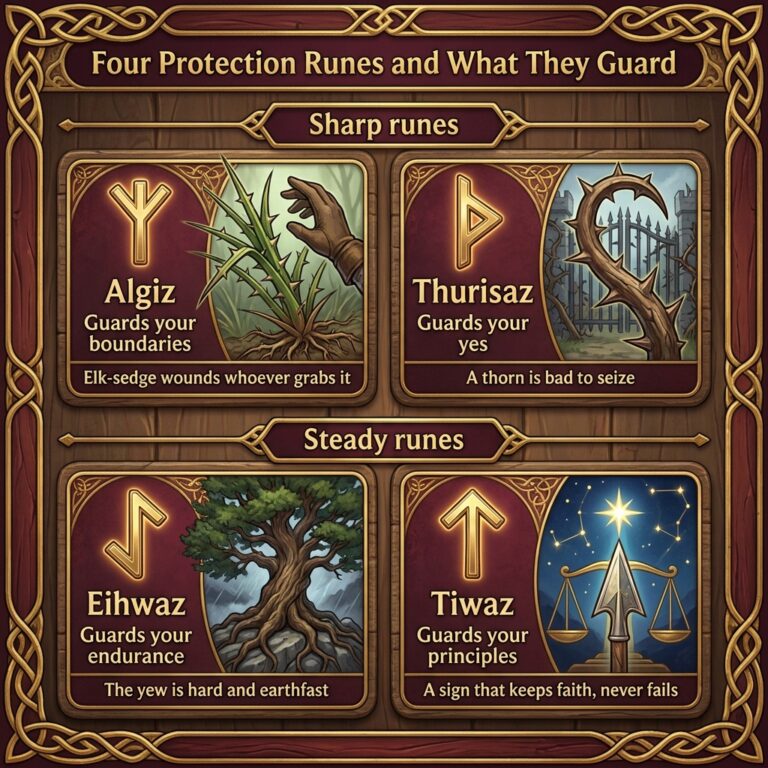
| Rune | Old English image | What it guards |
|---|---|---|
| Algiz ᛉ | Elk-sedge that wounds whoever grabs it | Your boundaries |
| Thurisaz ᚦ | A thorn that is bad to seize | Your yes |
| Eihwaz ᛇ | A hard, earthfast yew | Your endurance |
| Tiwaz ᛏ | A sign that keeps faith and never fails | Your principles |
Sharp Runes and Steady Runes
Read across the rows, and the four protection runes split into two pairs. Algiz and Thurisaz protect by being sharp. Both verses describe something that hurts the hand that grabs it. Eihwaz and Tiwaz, on the other hand, protect by being steady. One is a tree that won’t move, and the other is a sign that won’t fail.
As I read it, that gives you a simple way to choose. If something is pushing into your life, reach for a sharp rune. Algiz or Thurisaz suits a pushy coworker, a draining relative or a habit you keep saying yes to. If, instead, you need to hold on through a long, hard season, reach for a steady rune. Eihwaz or Tiwaz fits that better. Notice, too, that none of the four is a wall. In the old verses, protection is a quality that something has.
Protective Runes and Symbols That Aren’t Runes
Many “Viking protection runes” sold online aren’t runes at all. That doesn’t make them worthless. Still, it helps to know what you’re looking at.
The Helm of Awe and Icelandic Staves
The Helm of Awe, or Ægishjálmur, is a magical stave, which is a drawn symbol rather than a letter. The Museum of Icelandic Sorcery and Witchcraft in Hólmavík explains that it comes in many versions, all based on crosses with three-forked ends. According to the museum, it was meant to protect against evil spirits, enemies and the anger of rulers. Traditionally, it was carved into a lead plate and pressed to the forehead [7]. The museum adds that staves like it appear in Icelandic grimoires, some from the 17th century and some later [7].
The Vegvísir, or “Viking Compass”
The Vegvísir is often sold as a Viking rune for protection on journeys. In fact, it first appears in the Huld Manuscript, which Geir Vigfússon compiled in Iceland in 1860 [8]. That’s nearly 800 years after the Viking Age ended. So it’s a real Icelandic folk symbol, but it isn’t a Viking rune.
Are There Celtic Protection Runes?
Strictly speaking, no. Runes belong to Germanic peoples. The early Irish had their own script, called Ogham. According to Encyclopaedia Britannica, Ogham was used to write Irish and Pictish on stone monuments from the 4th century AD. Its basic form has 20 letters in four sets of five, and about 300 of the more than 375 known inscriptions are in Ireland [9]. So if a product calls itself a “Celtic rune,” it’s usually either a Norse rune or an Ogham letter with a new label.
Protection Runes for the Home
Using protection runes at home is one of the most popular parts of this practice. It sits alongside many old doorstep protection customs from other traditions. Here are a few gentle ways to use them.
Mark the Doorway
The front door is the natural place for a rune of protection. You might draw Algiz on a small card and tuck it above the inside of the doorframe. Or you might trace the shape with your finger on the door each night. Either way, the mark sits where the inside of your home meets the outside world. For more on this idea, see what warding means in occult practice.
Carry It With You
You can also carry a protection rune symbol on a stone, a card or a pendant. If you’d like to make jewelry into a charm, here’s how to enchant jewelry as a protection talisman.
Lock the Door, Too
Carry your symbol, sweetheart, and remember to lock your door. I mean that literally. A rune can remind you to protect your peace, but it doesn’t replace ordinary safety. So treat the symbol and the lock as partners.
A Simple Protection Rune Practice
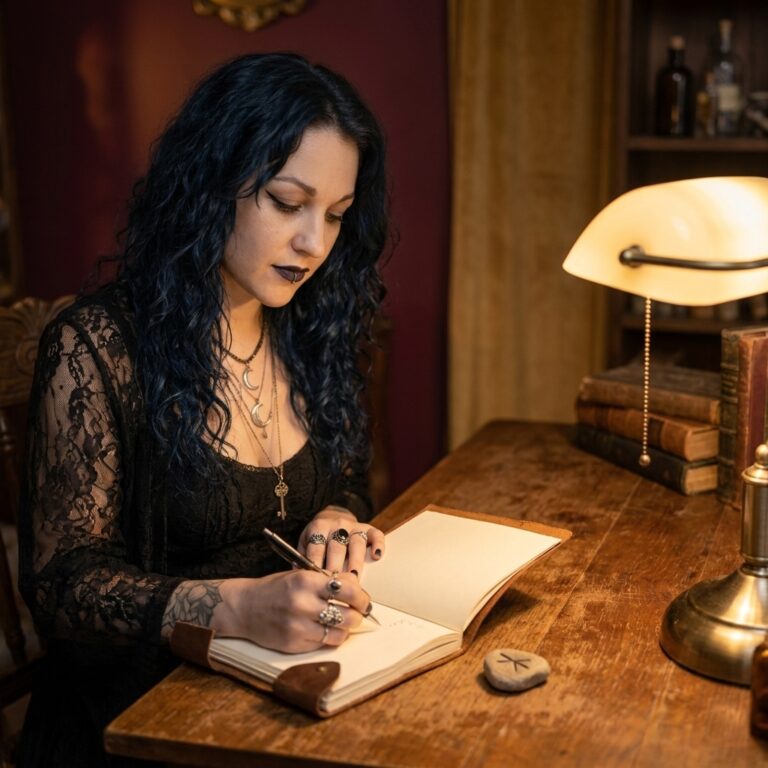
You don’t need carving tools or a full rune set to begin. Here’s the practice I suggest.
Step 1: Choose One Rune
First, choose one of the four protection runes above. Use the sharp-or-steady question to decide. Is something pushing in, or do you need to hold on?
Step 2: Draw It in Your Journal
Next, draw the rune slowly on a fresh page. Take your time with each line. Drawing it by hand makes you pay attention to it.
Step 3: Finish the Sentence
Then write: “Today, I protect my peace by…” and finish the sentence. Keep it honest and small.
Step 4: Name One Action
Finally, name one action you can actually take today. It might be declining a request, leaving a group chat or going to bed earlier. That action is where the protection becomes real.
Belief, Intention & The Power of Magic
Witchcraft, spells, and manifestation are deeply rooted in belief, intention, and spiritual practice. If these practices do not resonate with you, this may not be the path for you, and that’s perfectly okay. But if you believe in divine powers, trust your intentions, and feel drawn to the mysteries of the unseen, we invite you to continue exploring with Madame Celestine and discover the magic that speaks to your soul.
Protection Bind Runes: What to Know First
A bind rune joins two or more runes into one design. Many people ask for a protection bind rune for a tattoo or a pendant, often combining Algiz with another rune. Here are three things to check before you commit.
First, keep it simple. Two or three runes read more clearly than six. Second, check every shape against a reliable chart. Many designs online contain runes drawn wrong, or symbols that aren’t runes at all. Third, know what each part means to you. If you can’t explain the design in a sentence, it’s probably too crowded.
Is There a Banishing Rune?
No single rune was historically recorded as a “banishing rune.” Instead, modern practitioners choose runes for banishing by their meaning. A sharp rune like Thurisaz is a common choice, because its thorn already pushes things away. If you’re thinking about more serious banishing work, it’s wise to understand the difference between protection and removal first.
Viking Runes for Protection: What the Vikings Actually Used
Here’s a twist many guides skip. By the Viking Age, Scandinavians no longer used the 24-rune Elder Futhark. Instead, they wrote with a shorter row of 16 runes [2]. And in that shorter row, Algiz as we know it was gone.
Its shape didn’t vanish, though. Turned upside down, it became a rune called yr (ᛦ). Upright, the same shape turned up again as maðr (ᛘ), the rune for “man” [5]. So when you see Algiz sold as a “Viking protection rune,” know that a Viking would have read that shape as a different letter entirely.
Does that make modern protection runes less meaningful? Not necessarily. Meanings grow over time, and modern readers have every right to use the Elder Futhark symbolically. It just means the honest label is “Norse,” “Germanic” or “Elder Futhark,” rather than “Viking.”
Common Mistakes With Protection Runes
The first mistake is choosing a rune only for its look. A design that looks powerful may be a stave, an Ogham letter or a garbled shape. So check the source before you carve or ink anything.
The second mistake is expecting a symbol to do the whole job. Protection runes can remind you of a boundary, but you still have to hold it. That’s why the journal practice above ends with one real action.
The third mistake is ignoring context. Because extremists have misused a few runes, it’s worth knowing a symbol’s full history before you wear it in public.
Frequently Asked Questions
What is the strongest rune for protection?
Algiz is the most widely used protection rune. Still, the best choice depends on what you need to guard, whether that’s your boundaries, your time, your endurance or your principles.
What is the Norse rune for home protection?
Algiz is the usual choice for home protection. Many people place it near the front door, where the home meets the outside world.
Is the Helm of Awe a rune?
No. The Helm of Awe is an Icelandic magical stave, a drawn symbol rather than a letter of the runic alphabet.
Can I wear Algiz without it being seen as a hate symbol?
Yes, many neo-pagans wear it with no racist meaning. Because extremists have also used it, though, be ready to explain what it means to you.
Do protection runes work?
Practitioners believe protection runes focus intention and remind you to guard your peace. They work best alongside practical steps, such as setting boundaries and locking your door.
References
- Runes. Emma Groeneveld, World History Encyclopedia, June 19, 2018. https://www.worldhistory.org/runes/
- Runes and Runic Inscriptions. Vikings in the East Midlands, University of Nottingham. https://emidsvikings.ac.uk/resources/runes-and-runic-inscriptions/
- Runic Amulets and Magic Objects. Mindy MacLeod and Bernard Mees, Boydell Press, 2006. https://boydellandbrewer.com/?p=54146
- The Anglo-Saxon Rune Poem (translations from Stephen Pollington, Rudiments of Runelore). Þa Engliscan Gesiþas (The English Companions). https://www.tha-engliscan-gesithas.org.uk/written-and-spoken-old-english/old-english-alphabet-2/the-anglo-saxon-rune-poem/
- Algiz. Wikipedia. https://en.wikipedia.org/wiki/Algiz
- Life Rune. Hate Symbols Database, Anti-Defamation League. https://www.adl.org/resources/hate-symbol/life-rune
- Magical Staves (Galdrastafir). Strandagaldur, the Museum of Icelandic Sorcery and Witchcraft. https://galdrasyning.is/en/?p=2650
- Vegvísir. Wikipedia. https://en.wikipedia.org/wiki/Vegv%C3%ADsir
- Ogham writing. Encyclopaedia Britannica. https://www.britannica.com/topic/ogham-writing
Not sure where to start? You don’t have to do this alone.
Madame Celestine offers guided spellwork for beginners — real support for your first working, not just another guide to read.
Related reading: Uruz Rune Meaning: Strength, Health and Wild Power · Stag Symbolism: The Spiritual Meaning of a Stag
About Madame Celestine
Madame Celestine has practiced and taught spellwork, divination, and seasonal ritual for over two decades, helping newcomers build a grounded, confident practice from their very first spell.