
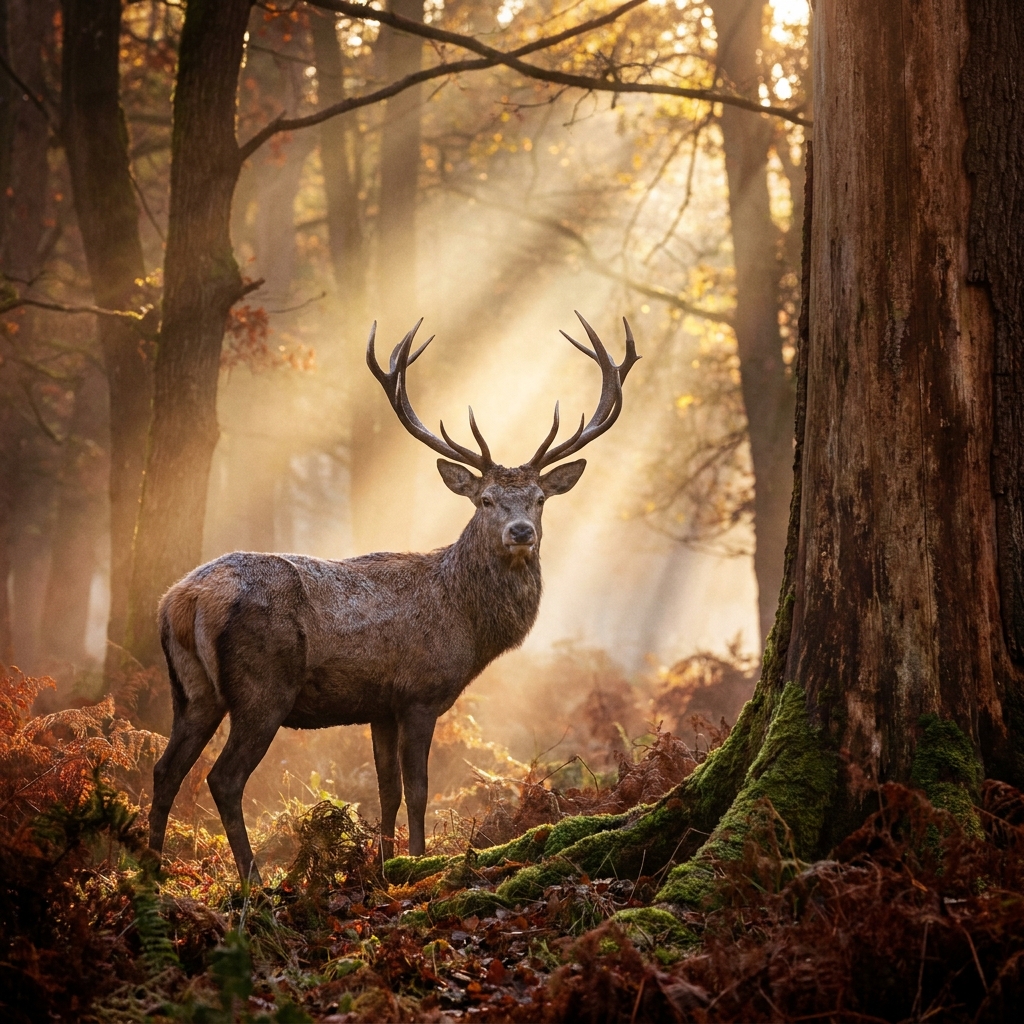
Stag symbolism usually starts with a moment: a stag stepping out of the trees, staring at you across a field, then gone. People want to know what that meant, and what a stag symbolizes more broadly. My answer is that it depends on which old story you’re standing in. In this article, I’ll walk you through the stag as it appears in Celtic carvings, a medieval bestiary, a saint’s legend, a king’s badge and an old grimoire. Then we’ll turn to the little stag beetle and to working with the stag as a spirit animal.
- What Does a Stag Symbolize? Stag Symbolism in Brief
- The Horned One: Cernunnos and Celtic Stag Symbolism
- Renewal at the Spring: Stag Symbolism in a Medieval Bestiary
- The Cross Between the Antlers: Saint Eustace’s Stag
- The White Hart: Royal Stag Symbolism
- The Storm Stag: Furfur in the Lesser Key of Solomon
- Stag Beetle Symbolism: Thunder, Fire and Antler Jaws
- What Do Stags Represent? Five Faces of Stag Symbolism
- Hart and Hind: The Pair in Stag Symbolism
- Following the Antler Year
- Spirit Animal Stag: How to Work With Stag Energy
- Frequently Asked Questions
- References
What Does a Stag Symbolize? Stag Symbolism in Brief
A stag most often symbolizes renewal, wild sovereignty and a call to cross into something new. In the old sources, it also stands for spiritual thirst, royal favor and, in one grimoire, storms and passion. Its antlers carry the renewal meaning, because a stag sheds them and grows a fresh set every year.
That yearly regrowth is the root of most stag symbolism. Few animals grow a crown of bone, lose it and grow it back every single year. So whenever the question is what a stag means, I think that cycle of losing and regrowing is the right place to start.
After that, the other meanings layer on top. Each tradition below picked up a different side of the animal, and together they give you a much fuller answer than any single list of keywords could.
The Horned One: Cernunnos and Celtic Stag Symbolism
The oldest face of the stag in European religion belongs to Cernunnos, a Celtic god whose name means “Horned One.” He wore stag antlers and the torc, the sacred neck ring of Celtic gods and heroes. He is believed to appear on the Gundestrup cauldron, a silver vessel found in Denmark and dated to around the first century BCE. Encyclopaedia Britannica calls him a “lord of wild things.”[1]
One detail I find telling is a relief from Reims, in France. There, Cernunnos sits between figures matched with the Roman gods Apollo and Hermes.[1] In other words, the antlered god was important enough to share space with major gods of the Roman world.
For stag symbolism, Cernunnos gives us wild authority. Here the antlers are the crown worn by the one who rules the forest. If this side of the stag calls to you, the wider family of goddesses of the forest and wild animals is a natural next step.
Renewal at the Spring: Stag Symbolism in a Medieval Bestiary
Medieval bestiaries were illustrated books of animals, each beast paired with a lesson. The Aberdeen Bestiary, a manuscript now held and digitized by the University of Aberdeen, tells a remarkable story about deer.
According to its translation, after eating a snake, deer run to a spring. There they drink and “shed their long coats and all signs of old age.” The bestiary reads this as a picture of the penitent, who is renewed by “shedding their sin like old age.”[2]
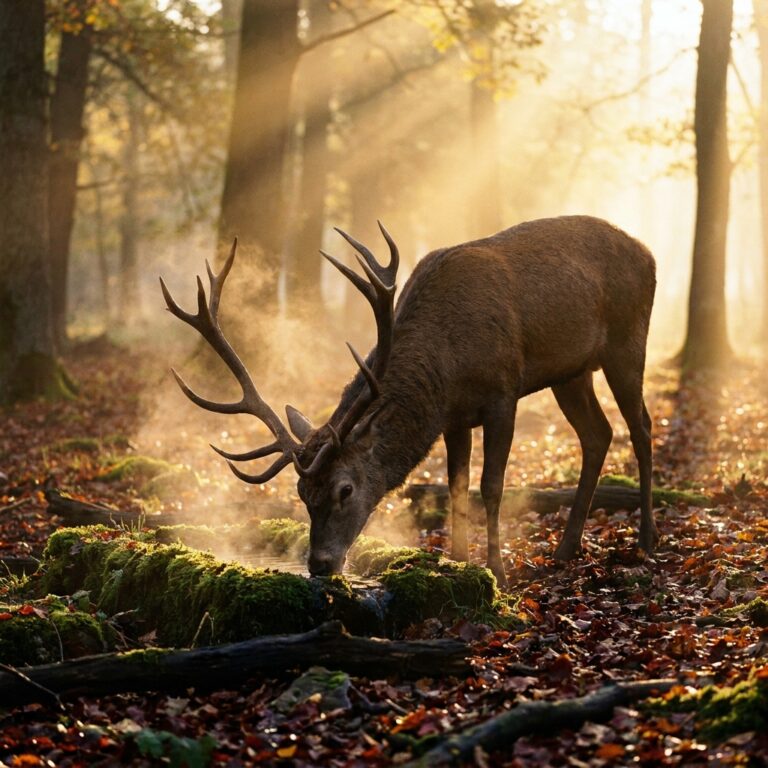
The same page also describes how deer cross wide rivers. Each one rests its head on the hindquarters of the deer in front, and they cross quickly so they don’t sink in the mire.[2] I love that image for anyone going through a hard passage. The herd gets across because each animal leans on the one ahead.
So the bestiary adds two meanings to stag symbolism. First, renewal after something poisonous has been faced and swallowed. Second, community during a crossing.
The Cross Between the Antlers: Saint Eustace’s Stag
Christian legend turned the stag into a messenger. The story of Saint Eustace, told in the medieval Golden Legend, begins with a Roman named Placidus out hunting. He chased a stag that broke away from a herd of harts. Then, between its antlers, he saw “the form of the holy cross,” shining brighter than the sun, with an image of Christ.[3]
Then Placidus answered, “I believe, Lord, that thou art he that made all things,” and he was baptized with his wife and sons.[3] A similar vision was later told of Saint Hubert as well.
In Christian stag symbolism, the stag is a call. It stops the hunter in his tracks and turns his whole life in a new direction. That’s the meaning I’d hold onto when a stag appears at a crossroads moment in your own life.
The White Hart: Royal Stag Symbolism
In medieval England, “hart” meant an adult male deer, and a white hart was something rarer still. Richard II made it his own badge. The National Gallery in London, which holds the Wilton Diptych, painted around 1395 to 1399, explains that Richard probably inherited the emblem from his mother’s white hind. The hart may also have been a pun on his name, written Richart in French.[4]
In the painting, the angels around the Virgin Mary wear white hart badges, marking them as Richard’s supporters. On the outside of one wing, a white hart with a crown around its neck lies chained on a bed of flowers.[4]
The white hart adds sovereignty and favor to stag symbolism. It marks someone as chosen, protected and set apart, although the chain is a reminder that even a royal stag can be bound.
The Storm Stag: Furfur in the Lesser Key of Solomon
Not every stag in the old books is gentle. The Goetia, the first part of the grimoire known as the Lesser Key of Solomon, was published in English by Samuel MacGregor Mathers in 1904. It lists Furfur as “a Great and Mighty Earl, appearing in the Form of an Hart with a Fiery Tail.”[5]
The same entry says Furfur can raise lightning, thunder and great storms. It also says he “will wittingly urge Love between Man and Woman.”[5] So the grimoire stag carries two forces at once: the storm and desire.
Working with Goetic spirits is a separate discipline with its own long protocols, and the grimoires themselves are full of protective tools for the magician. But it’s a useful reminder that the stag isn’t only a soft woodland symbol. In some traditions, it is wild, hot and hard to control.
Stag Beetle Symbolism: Thunder, Fire and Antler Jaws
The stag beetle earned its name because of its huge jaws. London’s Natural History Museum describes them as pincer-like and resembling deer antlers with several prongs.[6] The folklore around this beetle is just as striking as its looks.
For example, the Roman writer Pliny the Elder claimed that hanging stag beetles around children’s necks could ward off sickness. Later, people blamed them for house fires, saying they carried burning coals up into attics. And in German-speaking lands, they were tied to Donar, the thunder god, with names like Donnergueg, “thunder beetle.”[6]
So stag beetle symbolism splits two ways, much like stag symbolism itself. On one side, it’s a protective charm for children. On the other, it’s a carrier of fire and storms, which is the side most people remember.
What Do Stags Represent? Five Faces of Stag Symbolism
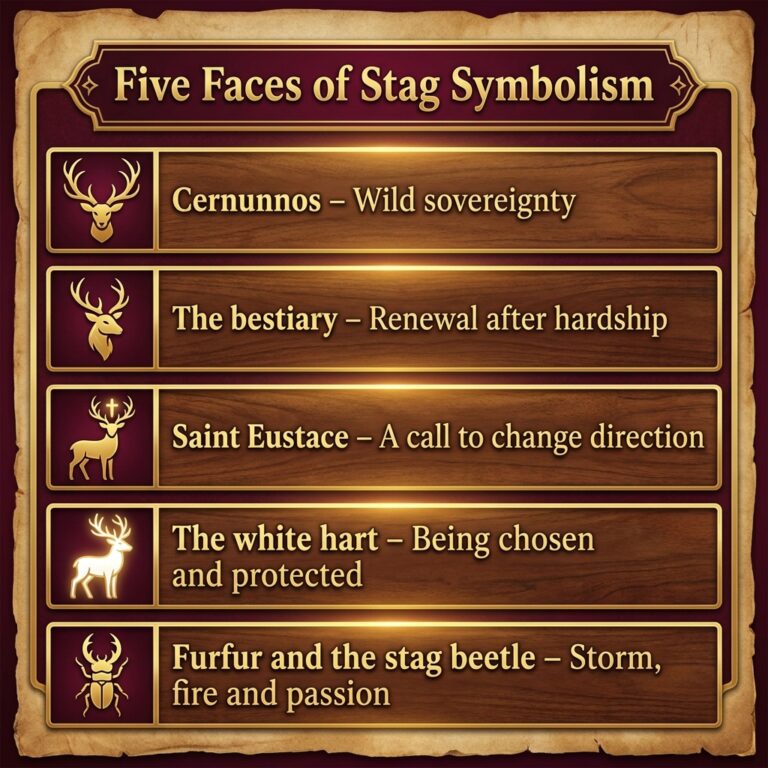
Put side by side, the traditions above give stag symbolism five distinct faces. The table sets them out.
| Tradition | The stag means |
|---|---|
| Cernunnos | Wild sovereignty |
| The bestiary | Renewal after hardship |
| Saint Eustace | A call to change direction |
| The white hart | Being chosen and protected |
| Furfur and the stag beetle | Storm, fire and passion |
Here’s what strikes me when I read them together. In almost every story, the stag shows up at a crossing. The bestiary deer move from old age to renewal and cross rivers together. Eustace’s stag turns a hunter into a believer. The white hart marks the line between ordinary people and the king’s own circle. Even Cernunnos sits at the edge between the wild and the settled world.
The second surprise is thunder. Furfur raises storms, and the stag beetle was called a thunder beetle.[5][6] So two very different creatures, one from a grimoire and one from German folklore, both carry the stag’s name into the storm.
This is my own reading of the sources, not an established rule. Still, it gives you a practical question. When a stag appears, ask yourself which crossing you’re at, and whether it feels like renewal, a calling or a storm.
Hart and Hind: The Pair in Stag Symbolism
Stag symbolism often focuses on the male, but the old sources keep pairing him with the female. Richard II’s white hart, the National Gallery suggests, came from his mother’s badge, a white hind.[4] The stag’s emblem was inherited from a doe.
I find that a useful correction to the idea of the stag as pure masculine force. The antlered one rarely stands alone. In the bestiary, deer cross rivers as a herd. In the Eustace story, the stag breaks away from a herd before it delivers its message. So when you work with stag energy, it’s worth asking who travels with you, and who you lean on during a crossing.
For partners, this gives a simple shared practice. Each person names one thing they want to grow and one thing they want to shed, then you speak them together beside the same bowl of water. The stag’s strength and the hind’s steadiness are meant to work as a pair.
Following the Antler Year
Because the stag’s meaning is tied to its antlers, you can follow its year as a ritual calendar. Red deer stags usually cast their antlers in late winter or early spring. The new set grows over the summer under a soft covering called velvet. By autumn, the antlers have hardened, and the rut, the mating season, begins.
That cycle maps neatly onto stag symbolism. Late winter suits release work, when you let go of what has run its course. Summer suits patient growth, with small steps taken every week. Autumn suits confidence and visible action, the season when the stag shows its full crown.
You don’t need to live near deer to use this. Simply check in at each turn of the year, and ask which stage of the antler cycle your own life feels closest to. Many practitioners pair that check-in with one of the full moon rituals they already keep.
Spirit Animal Stag: How to Work With Stag Energy
If the stag keeps showing up in your life, in dreams, on walks or in art you’re drawn to, many practitioners would call it a spirit animal. Here is a simple way to turn stag symbolism into a personal practice.
- Name the crossing. Write one sentence about the change you’re facing right now. Use the five faces above to decide which kind of stag energy you need.
- Choose a focus object. A picture of a stag works well. If you’d like a shed antler, buy one from a reputable seller or check your local rules before collecting, because laws on wildlife parts vary.
- Sit with water. Following the bestiary, place a bowl of fresh water beside the image. Spend a few minutes picturing what you’re ready to shed.
- Speak your intention. Say aloud what you want to grow back in its place, the way a stag regrows its antlers.
- Pour the water outside. Then note in a journal anything you notice over the following weeks.
Above all, treat any skull, antler or other part with respect. Keep it clean, keep it somewhere honored, and thank the animal when you work with it. If you’re unsure whether a sighting is a real message, this guide to signs from your spirit guides can help you tell the difference.
Belief, Intention & The Power of Magic
Witchcraft, spells, and manifestation are deeply rooted in belief, intention, and spiritual practice. If these practices do not resonate with you, this may not be the path for you, and that’s perfectly okay. But if you believe in divine powers, trust your intentions, and feel drawn to the mysteries of the unseen, we invite you to continue exploring with Madame Celestine and discover the magic that speaks to your soul.

Frequently Asked Questions
What does it mean when a stag crosses your path?
Many practitioners read it as a sign that you’re at a turning point. The stag’s old stories point to renewal, a new calling or a chance to step into your own authority.
What does a stag mean in a dream?
A dream stag often carries the same themes as a waking sighting: growth, leadership and change. Notice whether it was calm or charging, since that can show whether the change feels welcome or forceful.
Is stag symbolism only masculine?
No. Although a stag is a male deer, its themes of renewal and quiet authority belong to anyone. Many people of all genders feel drawn to stag energy.
Is it bad luck to see a stag beetle?
Old European folklore linked stag beetles with thunder and fire, but they were also used as protective charms. Today they’re a protected species in some places, so the kindest response is simply to let one be.
What is the difference between a stag and a hart?
Both words mean an adult male deer. “Hart” is the older English word, which is why it appears in medieval badges, bestiaries and grimoires.
References
- Cernunnos. Encyclopaedia Britannica. https://www.britannica.com/topic/Cernunnos
- The Aberdeen Bestiary, folio 13v. University of Aberdeen. https://www.abdn.ac.uk/bestiary/ms24/f13v
- Saint Eustace. Treasures of Heaven: Saints, Relics, and Devotion in Medieval Europe. Media Center for Art History, Columbia University. https://projects.mcah.columbia.edu/treasuresofheaven/saints/Eustace
- The Wilton Diptych, about 1395-9. The National Gallery, London. https://www.nationalgallery.org.uk/paintings/NG4451
- Seal of Furfur, from The Goetia: The Lesser Key of Solomon the King (1904), Samuel MacGregor Liddel Mathers. fromoldbooks.org. https://www.fromoldbooks.org/Mathers-Goetia/pages/034-Seal-of-Furfur/
- Interesting beetles. Natural History Museum, London. https://www.nhm.ac.uk/discover/interesting-beetles.html
Not sure where to start? You don’t have to do this alone.
Madame Celestine offers guided spellwork for beginners — real support for your first working, not just another guide to read.
Related reading: Cat Gods and Goddesses: From Bastet to Freyja’s Cats · Red Door Meaning: Protection, Welcome and Tradition

About Madame Celestine
Madame Celestine has practiced and taught spellwork, divination, and seasonal ritual for over two decades, helping newcomers build a grounded, confident practice from their very first spell.