
The divine feminine is everywhere in modern spirituality, yet few people can say what it actually means. Is it about women? About softness? About worshipping a goddess? The honest answer is richer than any of those. In this guide, you will learn how three very different traditions describe feminine divine energy, why one of them sees the feminine as the most active force in the universe, and how you can work with goddess energy in your own practice.
- What Is the Divine Feminine? It Is Not Just for Women
- 30,000 Years of Goddess Energy? The Venus of Willendorf
- Shakti: When the Feminine Is the Power That Moves
- Shekhinah: The Divine Feminine as Sacred Presence
- How to Connect With Divine Feminine Energy: A Simple Ritual
- Frequently Asked Questions
- References
What Is the Divine Feminine? It Is Not Just for Women
First, a common misunderstanding. The divine feminine is not the same as being female. Instead, it names a set of sacred qualities that every person can carry, whatever their gender.
Those qualities usually include intuition, creativity, nurture, receptivity and a deep bond with the body and the cycles of nature. However, many traditions also give the feminine a fierce side. It can protect, destroy and transform as well as soothe.
Most modern practitioners see this energy as one half of a balance. Its partner is the divine masculine, often linked to focus, action and structure. So the goal is not to reject one side. Rather, it is to notice which side you have neglected and bring it back into balance.

30,000 Years of Goddess Energy? The Venus of Willendorf
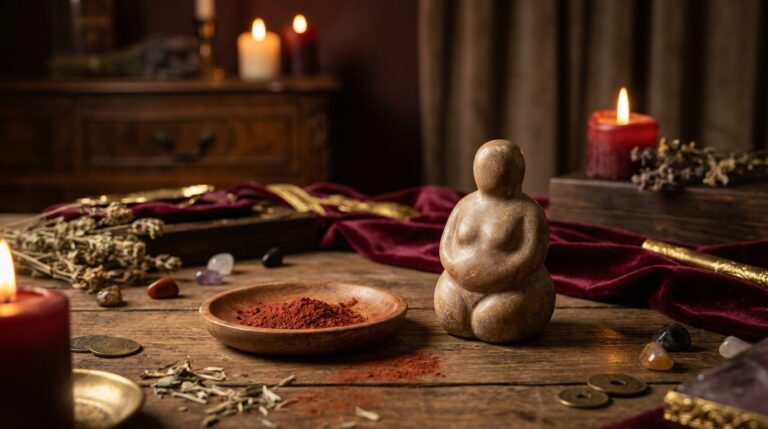
People often point to one tiny statue as proof that humans have honored the feminine for tens of thousands of years. An unknown artist carved the Venus of Willendorf from limestone around 28,000 to 25,000 BCE. It turned up in Austria in 1908 and still shows traces of red ochre, a natural pigment.[1] It is also small enough to fit in the palm of your hand.[1]
Here is the catch, though. Modern scholars gave it the name “Venus,” after the Roman goddess of love. It tells us about their assumptions, not about the people who made it.[1] Art historians also warn against assuming she was a fertility goddess, because we have no written record of her purpose.[1]
Still, the figure matters. Whatever she meant, someone spent real time and care on a full, rounded female body. For many practitioners today, she stands as a reminder that honoring the body is one of the oldest human impulses.
Symbols carry this story too. For example, the spiral is often tied to goddess traditions, and our guide to the sacred spiral and its goddess symbolism explores what it means.
Shakti: When the Feminine Is the Power That Moves
In the West, the feminine is often cast as the passive side. Hindu thought flips this idea on its head. The Sanskrit word shakti means “power,” and it names the active side of the divine.[2]
In this view, shakti is the dynamic energy behind the creation, upkeep and destruction of the universe.[2] It is usually pictured as female. Meanwhile, her partner, the god Shiva, stands for stillness. Shakti is what stirs that stillness into motion.[2]
Shakti also shows up as named goddesses, including the gentle Uma, the warrior Durga and the fierce Kali.[2] As a result, feminine power here is not one mood but a full range, from tender to terrifying. That is a useful lesson for anyone who thinks goddess energy has to be sweet.
Shekhinah: The Divine Feminine as Sacred Presence
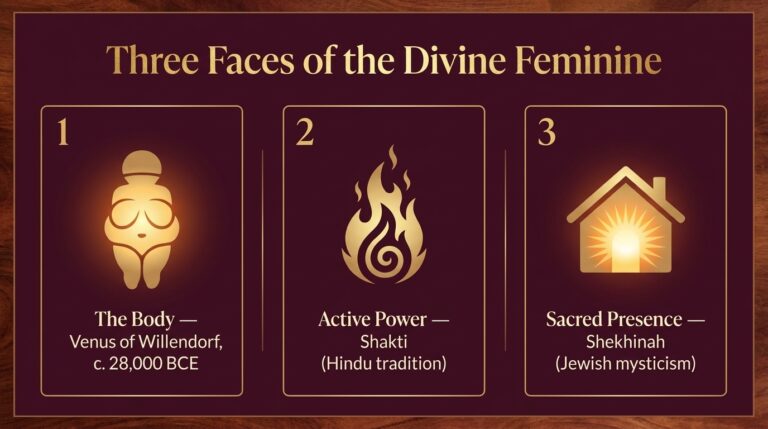
Judaism offers a quieter but equally striking image. The Hebrew word Shekhinah comes from a root meaning “to dwell.” In early rabbinic writing, it simply meant God’s presence among people.[3] The Talmud says this presence rests even when just two people study Torah together.[3]
Later, Jewish mystics gave the Shekhinah a clearly feminine face. The Zohar, a core text of Kabbalah, compares her to a mother, sister, daughter and bride.[3] In the Kabbalistic map of ten divine emanations, she sits at the lowest point, the one closest to the physical world.[3]
That placement carries a lovely idea. Here, the sacred feminine is the part of the sacred that comes nearest to everyday life. So you do not find her by escaping the world. Instead, you meet her in it.
How to Connect With Divine Feminine Energy: A Simple Ritual
This short ritual draws on all three traditions: the body, active power and sacred presence. You will need a white or silver candle, a bowl of water and a journal. A rose or a few flower petals are a nice addition.
- Choose your moment. Many practitioners work on a Monday, the moon’s day, or during the full moon. Practitioners link both with feminine energy.
- Settle into your body. Sit comfortably and place one hand on your belly. Take ten slow breaths, because the divine feminine starts with being present in your body.
- Light the candle. As you light it, invite in the quality you most need, such as rest, creativity or courage.
- Work with the water. Dip your fingers into the bowl and touch your brow, lips and heart. Water is the element most often tied to intuition and emotion.
- Name both faces. Next, say one gentle quality and one fierce quality you want to grow. This honors the full range that Shakti shows us.
- Write and close. Finally, journal for five minutes about what came up. Then thank the energy you called on and let the candle burn down safely, or snuff it out.
Belief, Intention & The Power of Magic
Witchcraft, spells, and manifestation are deeply rooted in belief, intention, and spiritual practice. If these practices do not resonate with you, this may not be the path for you, and that’s perfectly okay. But if you believe in divine powers, trust your intentions, and feel drawn to the mysteries of the unseen, we invite you to continue exploring with Madame Celestine and discover the magic that speaks to your soul.
Frequently Asked Questions
Can men connect with the divine feminine?
Yes. It describes qualities such as intuition, creativity and nurture, and every person carries them in some measure, whatever their gender.
Is the divine feminine a specific goddess?
Not one single goddess. It is a broad idea that different traditions express through many figures, such as Shakti’s forms in Hinduism or the Shekhinah in Jewish mysticism.
What is the difference between divine feminine and divine masculine?
The divine feminine is often linked to intuition, receptivity and cycles, while the divine masculine is linked to focus, action and structure. Most practitioners aim to balance the two.
Is goddess energy always gentle?
No. Many traditions include fierce feminine forms, such as the Hindu goddesses Durga and Kali, who protect and destroy as well as nurture.
How do I know if my feminine side is out of balance?
Many practitioners notice it as constant pushing, little rest, or feeling cut off from their body and intuition. Slowing down and tuning into your body is the usual first step.
References
- Beth Harris and Steven Zucker. Nude Woman (Venus of Willendorf). Art History I (Lumen), Humanities LibreTexts. https://human.libretexts.org/Bookshelves/Art/Book:_Art_History_I_(Lumen)/02:_The_Birth_of_Art/2.04:_Nude_Woman_(Venus_of_Willendorf)
- Jean Johnson. Shakti: The Power of the Feminine. Asia Society. https://asiasociety.org/education/shakti-power-feminine
- Shekhinah: The Divine Feminine. My Jewish Learning. https://www.myjewishlearning.com/article/the-divine-feminine-in-kabbalah-an-example-of-jewish-renewal/
Not sure where to start? You don’t have to do this alone.
Madame Celestine offers guided spellwork for beginners — real support for your first working, not just another guide to read.
Related reading: Celtic Pentacle: Spiritual Meaning, Symbolism & Power: Symbolism, Interpretation & Ritual Practice · Working with Echoes of the Ancients: Pagan Gods of Music: Ritual Context, Meaning & Practice

About Madame Celestine
Madame Celestine has practiced and taught spellwork, divination, and seasonal ritual for over two decades, helping newcomers build a grounded, confident practice from their very first spell.