
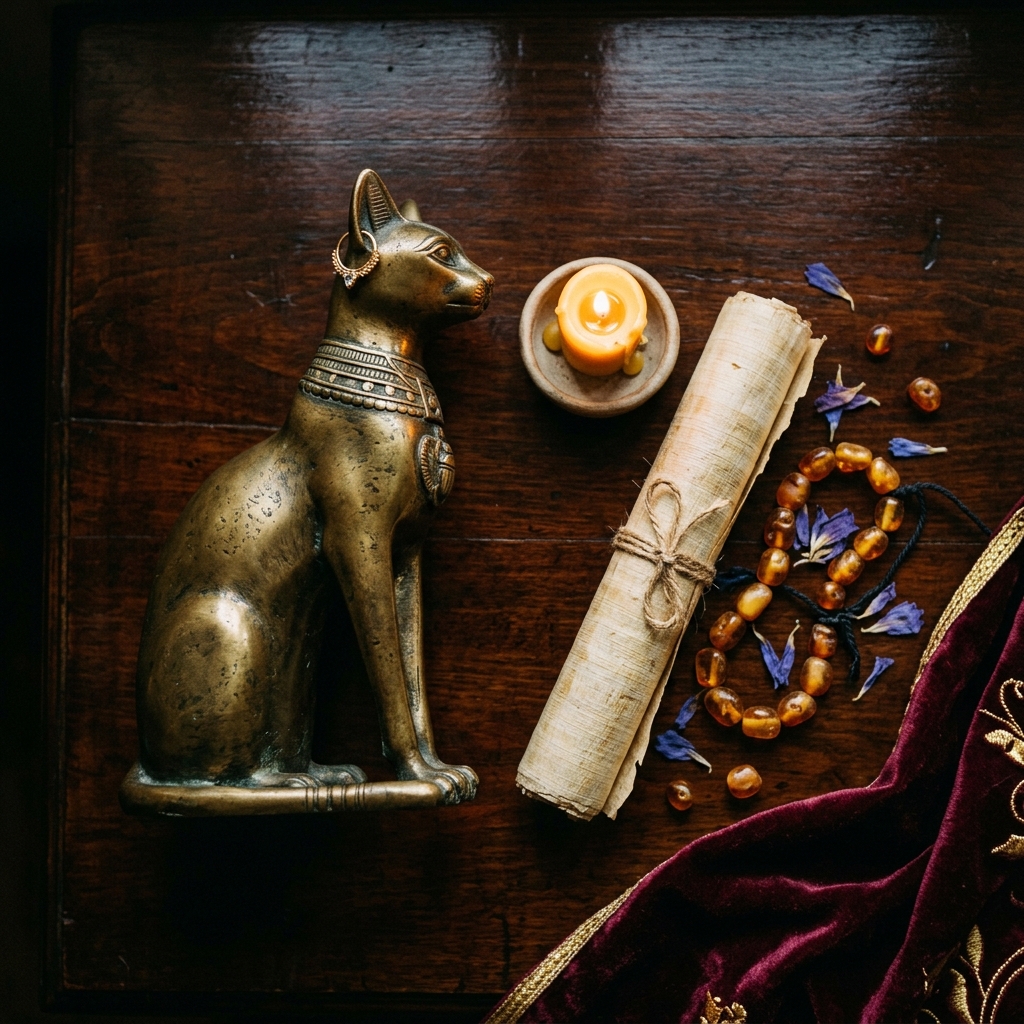
Who is the god of cats? The short answer is Bastet, the Egyptian goddess who began as a lioness and slowly became the gentle cat we know from museum statues. However, she was never alone. Egypt had several feline deities, and the Norse goddess Freyja rode in a chariot pulled by cats. In this guide, you’ll meet the main gods and goddesses of cats, learn where their stories come from, and see how people honor them today. You’ll also find out why the Greeks never had a cat god of their own.
- Bastet: The Lioness Who Became Egypt’s Cat Goddess
- Bubastis: The River City of the God of Cats
- Sekhmet, Mafdet and Ra: Was Bastet the Only God of Cats?
- Freyja’s Cats: The Norse Goddess Behind Two Felines
- Is There a Greek God of Cats?
- Beyond Egypt: Other Deities Associated With Cats
- Honoring the God of Cats Today: A Simple Bastet Prayer
- Frequently Asked Questions
- References
Bastet: The Lioness Who Became Egypt’s Cat Goddess
Bastet was the daughter of Ra, the Egyptian sun god.[1] In her earliest images, however, she was not a house cat at all. Instead, she was worshiped as a lioness, and only later took the form of a cat.[1] Britannica links this softening to the taming of the cat around 1500 BCE.
That change matters, because it tells us what Egyptians wanted from her. A lion-headed goddess could guard a king in battle. A cat-headed goddess, by contrast, stressed her peaceful side.[2] So Bastet became a protector of the home, of women, and of fertility.
Her statues often show her holding a sistrum, a metal rattle shaken in temple music.[2] Some also show kittens at her feet. Her name is harder to pin down. Many Egyptologists connect it to the word for an ointment jar, which would tie her to perfume and protective oils. Either way, she was far more than a pet with a crown.
So why a cat at all? The answer is practical. Egypt lived on stored grain, and grain drew mice, rats and snakes. Cats hunted all three, so they guarded both food and families. The Egyptian word for cat was miu, which simply copies the sound a cat makes. In daily life, then, the god of cats stood for a very useful neighbor. Her worship grew from real gratitude, not just from a love of pretty animals.
Bubastis: The River City of the God of Cats
Bastet’s home city was Bubastis, in the Nile Delta.[1] Today the site is called Tell Basta. Around 450 BCE, the Greek historian Herodotus described her yearly festival there. People traveled from all over Egypt to take part.[3]
According to Herodotus, locals claimed that about 700,000 adults gathered for it.[4] That figure is surely boastful, but it still shows how popular the god of cats had become. The high point came when her cult statue sailed on the sacred canals in a holy boat.[3] In other words, the goddess herself was carried out to meet the crowds.
Bubastis also held something stranger. Digs there uncovered thousands of cat mummies and many cat statuettes.[2] Large cat cemeteries were also made at Memphis, where Bastet had a second major cult.[1] Pilgrims left these mummies and bronzes as gifts. As a result, a small cat figure was among the most popular offerings of its day.[2]
Sekhmet, Mafdet and Ra: Was Bastet the Only God of Cats?
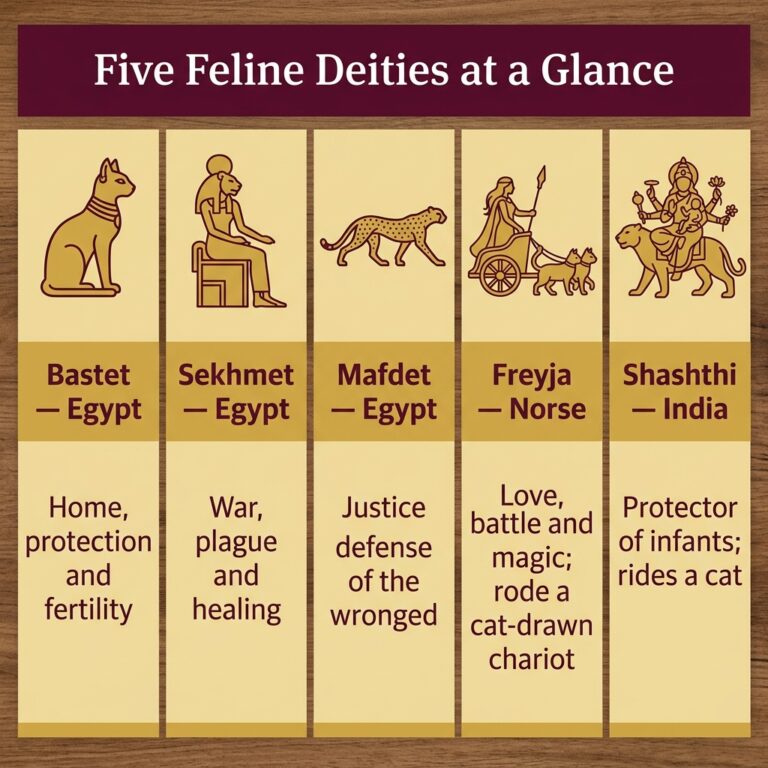
Bastet was the best-known cat deity, yet she had older and fiercer relatives. The first was Mafdet, an early feline goddess of justice. Of all the feline gods’ names in Egypt, hers is among the oldest. Both Bastet and Sekhmet took their early forms from her as defenders of the wronged.[4]
Sekhmet, next, kept the full lioness form. Her name means “the powerful one,” and she stood for plague, war and healing all at once. Egyptians often treated Sekhmet and Bastet as two moods of the same power. So the angry lioness and the calm cat could be one goddess, seen at different moments.
Finally, even the sun god took feline shape. In a well-known scene from the Book of the Dead, Ra appears as the “Great Cat.” He slays the chaos serpent Apophis beside a sacred tree. This image explains why cats were seen as guardians. After all, a cat that kills snakes near the house is doing the sun’s work on a small scale.
The respect ran deep. For example, a later story claims the Persian king Cambyses painted Bastet’s image on his soldiers’ shields at Pelusium. Egyptian troops then refused to fight for fear of harming the goddess.[4] Historians treat the tale with caution. Still, it shows how people remembered Egypt’s bond with its cats.
Freyja’s Cats: The Norse Goddess Behind Two Felines
Far to the north, cats appear in a very different myth. Freyja was the Norse goddess of love, fertility and battle. Among her vehicles was a chariot drawn by cats.[5] She also chose half of the heroes slain in battle for her own great hall.[5]
Freyja was also said to have taught witchcraft to the other gods.[5] This is one reason modern witches feel drawn to her. Her cats, then, belong to a goddess of both passion and magic.
One detail often surprises readers. Our main account of her cats comes from the Prose Edda, which the Icelandic writer Snorri Sturluson wrote around 1220. The medieval sources do not name the cats. So the names you may see online are modern inventions, not ancient lore. Also, no text explains why cats pull her chariot. Instead of guessing, it is wiser to treat the image simply as it stands.
It also helps to know how Snorri worked. He was a Christian writing two centuries after Iceland converted. So he recorded the old myths as heritage, not as living worship. Some details may be his own tidy summaries. That is why careful readers use his work with respect, but also with a little caution.
Is There a Greek God of Cats?
Many people search for a god of cats in Greek myth. However, there isn’t one. In early Greece, pet cats were rare, and many homes kept tame weasels to catch mice instead. So the Greeks had little reason to create gods of cats.
When Greek visitors met Bastet, they simply matched her with a goddess they already knew. They linked her closely with Artemis, the huntress.[4] Because Artemis had a twin brother, Apollo, some Greeks felt Bastet should have one too.[4]
Later, the Roman poet Ovid told a story about the gods fleeing the monster Typhon to Egypt. There, each god hid in animal form, and Diana (the Roman Artemis) became a cat. Hecate is also tied to cats in modern practice. That link, though, is newer than most people assume. So if you want a goddess of cats in Greek terms, Artemis is the closest honest answer.
Beyond Egypt: Other Deities Associated With Cats
Cats appear beside gods in other lands too. In India, for instance, the goddess Shashthi protects infants and childbirth. She is honored mainly in Bengal and Odisha, often on the sixth day after a birth.[6] In art and folk worship, she usually rides a cat.
In British folklore, by contrast, cats were not gods at all. Instead, they became the familiars of witches. The old word “grimalkin” meant an elderly female cat. A version of it, “Graymalkin,” is even called out in the opening scene of Macbeth. This matters, because it shows how the same animal can be sacred in one culture and suspect in another.
Japan offers a third path. The beckoning cat, or maneki-neko, is a luck charm rather than a deity. People place it in shops to invite customers and good fortune. Like spider figures such as Anansi, it shows how an ordinary creature can carry deep meaning. You can read more in our guide to spider deities and the weavers of fate.

Honoring the God of Cats Today: A Simple Bastet Prayer
Many modern pagans choose to honor Bastet at home. There is no single ancient rite to copy. Instead, you can build a small practice from what we know about her cult.
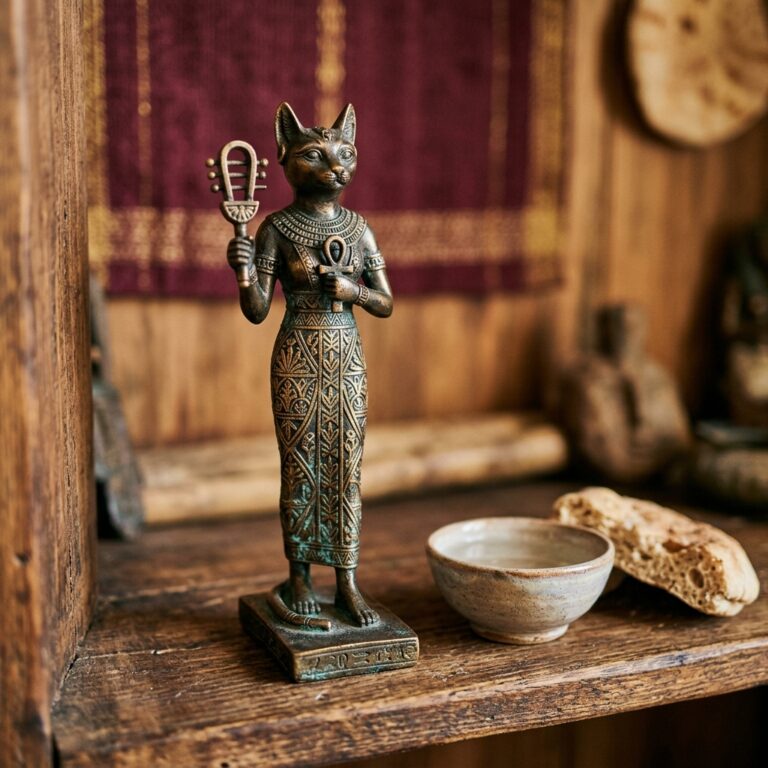
First, set up a small, quiet shelf. A cat figure or an image of Bastet works well, since statuettes were her most common offerings. Next, add a bowl of clean water and a small dish of bread. Egyptians often offered bread, beer and perfume to their gods. A dab of scented oil also fits, given the likely link between her name and ointment jars.
Then, light a candle and speak a short Bastet prayer. It should be your own words, rather than a text pretending to be ancient. For example: “Bastet, lady of the home, keep this house safe. Guard those who sleep here, and guard the small ones too.” Afterward, sit in silence for a minute.
Some people prefer Freyja to an Egyptian god of cats, and that choice is fine too. Finally, give something real. Many practitioners donate to a cat shelter as a modern offering. This keeps the heart of the old cult alive, which was care for living cats.
There are a few common mistakes to avoid. First, don’t treat Bastet and Sekhmet as fully the same. Sekhmet is honored with more caution. Second, be wary of “ancient” prayers you find online without a source. Also, never leave food on an altar that could harm a pet. Chocolate, onions and grapes are all dangerous for cats.
Belief, Intention & The Power of Magic
Witchcraft, spells, and manifestation are deeply rooted in belief, intention, and spiritual practice. If these practices do not resonate with you, this may not be the path for you, and that’s perfectly okay. But if you believe in divine powers, trust your intentions, and feel drawn to the mysteries of the unseen, we invite you to continue exploring with Madame Celestine and discover the magic that speaks to your soul.
Frequently Asked Questions
Who is the god of cats?
The best-known god of cats is Bastet, an Egyptian goddess who began as a lioness and later took a cat’s form. Sekhmet and Mafdet were other feline deities in Egypt.
Is there a god of cats in Greek myth?
No, the Greeks had no goddess of cats of their own. Instead, they linked Bastet with Artemis, and Ovid later told of Diana hiding as a cat.
Which goddesses are associated with cats outside Egypt?
Freyja rode in a chariot pulled by cats in Norse myth. In India, the goddess Shashthi, who protects infants, is often shown riding a cat.
What were the names of Freyja’s cats?
The medieval Norse sources never name them. So any names you see today are modern additions.
Is there an ancient Bastet prayer I can use?
No complete ancient prayer to Bastet is widely known today. Most people write a short prayer in their own words instead.
Why did Egyptians mummify so many cats?
Pilgrims gave cat mummies to Bastet as offerings at her temples. As a result, thousands were buried at Bubastis and Memphis.
References
- Bastet. Encyclopaedia Britannica. Revised and updated by Adam Augustyn. https://www.britannica.com/topic/Bastet
- Bastet, Late Period–Ptolemaic Period (664–30 BCE). The Metropolitan Museum of Art. https://www.metmuseum.org/art/collection/search/551774
- Tell Basta/Bubastis. Julius-Maximilians-Universität Würzburg, Faculty of Humanities. https://www.phil.uni-wuerzburg.de/en/tell-basta-bubastis/
- Bastet. Joshua J. Mark. World History Encyclopedia, July 24, 2016. https://www.worldhistory.org/Bastet/
- Freyja. Encyclopaedia Britannica. https://www.britannica.com/topic/Freyja
- Shashthi. Encyclopaedia Britannica. Revised by Matt Stefon. https://www.britannica.com/topic/Shashthi
Not sure where to start? You don’t have to do this alone.
Madame Celestine offers guided spellwork for beginners — real support for your first working, not just another guide to read.
Related reading: Thurisaz Rune Meaning: Thor’s Rune of Force and Protection · Spider Deities: Anansi, Arachne and the Weavers of Fate

About Edmund Hale
Edmund Hale is the pen name our editorial team uses for articles on grimoires, Qabalah, ceremonial magic and British folklore. Articles under this byline are researched from published sources and reviewed by Madame Celestine before publishing.