
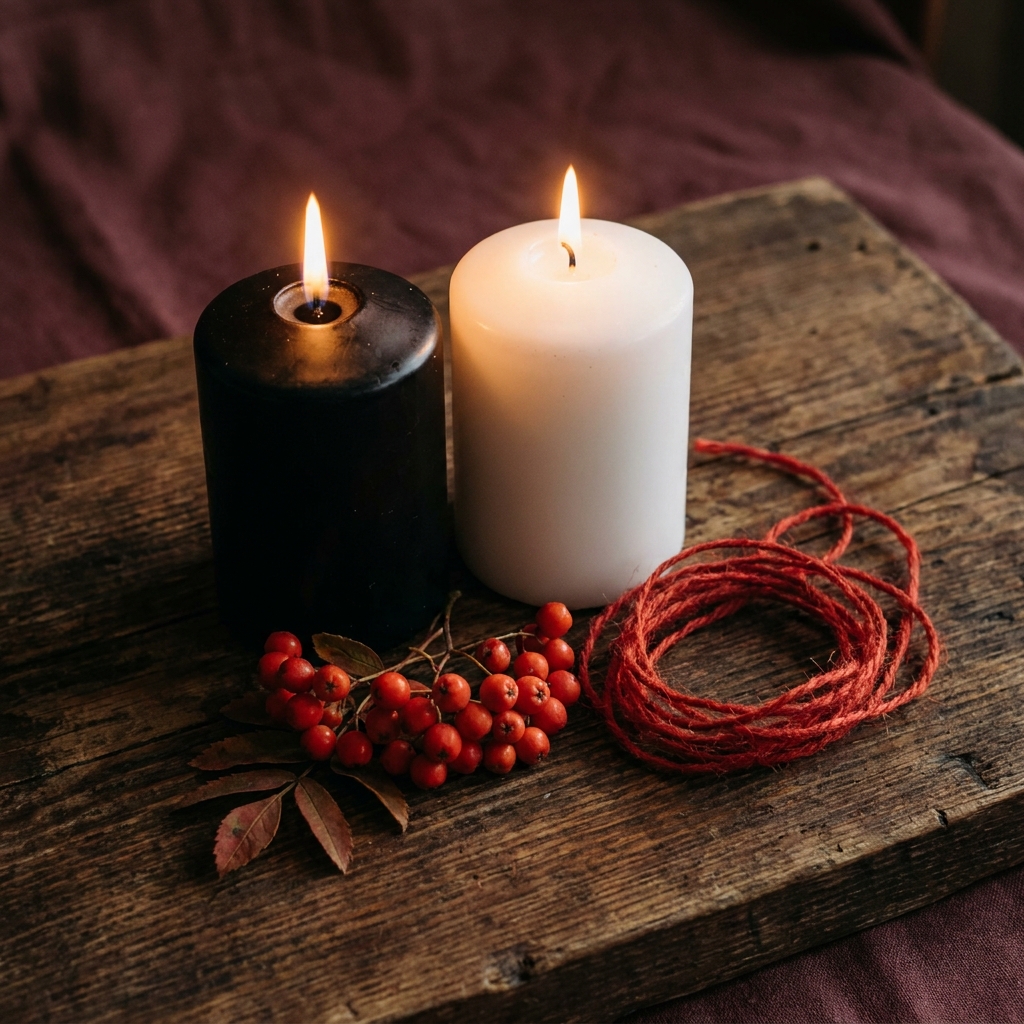
Standing in front of a shelf of spell candles, most people ask the same thing: which protection candle color actually fits what they need? The honest answer depends on what you want the protection to do. Practitioners believe some colors soak up harm, while others push it away. This guide covers the colors modern witches use for protection and why white can stand in for almost any of them. It also looks at what much older folk customs did with color long before candle shops existed. By the end, you’ll be able to pick a color on purpose.
- What Color Candle Is for Protection? The Short Answer
- Black, White and Beyond: Every Protection Candle Color Explained
- Why a White Candle Can Replace Any Other Color
- Colors of Protection Beyond the Candle: What Cultures Share
- How to Choose Your Protection Candle Color
- How to Burn a Protection Candle, Step by Step
- Common Mistakes When Picking a Protection Candle
- Frequently Asked Questions
- References
What Color Candle Is for Protection? The Short Answer
Black and white are the two most common choices for a protection candle color in modern witchcraft. Witches burn black to absorb and banish harmful energy. They burn white to purify and shield, and white can replace any other color. Red, blue, purple and brown cover more specific kinds of protection, which the next section explains.
Still, color is only one part of the work. Practitioners also weigh timing, the herbs or oils used on the candle, and above all the intention spoken over it. So treat the list below as a starting map, since books and teachers disagree on the finer details. For a wider view of where candles fit, see this overview of protection spell work.
Black, White and Beyond: Every Protection Candle Color Explained
Most color meanings in candle magic come from modern correspondence tables. A correspondence is simply an agreed link between a color, herb or day and a purpose. These tables vary from book to book. However, the core meaning of each protection candle color stays fairly steady.

Black: The Protection Candle Color That Absorbs
Black is the color most people picture for protection. Physically, black surfaces absorb light instead of reflecting it. Practitioners carry that idea over to energy, so they treat a black candle as a sponge for envy or ill will. It’s also the usual choice for banishing, which means sending an unwanted influence away for good.
Black’s protective reputation is older than modern witchcraft, too. For example, in parts of Asia, children have sometimes had their faces blackened near the eyes to guard them against the evil eye.[1] In that custom, black works as a shield placed exactly where people thought harm got in.
White: The All-Purpose Shield
White carries links to purity, clearing and blessing. Many witches burn a white candle to cleanse a room first and then hold a protective boundary around it. Because of that, white is often the first candle a beginner buys. It also works as a stand-in when you don’t have the right protection candle color on hand, as a later section explains.
Red: A Protection Candle Color for Courage
Practitioners reach for red when protection needs strength behind it. They turn to it for courage and for standing firm against someone hostile. In British folk belief, red was once seen as the best protection against magic itself. That’s why people sewed rowan crosses bound with red thread into coats or carried them in pockets, from Scotland down to Cornwall.[2] An old rhyme even claimed that rowan and red thread made witches lose their speed.
Blue: Calm Protection and Healing
Blue is the gentlest protection candle color. Practitioners use it for peace at home, safe travel and calm after a conflict. It’s also the most common answer to “what color candle for healing,” often paired with green. In this use, the candle supports rest and recovery in a spiritual sense, alongside medical care and never in place of it.
Blue has deep roots as a ward as well. Blue eye-shaped amulets called nazars are still sold in Turkey as protection against the evil eye.[1]
Purple and Brown: Spiritual and Household Protection
Purple is the protection candle color for psychic and spiritual work. Some practitioners light it before divination or meditation, so the work stays clear of unwanted influences. Brown, by contrast, is the practical, earthy choice. Witches use it to protect a house, a family’s land or pets, because brown suggests stability and the ground underfoot.
Why a White Candle Can Replace Any Other Color
Ask a group of witches what to do without the right candle, and most will say the same thing: use white. This rule shows up in book after book, and it has a neat parallel in physics. In 1665, Isaac Newton passed sunlight through a prism and split it into a band of colors. Then he used a second prism to combine those colors back into white light. That showed white light holds every color we can see.[3]
Of course, witches didn’t need Newton to start using white this way. Still, the comparison makes the logic easy to remember. White is treated as a “full” color, so your intention picks out the part you need. For that reason, many practitioners suggest saying the missing color’s purpose out loud when you light a white candle in its place.
Colors of Protection Beyond the Candle: What Cultures Share
Candle magic is only one place where color guards people. Folk traditions around the world chose protective colors long before shops sold spell candles. Put side by side, a pattern starts to show.
In the Lowcountry of South Carolina and Georgia, families painted porch ceilings a pale robin’s egg blue. Gullah Geechee belief held that the color kept away spirits called boo hags. (“Haint” is an old Southern word for a ghost, which is how the shade got its name.)[4] In China, one New Year legend says the monster Nian feared red, so people wore red to drive it off and protect their families.[5]
Poland offers a twist. There, Catholics took home a candle blessed on February 2, known as the gromnica or “thunder candle.” It was lit during storms and brought out when someone lay dying.[6] In this case, the protection came from the blessing, not from any particular color.
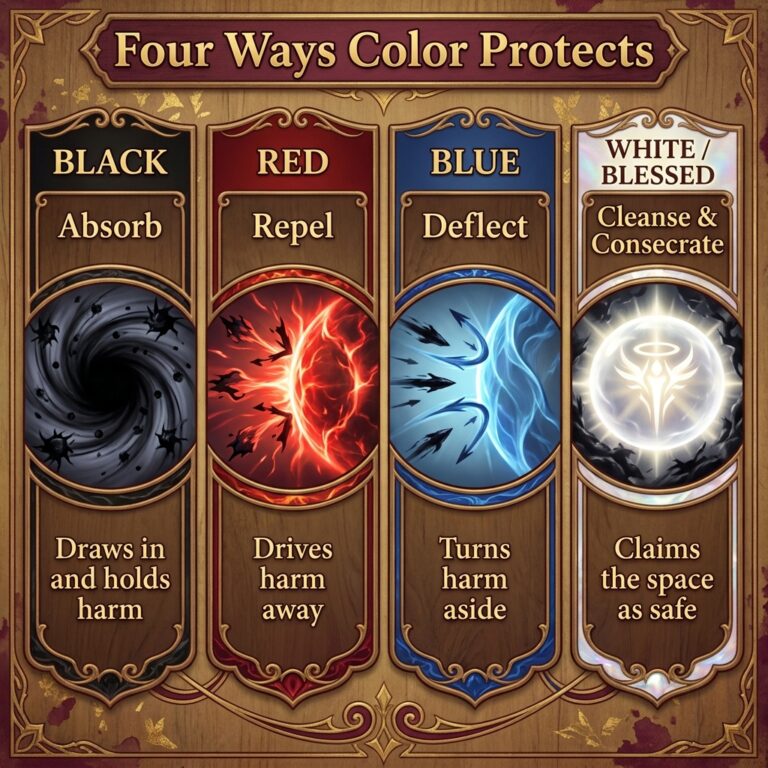
| Color | Where it shows up | What it’s meant to do |
|---|---|---|
| Black | Modern witchcraft; evil eye customs in Asia | Absorb harm |
| Red | Rowan and red thread in Britain; the Nian legend | Repel harm |
| Blue | Nazar amulets in Turkey; haint blue porches | Deflect harm |
| White or blessed | Modern witchcraft; the Polish thunder candle | Cleanse and consecrate |
Read across the table, and these traditions don’t agree on one “correct” protective color. Instead, each color carries a different strategy. Black takes harm in. Red scares it off. Blue turns it aside. Meanwhile, a white or blessed candle claims the space as safe. Seen this way, the useful first step is deciding which strategy fits your situation. Once you know that, the protection candle color follows.
How to Choose Your Protection Candle Color
Here is a simple way to match your protection candle color to the problem in front of you:
- Someone is sending hostility your way: black to absorb it, or red if you need courage to face it.
- Your home feels heavy after an argument: white to cleanse first, then brown to steady the household.
- You’re traveling, or tension needs to settle: blue.
- You want a clear head before a reading: purple.
- You only have one candle: white, with the missing purpose spoken aloud.
Many practitioners also pair a candle with other wards around the home. For example, some combine a brown or white candle with hanging witch bells by the door, an old folk custom meant to guard the threshold.
How to Burn a Protection Candle, Step by Step
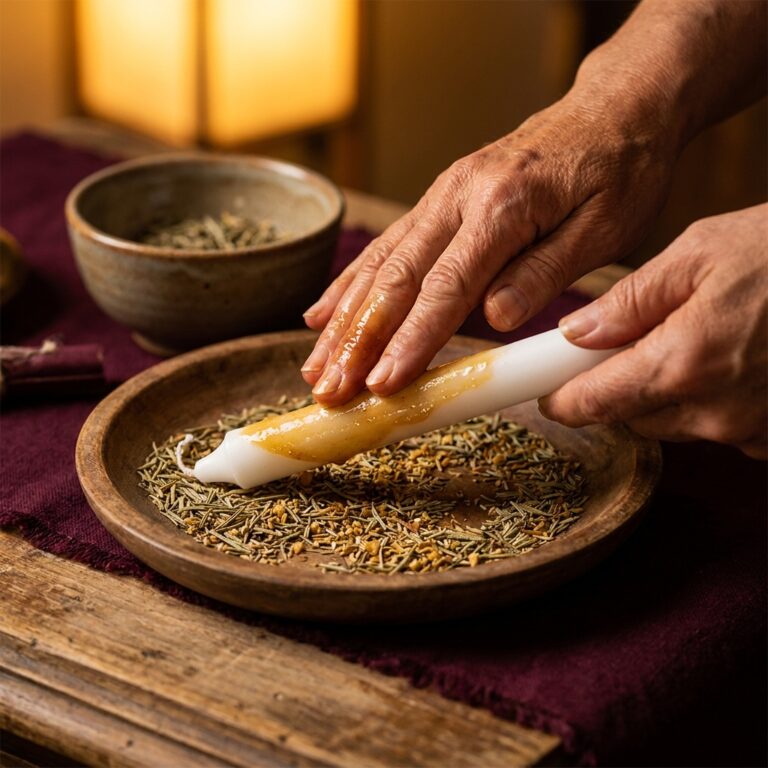
Once you’ve chosen a color, the method matters as much as the candle.
- Cleanse the space. Open a window, sweep the floor or burn a cleansing herb. Practitioners do this first so old, stale energy doesn’t mix with the new work.
- Dress the candle. Rub a thin layer of oil on the candle, then roll it in dried herbs. A common convention is to stroke the oil away from you when pushing harm off, and toward you when drawing safety in. Rosemary and bay are common picks, and this guide to protective herbs for jars and spells covers many more.
- Carve a symbol or word. Many witches carve a name or a short protective word into the wax. Carving is meant to fix the intention into the candle itself.
- Light it and state your intention. Say clearly what you want protected. Keep the focus on safety, not on harming anyone.
- Let it burn safely. Never leave a flame unattended. If you need to leave, snuff the candle and relight it later. Many practitioners prefer snuffing because they don’t want their breath to scatter the work.
Belief, Intention & The Power of Magic
Witchcraft, spells, and manifestation are deeply rooted in belief, intention, and spiritual practice. If these practices do not resonate with you, this may not be the path for you, and that’s perfectly okay. But if you believe in divine powers, trust your intentions, and feel drawn to the mysteries of the unseen, we invite you to continue exploring with Madame Celestine and discover the magic that speaks to your soul.
Common Mistakes When Picking a Protection Candle
The first mistake is treating black as the only protection candle color worth using. Because practitioners believe black absorbs, some practitioners avoid it in a bedroom or nursery. They prefer white or blue there instead. Another mistake is skipping the cleansing step. In practitioners’ view, lighting a protection candle in a tense, cluttered room is like locking the door with the intruder still inside.
Many people also read too much into the flame. A high, dancing flame or heavy soot can come from a draft or a long wick, not only from energy. So it helps to learn the basics of reading a candle’s flame before drawing conclusions. Finally, remember that a protection candle color supports intention but can’t replace it.
Frequently Asked Questions
What color candle is best for protection?
Black and white are the most common choices. Witches burn black to absorb and banish harm, and white to cleanse, shield and stand in for any other color.
What color candle is for healing?
Blue is the most common healing candle color, often paired with green. Practitioners use it to support rest and calm, alongside medical care rather than instead of it.
What colors ward off evil spirits?
Folk traditions point to several. Blue guards against the evil eye and appears on haint blue porch ceilings. Red has a long history as a ward against witchcraft, and practitioners trust black to absorb harm.
Can a white candle replace any protection candle color?
Yes, most practitioners treat white as a universal substitute. When you use it this way, say the purpose of the missing color out loud as you light it.
Is it bad to burn a black candle for protection?
No. In modern witchcraft, black is a protective color, not a harmful one. It’s believed to absorb negativity, though some people prefer white or blue in bedrooms.
References
- Evil eye: Protection, Superstition & Beliefs. Encyclopaedia Britannica. https://www.britannica.com/topic/evil-eye
- Rowan tree mythology and folklore. Trees for Life. https://treesforlife.org.uk/forest/mythology-folklore/rowan2/
- Newton’s Prism Experiment. Molecular Expressions: Science, Optics and You, The Florida State University. https://micro.magnet.fsu.edu/primer/java/scienceopticsu/newton
- Haint Blue. Central Michigan University Libraries blog. https://blogs.cmich.edu/library/?p=2352
- The Monster Nian, Chinese New Year, and Red. USC Digital Folklore Archives. https://folklore.usc.edu/?p=87495
- Philip Kosloski, The Polish tradition of Our Lady of the Thunder Candle. Aleteia, February 1, 2023. https://aleteia.org/2023/02/01/the-polish-tradition-of-our-lady-of-the-thunder-candle
Not sure where to start? You don’t have to do this alone.
Madame Celestine offers guided spellwork for beginners — real support for your first working, not just another guide to read.
Related reading: House Cleansing After a Hard Season: Clearing Grief, Illness or Conflict · Herbs for Protection: Spices and Plants for Jars and Spells

About Wren Ashby
Wren Ashby is the pen name our editorial team uses for articles on sigils, Tarot and modern traditional witchcraft. Articles under this byline are researched from published sources and reviewed by Madame Celestine before publishing.