
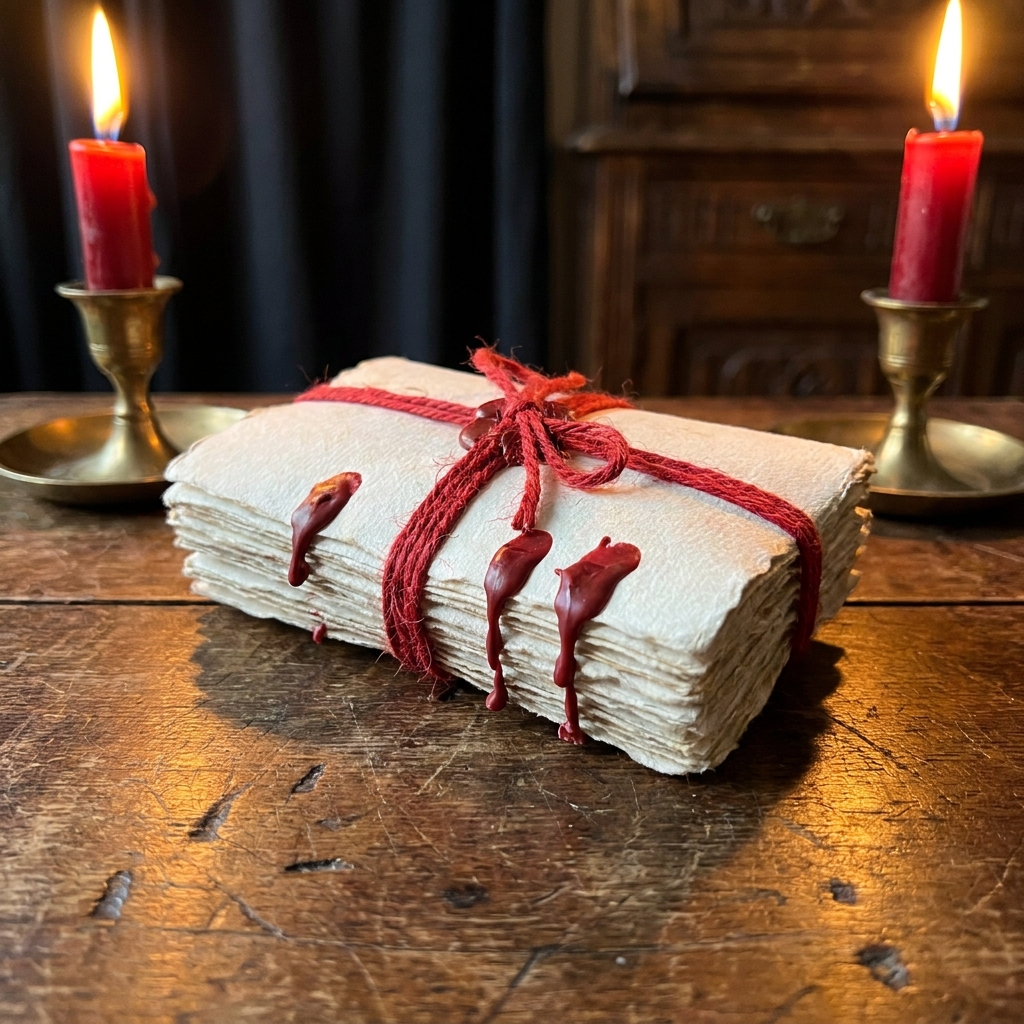
A love binding spell is one of the oldest requests in the history of magic, and it’s still one of the most searched. Most people who look it up want two answers. First, what does the spell actually do? Then, what happens after the candle burns out and you tie the last knot? This guide covers both. You’ll see how binding love spells differ from other love work, so you can tell whether a binding is even the right tool for your situation. You’ll also see the real archaeological evidence behind them, including a clay figure in the Louvre and a lead tablet from a Macedonian grave. Finally, you’ll learn what practitioners believe unfolds in the days and weeks after a binding, and how to undo one.
- What a Love Binding Spell Really Ties Together
- The Love Binding Found in a Macedonian Grave
- Thirteen Needles and a Clay Doll: The Louvre’s Binding Love Spell
- From Lead Tablets to Knotted Cords: How Binding Spells for Love Changed
- Why Friday, a Red Cord and a Growing Moon?
- How a Love Binding Spell Is Built, Step by Step
- The Night After: What Happens Once a Love Binding Spell Is Cast
- Binding Someone Without Consent: The Fight Witches Still Have
- Changed Your Mind? How a Binding Love Spell Is Undone
- Why So Many People Hand This Work to a Practitioner
- Frequently Asked Questions
- References
What a Love Binding Spell Really Ties Together
A love binding spell is a ritual meant to tie two people together. Most love magic tries to attract, open or warm. A binding, by contrast, tries to hold. The image at its center is a knot, a seal or a wrapped bundle. So the intention is about staying power rather than first sparks.
That difference matters when you choose a spell. For example, people cast an attraction spell when there’s no relationship yet. They cast a reconciliation spell when a relationship has broken. However, most people turn to a love binding spell when a relationship exists and they fear losing it. The site has a separate guide on commitment spells versus love spells, and binding sits close to the commitment side of that line.
Practitioners also split bindings into two kinds. The first binds a couple together, usually with both partners aware of it. The second binds one person to another without that person’s knowledge. That second kind is the oldest form on record. It’s also the form modern witches argue about most, as you’ll see further down.
The Love Binding Found in a Macedonian Grave
In 1986, archaeologists at Pella, the old capital of Macedon, found a thin lead sheet with a woman’s plea scratched into it. It dates to roughly 380 to 350 BCE. The writer’s name is uncertain. She loved a man named Dionysophon, but he was about to marry a woman named Thetima. So she bound their wedding and marriage, and she asked that he marry her instead. She also wrote that she wished to grow old at his side.[1]
She didn’t send the request upward to the sky gods, either. Instead, she placed it with a dead man named Macron, whose grave would carry the message below. That detail tells you a great deal about how the ancient world saw binding love. It was underworld work, done quietly, and aimed as much at a rival as at a lover.
The Pella tablet, one of the earliest love binding spells on record, belongs to a large family of objects. The Greeks called them katadesmoi, and the Romans called them defixiones. Both names come from words meaning to bind and to pierce. Archaeologists have found around 1,600 so far, most of them in Greek. Writers scratched them onto very thin lead, then rolled, folded or nailed them. After that, they buried them in graves or dropped them into wells.[2]
Erotic bindings were especially popular in the Hellenistic period. Unlike most curse tablets, they were often hidden inside the target’s own home. They also often called for a lock of the target’s hair.[2] So the hair-and-name step that many modern binding spells use has a very long pedigree.
Thirteen Needles and a Clay Doll: The Louvre’s Binding Love Spell
The most famous love binding spell in any museum sits in the Louvre’s Egyptian department under inventory number E 27145. It’s a small clay figure of a kneeling woman, about 9 centimeters tall. Her hands and feet are bound, and thirteen pins pierce her body. She lay inside an earthenware pot together with a lead sheet carrying 28 lines of Greek text. The Louvre bought the set from a dealer in 1975, and it probably came from Middle Egypt.[3]
The text names everyone involved. A man called Sarapammon wants a woman called Ptolemais, daughter of Horigenes, to love him. Scholars date the writing to the second through fourth centuries CE.[3] The spell calls on underworld powers and on the spirit of Antinous, the drowned favorite of the emperor Hadrian. It then asks the powers to bind Ptolemais to Sarapammon for life. It’s a love binding spell in the most literal sense.[4]
The figure also wasn’t improvised. Instead, it seems to follow a written recipe very close to one in a great magical handbook now kept in Paris, known to scholars as PGM IV. Its title reads “wondrous spell for binding a lover.” It calls for thirteen copper needles and a lead tablet, which is exactly what the pot contained.[4] In other words, the person who made this doll was following instructions, much like a modern witch working from a spell book.
The text also ends with a bargain offered to the spirit: “If you do this, I will release you.”[4] Even 1,700 years ago, then, a binding came with a promise of release once the work was done.
From Lead Tablets to Knotted Cords: How Binding Spells for Love Changed
The Pella and Louvre finds are only two points on a long line. Set the evidence in order, and a clear story appears.
The ancient Greek tablets come first, from the 4th century BCE onward. They’re private, hidden and usually aimed at a rival. Next come the Roman-era Egyptian spells, which add figures, needles and handbook recipes. After that, the record moves into medieval Jewish communities. One page from the Cairo Geniza, now in the Bodleian Library in Oxford, holds two spells side by side. One arouses love, and the other binds someone’s tongue.[5] So the same scribe treated love and binding as close neighbors.
Then the knot takes over. The 1797 edition of the Encyclopaedia Britannica has an entry for “ligature,” and one of its meanings is witchcraft. It describes a supposed spell of magical impotence worked through charms. It also reports a knotting charm from parts of Asia meant to keep a couple from being with anyone else, and a Russian wedding custom meant to defeat such a charm.[6] That’s a love binding spell in its plainest form: a knot tied to close a person off to everyone but one partner.
Finally, modern Wicca added an ethical frame. In 1964, Doreen Valiente gave the first public record of the Wiccan Rede, “An it harm none, do what ye will.”[7] After that, many practitioners began asking a new question about every binding: who does this harm?

What the pattern reveals
Put side by side, these sources share two habits. First, every one of them makes the binding physical. Someone folds a tablet, pierces a doll or knots a cord. Second, the object is then sealed and kept out of sight. However, the target of the binding has shifted. The oldest spells bind a rival or an unwilling person. Many modern practitioners now bind a willing couple instead. So the physical sealing is the one habit all of these sources share, and it’s the step a modern caster shouldn’t skip. The aim at an unwilling person is the part many modern practitioners dropped.
Why Friday, a Red Cord and a Growing Moon?
Most love binding spell recipes share the same handful of choices. They aren’t random, and each one carries a reason.
Take the day first. In several European languages, Friday carries the name of a love goddess. The French vendredi and the Italian venerdì both come from Venus, the Roman goddess of love. The English word likely traces back to Frigg, a Germanic goddess linked to marriage. So practitioners treat Friday as the natural day for love work.
Color comes next. Red stands for passion and close ties, while pink stands for tenderness. For that reason, many practitioners choose red for a couple’s binding and pink for a gentler commitment. Some also add a white candle for clarity.
Then there’s the moon. Practitioners usually cast drawing and strengthening work while the moon grows toward full. By contrast, they save the waning moon for release. That’s also why many traditions undo a binding while the moon shrinks.
Finally, there’s the cord itself. Many witches prefer cotton, wool or silk over plastic. Partly that’s because natural fibers feel closer to the old craft. But it’s also practical, since a natural cord breaks down if it’s later buried. The number of knots usually stays odd. Seven echoes the seven classical planets, and nine is three times three.
How a Love Binding Spell Is Built, Step by Step
Modern love binding spells vary by tradition. Still, most follow the same core pattern. Here’s how practitioners put together a typical candle-and-cord love binding spell, along with the reason behind each step.
1. Write both names
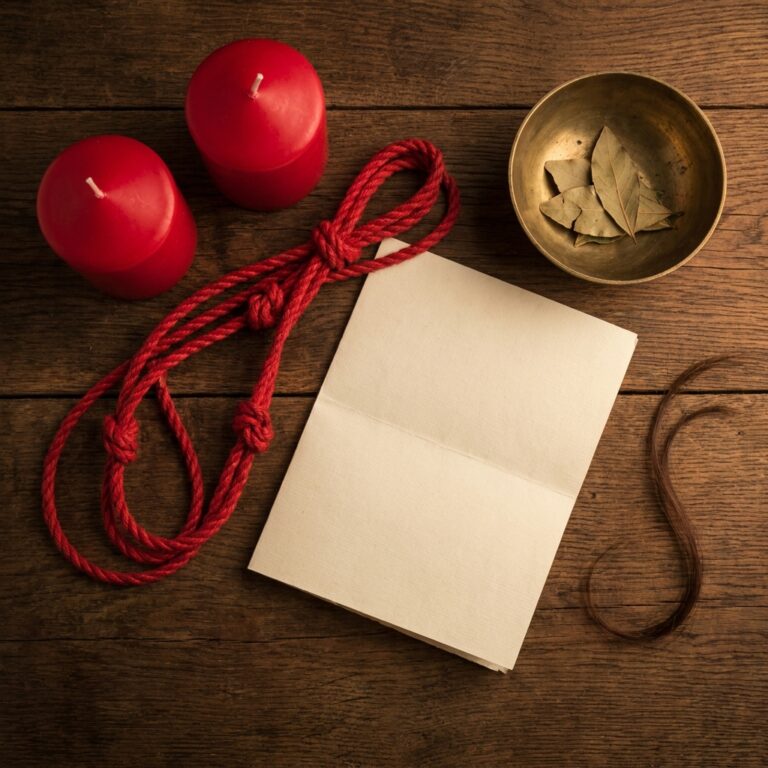
The two names go on one small piece of paper, often written so the letters cross. This echoes the ancient tablets, which usually named the people involved. The idea is that a name gives the spell a precise target.
2. Add a personal link
Many practitioners add a strand of hair or a scrap of worn fabric. As the Greek evidence shows, hair has been part of erotic binding for more than two thousand years. Practitioners believe the link ties the spell to a real person rather than to an idea.
3. Light two candles
Two red or pink candles stand for the two people. Some practitioners move the candles a little closer each night. As a result, the ritual acts out the drawing together it intends.
4. Tie the cord
Next, the caster wraps a red cord around the folded paper and ties a set number of knots. Three, seven and nine are common. The caster speaks an intention with each knot. Because the knot holds the spell, tying it badly is a common reason a binding is thought to fail. For more on that, see this guide to why a knot spell slips.
5. Seal and hide the bundle
Then the caster drips candle wax over the knots to seal them. The bundle goes somewhere private, such as a drawer, a box or a jar. This is the modern version of burying a tablet. The seal says the work is finished. The hiding place says it shouldn’t be disturbed.
Belief, Intention & The Power of Magic
Witchcraft, spells, and manifestation are deeply rooted in belief, intention, and spiritual practice. If these practices do not resonate with you, this may not be the path for you, and that’s perfectly okay. But if you believe in divine powers, trust your intentions, and feel drawn to the mysteries of the unseen, we invite you to continue exploring with Madame Celestine and discover the magic that speaks to your soul.
The Night After: What Happens Once a Love Binding Spell Is Cast
Practitioners don’t describe one fixed result. After all, a love binding spell works on a bond, and bonds change at their own pace. Still, they describe a fairly steady pattern of stages.
The first few days
Most traditions say to do nothing at all right after casting a love binding spell. The spell is thought to need quiet to settle. So practitioners advise against reopening the bundle, recasting the spell or checking for results every hour. Instead, they suggest ordinary life: sleep, work and normal contact with the other person.
The first weeks
Practitioners say this is when a binding may start to show. Typical signs people watch for are small. A partner calls more often, fights cool down faster, or talk about the future comes up on its own. However, these are signs of belief and interpretation, not proof. Every relationship has good weeks, and it’s easy to credit a spell for one.
When nothing seems to change
Sometimes a month passes and the relationship looks the same. Practitioners usually suggest waiting at least one full lunar cycle, about 29 and a half days, before judging a love binding spell. After that, they look at the work itself. Did the knot hold cleanly? Has anyone disturbed the bundle? And was binding even the right tool, or did the situation call for reconciliation instead? Those questions are often easier to answer with a second, more experienced pair of eyes.
The part people don’t expect
Many practitioners say a love binding spell ties the caster too. That idea fits the oldest evidence well, since a knot holds both ends of the cord. In practice, it means the caster is also tied to the relationship. As a result, if feelings change later, the binding may feel heavy rather than comforting. That’s one reason to choose a love binding spell only for a bond you truly want to keep.
There’s another trap. Anxiety after casting can turn into constant checking, and that can tip into fixation. Love that’s held too tightly often slips, with or without magic. That line between devotion and fixation is worth thinking about before any binding.
Binding Someone Without Consent: The Fight Witches Still Have
No question splits modern practitioners more than this one. Can you ethically cast a love binding spell on someone who doesn’t know about it?
Many Wiccans say no, and they point to the Rede. The word “rede” simply means advice. Most Wiccans read it as a version of the Golden Rule, and they treat it as guidance each person must apply case by case.[7] Under that reading, a binding that overrides another person’s choice causes harm, so it’s ruled out.
Some also cite the Rule of Three. This is the belief that whatever energy you send out comes back to you threefold. A possible early form appears in Gerald Gardner’s 1949 novel High Magic’s Aid. Later, Raymond Buckland popularized it as a formal law.[8] For those who hold it, a manipulative binding is a bad bet.
On the other hand, not every tradition accepts these rules. Many Wiccans see the Rule of Three as a modern add-on rather than an ancient law.[8] Also, plenty of witches don’t follow Wicca at all. Folk traditions, as the ancient tablets show, have bound lovers and rivals for millennia without asking permission.
So the honest answer depends on your path. Even so, many working practitioners now settle on a middle position. They’ll bind a couple who both want to stay together. They’ll also bind a person’s own heart to a commitment. However, they’re wary of binding a person who has clearly said no. That’s a practical choice as well as an ethical one. A binding aimed at a willing bond works with the relationship rather than against it.
Changed Your Mind? How a Binding Love Spell Is Undone
The Louvre spell ended with a promise to release the spirit once the work was done.[4] Modern practice keeps a similar idea. Most practitioners treat a love binding spell as something they can undo with care.
The most common method reverses the casting. First, the practitioner finds the bundle. Then they break the wax seal. Next, they untie the knots one by one, rather than cutting them, while speaking an intention of release. After that, they burn the paper with the names and bury the cord or drop it into running water. Some traditions also cleanse the space with smoke or salt afterward.
If the bundle is lost, practitioners usually make a new cord with the same number of knots and cut it instead. The site’s guide on cutting spiritual ties walks through that version.
Why So Many People Hand This Work to a Practitioner
Reading about a love binding spell is one thing. Casting one with a racing heart is another. That’s the main reason people commission the work instead of doing it alone. After all, binding has always been specialist work. The Louvre doll follows a recipe from a magical handbook, and whoever made it needed knowledge most people of the time didn’t have.
A practitioner brings three things a first-timer usually lacks. First is distance. Someone outside the relationship can ask whether binding is even the right tool, or whether reconciliation or commitment work fits better. Second is method. An experienced hand knows which knots, colors and timing suit a given tradition, and how to seal the work properly. Third is a plan for aftercare and, if needed, for release.
If that sounds like what you’re looking for, the love spells offered on this site include binding work built around your own situation. Each request starts with a conversation about what you want to hold on to and why. That way, the spell fits a bond worth keeping. No spell can promise how another person will feel. Still, a carefully made love binding spell gives your intention a clear form and a proper seal.
Frequently Asked Questions
What is the difference between a love binding spell and a regular love spell?
A regular love spell usually aims to attract or warm feelings. A love binding spell aims to hold an existing bond in place, so it’s used when the relationship already exists.
How long does a binding love spell last?
Most practitioners treat a binding as lasting until it’s deliberately undone. That’s why people keep the sealed bundle safe and private rather than throwing it away.
Can you break a love binding spell?
Yes. The usual method is to break the wax seal, untie the knots one by one, burn the paper with the names, and bury the cord or release it into running water.
Is it wrong to bind someone who doesn’t know?
It depends on your tradition. Many Wiccans consider it a violation of free will, while some folk traditions don’t require consent. Today, a lot of practitioners will only bind a couple who both want to stay together.
Do binding spells for love affect the person who casts them?
Many practitioners believe they do. They say the bond ties the caster too. So it makes sense to cast one only for a relationship you’re sure you want.
References
- Pella curse tablet. Wikipedia. https://en.wikipedia.org/wiki/Pella_curse_tablet
- Curse tablet. Wikipedia. https://en.wikipedia.org/wiki/Curse_tablet
- Kyprianos M873 (Louvre E 27145). Kyprianos Database of Ancient Ritual Texts, University of Würzburg. https://www.coptic-magic.phil.uni-wuerzburg.de/index.php/manuscript/kyp-m873
- A Cursed Figurine. Brent Nongbri, Variant Readings, January 7, 2023. https://brentnongbri.com/2023/01/07/a-cursed-figurine/
- Paraliterary text: Bodl. MS heb. c 28/14. Princeton Geniza Project. https://geniza.princeton.edu/documents/6423/
- Ligature. Encyclopaedia Britannica, 3rd edition (1797), via Early Encyclopaedia Britannica archive. https://jimclifford.ca/early_encyclopedia_britannica/articles/1797/eb_3rd_1797_012892.html
- Wiccan Rede. Wikipedia. https://en.wikipedia.org/wiki/Wiccan_Rede
- Rule of Three (Wicca). Wikipedia. https://en.wikipedia.org/wiki/Rule_of_Three_(Wicca)
Not sure where to start? You don’t have to do this alone.
Madame Celestine offers guided spellwork for beginners — real support for your first working, not just another guide to read.
Related reading: Signs Your Love Spell Is Working: 7 Changes to Notice · Signs Someone Put a Love Spell on You: 11 Symptoms Explained

About Wren Ashby
Wren Ashby is the pen name our editorial team uses for articles on sigils, Tarot and modern traditional witchcraft. Articles under this byline are researched from published sources and reviewed by Madame Celestine before publishing.