
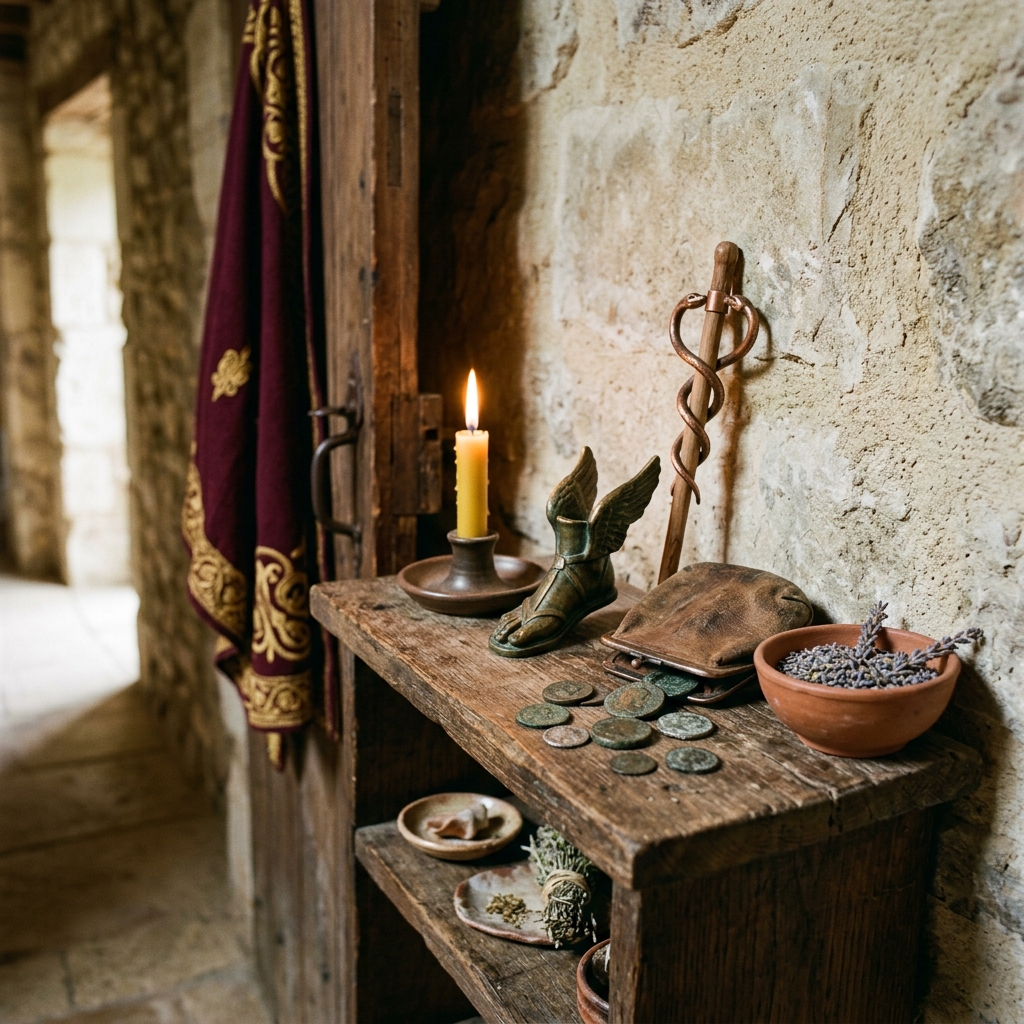
The god Mercury turns up everywhere, from the name of the smallest planet to lists of magical herbs and even the day we call Wednesday in other languages. But what was Mercury the god of, and why do modern practitioners still call on him for messages, deals and quick thinking? In this guide, you’ll learn who the Roman deity Mercury was, how Rome and its neighbors honored him, and why so many different things ended up under his name. You’ll also get a list of Mercury herbs and a simple working for clear communication.
- What Was Mercury the God Of? Merchants, Travelers and Tricksters
- Winged Sandals and a Purse: How Rome Honored the God Mercury
- Hermes and the Gauls: Mercury Beyond Rome
- The Common Thread: Why Mercury Rules Everything That Moves
- Mercury Herbs and Correspondences
- Setting Up a Small Mercury Altar
- A Simple Mercury Magic Working for Clear Communication
- Did the God Mercury Do Anything Bad? His Trickster Side
- Frequently Asked Questions
- References
What Was Mercury the God Of? Merchants, Travelers and Tricksters
Britannica sums up the Roman god Mercury as the god of shopkeepers and merchants, travelers and people who move goods, and also thieves and tricksters.[1] That is quite a mix. Yet it makes sense once you notice the pattern. Every one of those roles involves things changing hands or moving from place to place.
Romans closely identified the god Mercury with the Greek Hermes, the fleet-footed messenger of the gods.[1] As a result, Mercury took on the role of divine messenger as well. That is why he is often called the messenger of the gods, and why his name became shorthand for speed.
So if you have wondered “what god is Mercury,” the short answer is this. He is the Roman god of trade, travel, communication and cleverness, and the god of speed in Roman religion.
Winged Sandals and a Purse: How Rome Honored the God Mercury
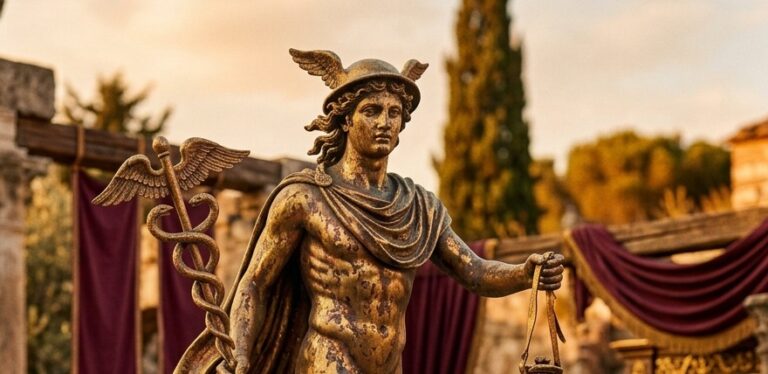
Mercury had a real home in the city. His temple on the Aventine Hill in Rome was dedicated in 495 BCE.[1] Its dedication day, May 15, became his festival, the Mercuralia. On that day, Romans honored Mercury together with his mother, Maia.[1]
His look was just as clear. Artists showed him with winged sandals or a winged cap, a caduceus (a herald’s staff, often twined with two snakes) and a purse for commerce.[1] Each object tells part of his story. The wings mean speed, the staff means safe passage as a messenger, and the purse means profit.
These symbols of the god Mercury still work on a modern altar. A small coin purse, a feather or a simple staff shape can stand for him without any statue at all.
Hermes and the Gauls: Mercury Beyond Rome
The god Mercury’s Greek twin, Hermes, adds depth to the picture. Hermes was the son of Zeus and Maia. In Homer’s Odyssey, he appears mainly as the messenger of the gods and as the guide who leads the dead to Hades.[2] So this god carried more than letters. He also crossed the boundary between life and death.
Then there are the Gauls, the Celtic peoples of ancient France. Julius Caesar wrote that, among all the gods, they worshipped Mercury most. He added that they had many images of him and called him the inventor of all arts. They also saw him as the guide for every road and journey and the power behind money-making and trade.[3] Caesar was using a Roman name for a Gaulish god, so the match is his interpretation. Still, it shows how naturally this figure fit other cultures.
The Common Thread: Why Mercury Rules Everything That Moves
Put side by side, the things named after the god Mercury share one idea. Each is about movement and exchange.
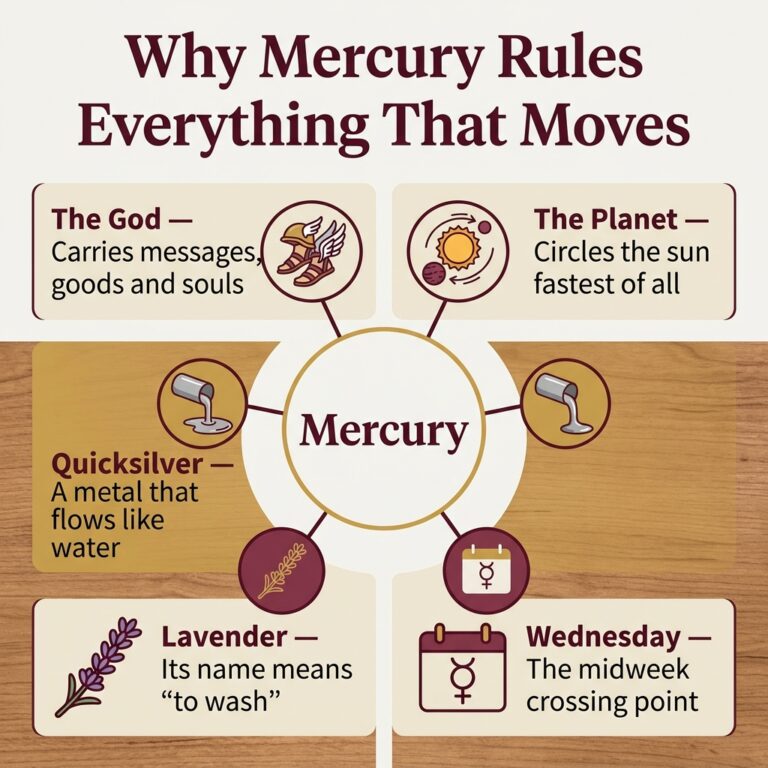
| Thing named for Mercury | How it moves |
|---|---|
| The god | Carries messages, goods and souls |
| The planet | Circles the sun fastest of all |
| Quicksilver | A metal that flows like water |
| Lavender | Its name means “to wash” |
| Wednesday | The midweek crossing point |
The planet shows the logic most clearly. NASA notes that Mercury speeds around the sun every 88 days, faster than any other planet, and that it is named for the swiftest of the Roman gods.[4] Quicksilver, the liquid metal we now call mercury, earned the name because it runs and scatters like no other metal. Meanwhile, the day name survives in mercredi in French and miércoles in Spanish.
Herbs joined the list too. The 17th-century herbalist Nicholas Culpeper wrote that “Mercury owns” lavender.[5] Fittingly, its name comes from the Latin lavare, “to wash.”[5] Washing, like trade and travel, is about moving something from one state to another.
Here is the practical insight. Mercury magic suits situations where something needs to cross a gap: a message to reach someone, a deal to close, a trip to go smoothly or a new skill to click. It suits fixed, long-term goals less well. So for lasting love or home protection, most practitioners reach for other correspondences and save Mercury for moments of transfer.
The pattern even explains his most serious job. Guiding the dead to Hades is also a kind of crossing, the final journey from one world to the next. So the same god who hurries a merchant’s parcel across town also walks souls to the underworld. Seen this way, he is less a god of speed than a god of safe passage.
Mercury Herbs and Correspondences
Lavender is the best-documented of the Mercury herbs, thanks to Culpeper. Modern correspondence lists often add dill, fennel, marjoram and parsley, which share a light, airy scent or feathery leaves. Treat these as later practitioner traditions rather than ancient Roman rules.
Other common correspondences follow his themes. Wednesday is his day. Yellow and orange are popular candle colors, because they suggest quick, bright energy. Agate is a favorite stone in modern practice. Coins, feathers and keys make good symbolic objects, since they stand for trade, flight and open doors.
One firm warning belongs here. Never use real liquid mercury in any spell or altar. It is highly toxic, even in small amounts. Instead, a silver-colored coin or a small mirror can stand in for quicksilver safely.
Setting Up a Small Mercury Altar
A shrine for the god Mercury can be tiny, because he is a traveler at heart. Many people use a shelf near the front door, since doorways are places of coming and going. Others keep a small tray on a desk where they write, study or handle money.
Start with one symbol from his statues, such as a coin purse, a feather or a small staff. Then add a yellow or orange candle and a dish of dried lavender. A few coins in a bowl nod to his role as patron of trade. Some people also add a small key, because keys open doors and he guards thresholds and roads.
Keep the space tidy and a little lively. Because Mercury is linked with movement, many practitioners refresh the offerings often rather than letting them sit for months. A fresh sprig of herbs or a new coin each Wednesday is enough. When you travel, you can even take a coin from the altar with you, as a small token of his protection on the road.
A Simple Mercury Magic Working for Clear Communication
This short working draws on the god Mercury’s role as messenger. It is meant for a conversation, email or interview you feel nervous about.
First, choose a Wednesday if you can, since that is his day. Then gather a yellow candle, a small sprig or sachet of lavender and a piece of paper.
Next, write the message you want to deliver in one or two plain sentences. Keep it honest and kind. Mercury is a patron of clever speech, so clarity matters more than force.

After that, light the candle and hold the lavender for a moment. Read your message aloud three times. Many practitioners picture it traveling swiftly and arriving intact, the way Mercury carried the words of the gods.
Finally, fold the paper toward you and keep it with you until the conversation happens. Afterward, thank the god Mercury and return the lavender to the earth.
You can adapt the same steps for travel. Instead of a message, write the route of your journey and the hope that it goes smoothly. Then carry a coin from the working in your pocket or bag until you arrive home safely.
Belief, Intention & The Power of Magic
Witchcraft, spells, and manifestation are deeply rooted in belief, intention, and spiritual practice. If these practices do not resonate with you, this may not be the path for you, and that’s perfectly okay. But if you believe in divine powers, trust your intentions, and feel drawn to the mysteries of the unseen, we invite you to continue exploring with Madame Celestine and discover the magic that speaks to your soul.
Did the God Mercury Do Anything Bad? His Trickster Side
Many people are surprised to learn that the god Mercury also watched over thieves and tricksters.[1] In one famous Greek story, the newborn Hermes slipped out of his cradle and stole a herd of Apollo’s cattle. He then talked his way out of trouble and made peace by giving Apollo the lyre he had just invented.
So yes, this god has a mischievous streak. However, the myths rarely paint him as cruel. Instead, he shows how quick wits can bend rules and then repair the damage. For that reason, many practitioners approach him with respect and a sense of humor, and they keep their own requests honest.
If his musical side interests you, this overview of pagan gods of music explores other deities linked with song and sound.
Frequently Asked Questions
What is Mercury god of?
Mercury is the Roman god of merchants, trade, travelers and messages, and also of thieves and tricksters. He was identified with the Greek god Hermes, messenger of the gods.
Is there a goddess Mercury?
No. Mercury is a male god. His mother, Maia, was honored alongside him at his festival on May 15, which may be why some people search for a goddess of Mercury.
Why is Mercury the god of speed?
As the messenger of the gods, he had to travel quickly, so artists gave him winged sandals and a winged cap. The fastest planet in our solar system is named after him for the same reason.
What herbs are associated with the god Mercury?
Lavender is the classic Mercury herb, named as his by the herbalist Nicholas Culpeper. Modern lists often add dill, fennel, marjoram and parsley.
What day is best for Mercury magic?
Wednesday is traditionally his day, which is why it is called mercredi in French. Many practitioners time communication or travel workings for a Wednesday.
References
- Mercury. Encyclopaedia Britannica. https://www.britannica.com/topic/Mercury-Roman-god
- Hermes. Encyclopaedia Britannica. https://www.britannica.com/topic/Hermes-Greek-mythology
- Caesar, The Gallic War, Book VI (Loeb Classical Library, 1917). LacusCurtius, University of Chicago. https://penelope.uchicago.edu/Thayer/E/Roman/Texts/Caesar/Gallic_War/6B*.html
- Mercury: Facts. NASA Science. https://science.nasa.gov/mercury/facts/
- Lavender: History, Taxonomy, and Production. Joe-Ann McCoy; updated by J.M. Davis. NC State Extension. https://newcropsorganics.ces.ncsu.edu/herb/lavender-history-taxonomy-and-production/
Not sure where to start? You don’t have to do this alone.
Madame Celestine offers guided spellwork for beginners — real support for your first working, not just another guide to read.
Related reading: Thurisaz Rune Meaning: Thor’s Rune of Force and Protection · Spider Deities: Anansi, Arachne and the Weavers of Fate

About Wren Ashby
Wren Ashby is the pen name our editorial team uses for articles on sigils, Tarot and modern traditional witchcraft. Articles under this byline are researched from published sources and reviewed by Madame Celestine before publishing.