

Witch bells hang on doors in homes around the world, and most people who see them ask the same thing: what are witch bells actually for? The short answer is protection. The longer answer is more interesting, because the belief that a bell’s sound can guard a threshold is thousands of years older than the modern craft. This guide covers where that belief comes from, what bells symbolize across cultures, and how to choose and hang witch bells for doors so they do their job well.
- What Are Witch Bells? A Modern Charm With Old Roots
- The Roman Wind Chime That Guarded the House
- Golden Bells at the Sacred Threshold
- Church Bells Against the Storm
- Bells Symbolism: What Do Bells Represent?
- Witches Bells Meaning: Metal, Number and Color
- How to Hang Witch Bells for Doors
- Keeping Witch Bells Working Over Time
- Frequently Asked Questions
- References
What Are Witch Bells? A Modern Charm With Old Roots
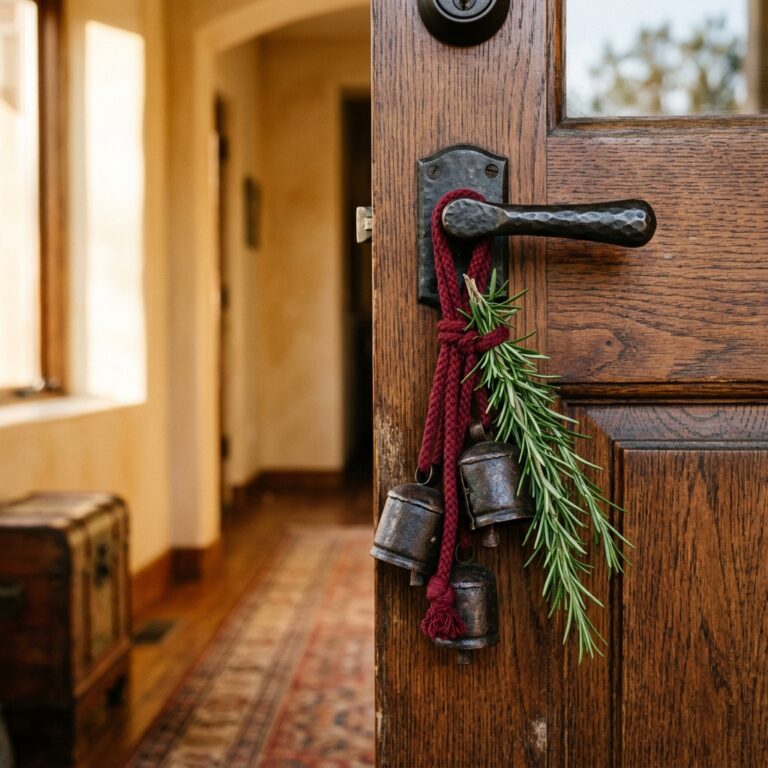
A witch bell is a small cluster of bells, usually three or more, tied to a cord or ring and hung on a door. Most modern sets add beads, charms, dried herbs or a crystal. When the door opens, the bells ring. In witchcraft, that ring is believed to clear away unwanted energy and announce whoever crosses the threshold.
It’s worth being honest about the history. Many shops claim witch bells come from an ancient Scandinavian tradition. However, there’s no solid evidence for a single origin like that. The named craft of the “witches bell” as we know it is fairly recent.
What is old, and well documented, is the idea behind it. For thousands of years, people have hung bells at doorways and worn them at sacred boundaries to keep harm away. So modern witch bells gather that long thread into one handmade charm.
The Roman Wind Chime That Guarded the House
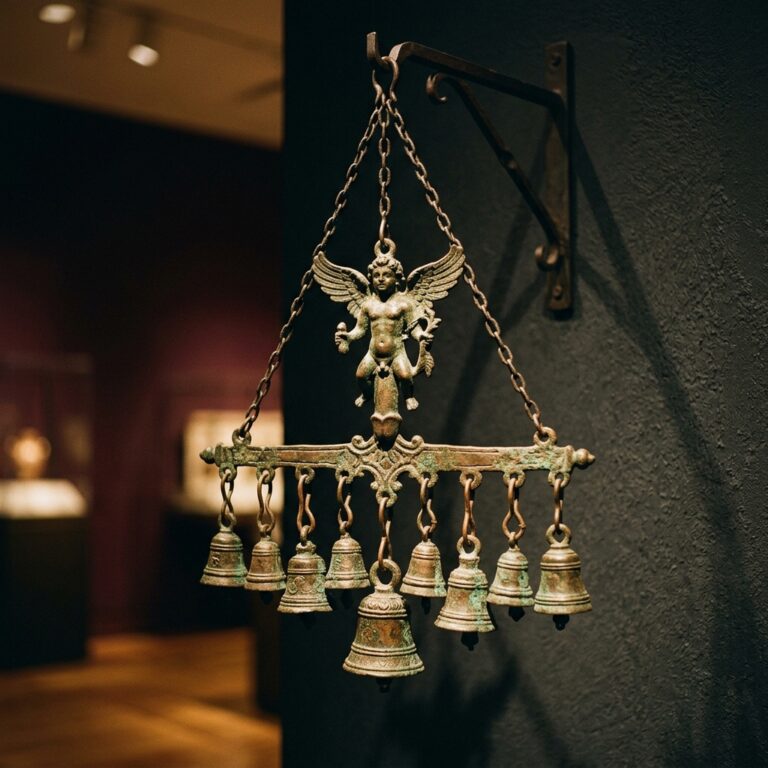
One of the clearest ancestors sits in the British Museum. It’s a bronze tintinnabulum, a Roman wind chime from the 1st century, hung with small bells. It’s shaped like a winged lion combined with a phallus. People believed that combination protected the household against evil and brought good luck.[1]
That shape surprises visitors, but it made sense to Romans. The phallus was a common charm against the evil eye, meaning the harm believed to come from an envious look. Then the bells added sound. So the charm worked twice, once by sight and once by ear, every time the breeze moved it.
Notice the placement, too. A chime needs moving air, so it naturally hung at openings, where wind and people came in. That’s the same spot where witch bells for protection hang today.
Golden Bells at the Sacred Threshold
The Hebrew Bible gives another striking example. In Exodus, the high priest Aaron’s robe carries golden bells alternating with pomegranates around its hem. The text says the bells’ sound must be heard when he goes into the holy place and when he comes out, “so that he may not die.”[2]
Look closely at when the bells matter. They ring at the moment of entering and leaving, not while the priest stands still. In other words, the sound marks a crossing between ordinary space and holy space. That’s exactly the job witch bells do at a front door, on a much humbler scale.
Church Bells Against the Storm
Medieval and early modern Europe took the idea to the rooftops. Church bells were often cast with the Latin words Fulgura Frango, meaning “I break up lightning flashes.” When storms came, ringers climbed the towers and rang the bells.[3]
People explained it in two ways. Many believed the peals drove off the evil spirits of the storm. More educated observers guessed the sound disturbed the air and broke the lightning’s path.[3] Either way, the practice proved deadly. Bell towers attract lightning, and so many ringers died that rulers eventually banned it.[3]
That history is a useful warning for anyone curious about bells in witchcraft. The belief in a bell’s protective sound ran deep, but it never replaced practical safety. A witch bell is a spiritual charm, not a lock or an alarm system.
Bells Symbolism: What Do Bells Represent?
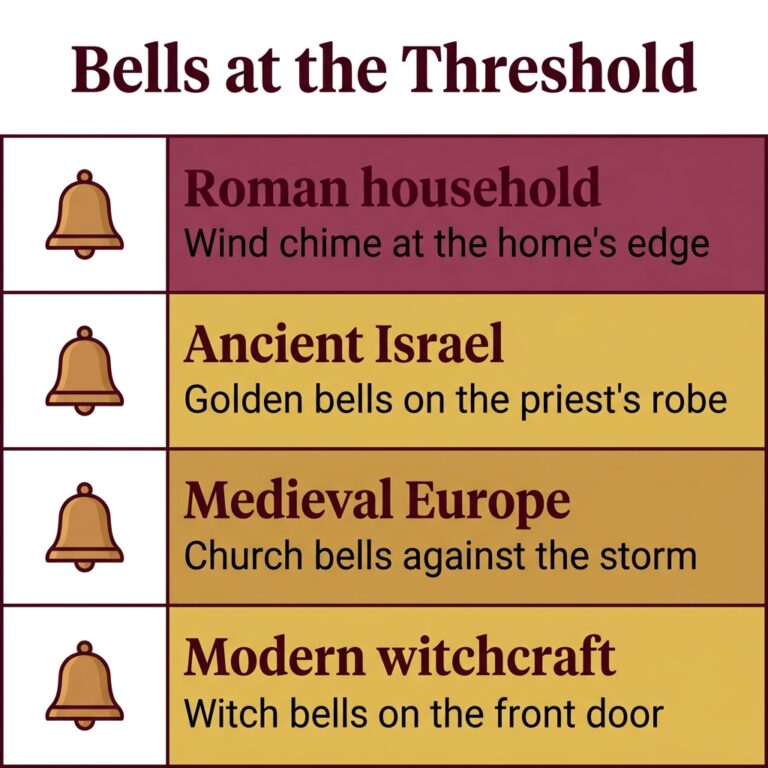
Put side by side, these traditions share a pattern. Here’s how each one used the bell.
| Tradition | Where the bell rang | What it marked |
|---|---|---|
| Roman household | At openings in the wind | The home’s edge |
| Ancient Israel | On the priest’s hem | Entering holy space |
| Medieval Europe | In the church tower | The coming storm |
| Modern witchcraft | On the front door | Every arrival |
Read down the last column. In each case, the bell rings at a moment of change, when something crosses a line. So the deepest spiritual meaning of bells isn’t “block.” It’s “announce.” A bell doesn’t build a wall. Instead, it makes sure nothing crosses unnoticed.
That’s my own reading of these examples, not an established rule. Still, it changes how you use witch bells. If the bell is an announcer, then it only works when you’re listening. That’s why placement and attention matter more than how many charms you add.
Bells carry other meanings too. Across many cultures, the symbolism of a bell includes celebration, calling people together and marking time. At many Shinto shrines in Japan, for example, visitors ring a large bell before praying. And in everyday English, arriving “with bells on” simply means showing up eager and ready to enjoy yourself.
Witches Bells Meaning: Metal, Number and Color
So what do bells mean when you build your own set? Practitioners read three things: the metal, the number and the color of the cord. None of these rules is fixed. Still, knowing the common choices helps you design witches bells for doors that feel intentional rather than random.
Metal comes first. Iron carries the strongest protective reputation in European folklore, which is why many people choose it for protection bells. Brass rings brighter and is often chosen for joy and welcome. Silver-toned bells are popular for calm and cleansing.
Number comes next. Three is the most common, because many traditions treat three as a number of completeness. However, some people use one bell for simplicity or seven for a busy household. Then there’s color. Red or black cord usually signals protection, green suits growth and blue suits peace.
Some people call the finished charm a witch doorbell, and that’s a fair description. It does what any doorbell does, only for energy as well as visitors. You’ll also see the old phrase “witching bells” in shops and poems. Whatever you call them, witches bells for protection work best when every part has a reason you can name. That’s the practical heart of bells witchcraft: a simple object, chosen with care, placed where it will be heard.
How to Hang Witch Bells for Doors
First, choose your bells. Brass and iron bells are common, and many practitioners prefer iron because of its long folk link with protection. Three bells is a popular number, but pick what sounds right to you. The tone matters more than the count.
Next, add a cord. Red cord is a common choice for protection, while other colors can suit other goals, such as green for growth. Then add any extras, such as a small bundle of rosemary, a protective bead or a charm with personal meaning. Keep it light enough to hang without strain.
Before you hang it, hold the finished bells and state what they’re for in one clear sentence, such as “Only kindness enters here.” Then hang them on the inside of your main door, from the handle or a hook, where the door will brush them each time it opens.
Finally, listen. For the first week, notice the sound as people come and go. Many practitioners also ring the bells by hand after an argument or a hard visit, to clear the air.
Belief, Intention & The Power of Magic
Witchcraft, spells, and manifestation are deeply rooted in belief, intention, and spiritual practice. If these practices do not resonate with you, this may not be the path for you, and that’s perfectly okay. But if you believe in divine powers, trust your intentions, and feel drawn to the mysteries of the unseen, we invite you to continue exploring with Madame Celestine and discover the magic that speaks to your soul.
Keeping Witch Bells Working Over Time
Here’s the catch with any sound charm. After a few weeks, most people stop hearing it. The bells still ring, but your mind files the sound away. If the bell’s job is to announce, then a bell you no longer notice has gone quiet in the way that matters.
So refresh your witch bells now and then. Move them to a different spot on the door, swap the cord or ring them on purpose at the new moon. Some practitioners cleanse them in incense smoke each season. Others simply wipe them clean and restate the intention. Either way, the small act of care wakes up your attention again.
Also think about other doorways. A back door, a garden gate or even a bedroom door can hold a smaller bell. For a broader look at guarding a home in layers, see this guide to what warding means in occult practice.
Frequently Asked Questions
What are witch bells used for?
Witch bells are hung on doors for protection. Practitioners believe their ringing clears unwanted energy and announces whoever crosses the threshold.
Where do you hang witch bells for protection?
Most people hang them on the inside handle or frame of the main entrance, where the door brushes them as it opens. A smaller set can go on back doors or gates.
What do bells symbolize in witchcraft?
Bells in witchcraft usually stand for protection, cleansing and announcement. Across many traditions, bells ring at moments of crossing, such as entering a sacred space or a home.
Are witches bells an ancient tradition?
The belief that bells protect doorways is very old, reaching back at least to Roman household chimes. However, the witches bell as a named craft is fairly modern.
What does “with bells on” mean?
It’s an English phrase meaning to arrive eagerly and ready to enjoy yourself. It has no known link to witch bells.
References
- Tintinabulum, 1856,1226.1086. British Museum. https://www.britishmuseum.org/collection/object/G_1856-1226-1086
- Exodus 28:33–35 (New Revised Standard Version Updated Edition). BibleGateway. https://www.biblegateway.com/passage/?search=Exodus%2028%3A33-35&version=NRSVUE
- Brendan McWilliams. An ancient remedy to ward off lightning. The Irish Times, July 9, 1999. https://www.irishtimes.com/news/an-ancient-remedy-to-ward-off-lightning-1.204678
Not sure where to start? You don’t have to do this alone.
Madame Celestine offers guided spellwork for beginners — real support for your first working, not just another guide to read.
Related reading: Spell Jar for Protection, Love or Happiness: How to Make One · Knot Magic Mistakes: Why Your Knot Spell Isn’t Holding

About Wren Ashby
Wren Ashby is the pen name our editorial team uses for articles on sigils, Tarot and modern traditional witchcraft. Articles under this byline are researched from published sources and reviewed by Madame Celestine before publishing.