

Spell ingredients can feel overwhelming when you’re starting out. Shops sell hundreds of herbs, oils, stones and powders, and every spell seems to call for something different. Yet the oldest magical books in both Europe and China lean on the same small set of basics. This guide covers the ten spell ingredients every beginner witch should own, what each one is used for and where that use comes from. You’ll see why an old European grimoire and a fourth-century Taoist text agree on more than you’d expect. Then you’ll find a simple way to sort your kit by job, plus the mistakes that waste money on ingredients you don’t need yet.
- The Old Books Agree: You Need Fewer Spell Ingredients Than You Think
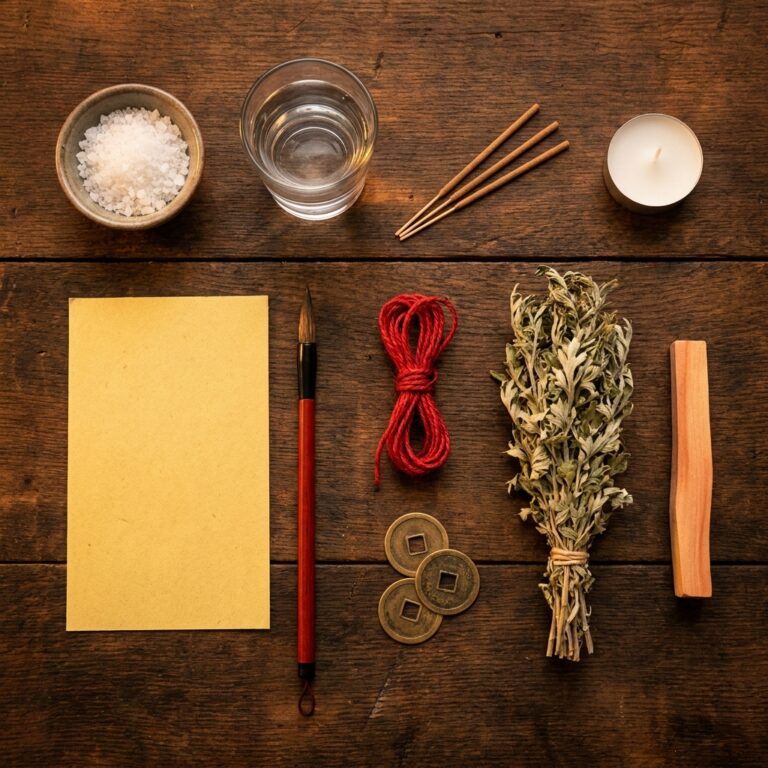
- The 10 Spell Ingredients Every Beginner Witch Should Own
- Salt in Europe, Peach Wood in China: The Spell Ingredients Both Traditions Agree On
- Your First Spell With Beginner Ingredients, Step by Step
- How to Store Spell Ingredients So They Stay Useful
- A Beginner’s Spell Ingredients Kit for Under $20
- Spell Ingredients to Add Once You’ve Mastered the Basics
- Five Beginner Mistakes With Spell Ingredients
- When You’d Rather Have the Spell Made for You
- Frequently Asked Questions
- References
The Old Books Agree: You Need Fewer Spell Ingredients Than You Think
Beginners often assume that a stronger spell needs rarer ingredients. The old manuals suggest otherwise. Take The Key of Solomon, a famous European grimoire translated into English by S. L. MacGregor Mathers in 1889. Before any working, it tells the magician to prepare something very ordinary: blessed salt cast into a vessel of clear spring water.[1] The water is then sprinkled over everything used in the work, and the text claims it drives away phantoms wherever it falls.[1]
Chinese tradition starts in a similar place. Incense, paper, ink and a few protective plants carry most of its everyday magic. In other words, the core spell ingredients in both traditions are cheap, common and already in many homes. What turns them into spell ingredients is the reason behind each one, and that’s what the list below explains.
The 10 Spell Ingredients Every Beginner Witch Should Own
1. Salt: the first ingredient in almost every tradition
If you buy only one ingredient, make it salt. The Key of Solomon calls it “this Creature of Salt” and blesses it before use.[1] In Japan, Shinto uses salt to purify people and places, and small piles of salt are set in dishes near entrances to ward off evil and draw in customers. In Mahayana Buddhism, people believe salt keeps away evil spirits, and some people throw a pinch over the left shoulder after a funeral to stop spirits following them home.[2] For beginners, its spell uses are simple: cleansing, protection and drawing a boundary.
2. Water: the carrier for everything else
Water turns other ingredients into something you can sprinkle, wash with or drink. That’s why the Solomonic recipe pairs salt with clear spring water rather than using either alone.[1] Modern witches also make moon water by leaving a jar out under the moon. For recipes, see this guide to moon water for every phase.
3. A cleansing herb: hyssop, rosemary or vervain
The same grimoire chapter calls for a sprinkler made of hyssop bound with other herbs, including vervain, fennel and rosemary. It even specifies timing: gather them on a Wednesday, the day of Mercury, while the moon is waxing.[1] You don’t need all of them. One dried cleansing herb is enough to start, and rosemary is the easiest to find in any grocery store.
4. Incense: smoke as a messenger
Incense is one of the oldest spell ingredients on earth. Chinese cultures burned it as early as the Neolithic period, and censers appear by the Warring States period, in the mid-fifth to late fourth centuries BCE.[3] It also measured time. The poet Yu Jianwu (487–551) wrote, “By burning incense we know the o’clock of the night.”[3] Today, incense is offered to ancestors and deities and is used to cleanse a room. A simple stick of sandalwood is a good first choice.
5. Candles: fire you can control
A candle is the beginner’s safest way to work with fire. It gives a spell a clear beginning and end, since the work is often considered done when the flame goes out. Start with plain white candles, because most traditions treat white as an all-purpose color. Later, you can add colors for specific goals, using this guide to candle color correspondences.
6. Paper and red ink: writing the spell down
Written charms are central to Taoist magic. Practitioners write or paint fu, talismans that carry instructions for deities and spirits, symbols for exorcism and recipes for healing charms.[4] Healers used talismans on patients at least as far back as the Eastern Han dynasty. Remarkably, the scholar Ge Hong argued that a talisman worked if its inscription was authentic, even if the person using it couldn’t read it.[4] His book Baopuzi, finished around 317–318 CE, includes a chapter that catalogs Taoist books and lists talismans.[5] These Chinese talismans also inspired the ofuda of Japan and the bujeok of Korean shamanism.[4] For a beginner, a pad of plain paper and a red pen are enough to write petitions and simple symbols.
7. Red string: protection you can wear
Red string appears in several unrelated traditions. In Jewish folk custom, people wear a thin scarlet thread on the wrist to ward off misfortune from the evil eye. Hinduism and Chinese culture also use red strings and bracelets for luck, love and protection.[6] In spells, red string ties bundles, closes charm bags and holds knot magic. It’s cheap, reusable and easy to carry.
8. Coins: the simplest drawing ingredient
Coins are the classic ingredient for money and luck work. In China, decorative charm coins called yansheng qian first appeared during the Western Han dynasty, and most early ones copied the round coins with a square hole then in use. People used them for fortune telling, folk ritual and feng shui. Some, known as vault protector coins, were hung with red silk and tassels for the God of Wealth.[7] A few old coins in a jar or bowl are all a beginner needs.
9. Mugwort: the doorway herb
Mugwort is a protective herb with a famous festival behind it. On the fifth day of the fifth lunar month, during the Dragon Boat Festival, people hung calamus, mugwort and garlic above their doors. They believed the strong smell and shape of these plants would ward off evil, since that month was considered unlucky and poisonous.[8] In spells, practitioners use mugwort for protection and, in many Western traditions, for dreams and divination. One note of caution: mugwort is not safe during pregnancy, so many practitioners burn or hang it rather than handle it heavily.
10. Peach wood: the tree ghosts avoid
Peach wood is the most surprising item on this list, and one of the most traditional. Ancient Chinese believed the peach had more vitality than any other tree, because its blossoms appear before its leaves. When early rulers toured their lands, sorcerers walked ahead of them carrying peach rods to guard against spectral evils. On New Year’s Eve, local magistrates hung peach branches over their doors, and Han dynasty door gods were made of peach wood.[9] A small peach-wood stick or charm is a beginner’s first protective tool in Chinese-style practice.
Salt in Europe, Peach Wood in China: The Spell Ingredients Both Traditions Agree On
Put the European grimoire beside the Chinese sources, and the overlap is striking. Both purify first. The Key of Solomon uses salt and water, while Shinto and Buddhist practice use salt at doors and after funerals.[1][2] Both use smoke. The grimoire prepares a censer of fragrant spices, and Chinese households burn incense for ancestors and deities.[3] Both write the spell down. The Solomonic sprinkler carries engraved characters, and Taoist practice rests on written talismans.[1][4] And both guard the doorway, with blessed water in one tradition and mugwort or peach branches in the other.[8][9]
Seen side by side, these traditions suggest a practical way to think about spell ingredients. Each ingredient does one of four jobs: it cleanses, it focuses, it protects or it draws. Salt, water, herbs and incense cleanse. Candles, paper and ink focus the mind on a goal. Red string, mugwort and peach wood protect. Coins draw. So a beginner doesn’t need a hundred items. A kit that covers all four jobs can handle almost any simple spell, and every new ingredient you add later should fill a gap in one of those jobs.

Your First Spell With Beginner Ingredients, Step by Step
Here’s a simple home cleansing and protection spell that uses six of the ten spell ingredients. Each step comes with the reason behind it.
1. Mix the salt water
Stir a spoonful of salt into a bowl of clean water while stating your intention, such as “this water clears what doesn’t belong here.” This follows the oldest pattern on the list: salt and water blessed together before anything else.
2. Light a candle and incense
Set a white candle and one stick of incense on a heat-safe dish. The candle marks the start of the work, and the smoke carries your intention through the room.
3. Sprinkle with a herb bundle
Dip a sprig of rosemary into the salt water and lightly sprinkle each room, moving from the back of the home toward the front door. This mirrors the hyssop sprinkler in the old grimoire.
4. Write a protection petition
On a small piece of paper, write a short sentence in red ink, such as “only peace enters this home.” Fold it toward you three times.
5. Tie it with red string
Wrap the folded paper with red string and tie three knots. Then place it above or beside your front door, the same spot where Dragon Boat Festival households hung mugwort.
6. Close the work
Finally, let the candle burn down safely, or snuff it with thanks. Pour the leftover salt water out the front door or down the drain. Practitioners consider the spell finished once the candle is out and the water is gone.
Belief, Intention & The Power of Magic
Witchcraft, spells, and manifestation are deeply rooted in belief, intention, and spiritual practice. If these practices do not resonate with you, this may not be the path for you, and that’s perfectly okay. But if you believe in divine powers, trust your intentions, and feel drawn to the mysteries of the unseen, we invite you to continue exploring with Madame Celestine and discover the magic that speaks to your soul.
How to Store Spell Ingredients So They Stay Useful
Good spell ingredients are only useful if they stay fresh. Dried herbs lose their scent within months when they sit in sunlight, so keep them in sealed glass jars in a dark cupboard. Label each jar with the herb’s name and the date you bought or dried it. Salt, coins and peach wood last indefinitely, while incense should stay dry to burn evenly.
Many practitioners also keep their spell ingredients apart from cooking supplies, even when they’re the same thing. A separate jar of salt for spell work keeps the intention clear. It also makes it easier to see when you’re running low before an important working.

A Beginner’s Spell Ingredients Kit for Under $20
The good news is that most of these spell ingredients cost very little. Salt, water, rosemary, plain white candles, paper, a red pen and a few coins are probably already in your home. Red string and a pack of incense sticks cost a few dollars at most craft or grocery stores. Dried mugwort is sold cheaply as a tea herb. Peach wood is the only item you may need to order, and a small charm or stick is usually inexpensive.
Start with a simple box or drawer just for spell work. Put each ingredient in its own jar or bag, then add a notebook to record what you used and what happened. Over time, that notebook becomes your own handwritten book of spells, the kind many practitioners keep for life.
Spell Ingredients to Add Once You’ve Mastered the Basics
Once your ten basics feel familiar, a few more spell ingredients open up new kinds of work. Bay leaves are a classic for wishes and success, because you can write on them and burn them. Cinnamon adds warmth to money and love spells. Honey sweetens a person or a situation in jar spells. Black pepper is used to drive away unwanted influences.
Add them one at a time, and give each one a job from the four-part kit. Bay and cinnamon draw, honey sweetens, which is a gentle kind of drawing, and black pepper protects. That way, your collection grows with purpose instead of filling up with things you never use. Most practitioners find that a well-understood kit of fifteen ingredients does more than a cupboard of fifty.
Five Beginner Mistakes With Spell Ingredients
Buying a huge kit before casting a single spell
Big starter boxes often hold dozens of items a beginner won’t use for months. Instead, start with the ten above and add one new ingredient each time a spell genuinely calls for it. This guide to easy spells for beginner witches shows how far the basics go.
Using ingredients without knowing why
An ingredient you can’t explain is just decoration. Before adding anything, ask which of the four jobs it does: cleanse, focus, protect or draw.
Ignoring safety
Some ingredients aren’t safe on skin or around certain people. Mugwort should be avoided in pregnancy, and essential oils can irritate skin. Never eat or drink a spell ingredient unless you know it’s food-safe, and keep burning incense and candles away from curtains, pets and children.
Mixing too many purposes in one spell
A jar with coins, peach wood and a love petition sends mixed signals. One goal per spell, with ingredients chosen for that goal, keeps the work clear.
Forgetting the words
The old texts never treat ingredients as enough on their own. The grimoire blesses its salt with a prayer, and Ge Hong valued the authentic inscription on a talisman.[1][4] So always pair your ingredients with a clear spoken or written intention.
When You’d Rather Have the Spell Made for You
Building your own kit is one of the best parts of learning witchcraft. Still, not every situation is a good time to experiment. A big job interview, a relationship at a crossroads or a home that feels heavy after a hard season can all call for more than a first spell.
That’s where an experienced practitioner helps. They bring two things a beginner usually lacks. The first is judgment about which ingredients fit the real problem. The second is method, including timing, words and how to close the work properly. Historically, this is how talismans and charms were often made: by someone trained in the tradition, for someone who needed help.
If that’s what you need, the spells offered on this site start from your own situation, from cleansing and protection to love and money. Each request begins with a conversation about what’s happening and what you hope for. No spell can promise a specific outcome. Still, a carefully made spell, with the right ingredients for the job, gives your intention a clear form.
Frequently Asked Questions
What ingredients do you need for a spell?
Most simple spells need something to cleanse, such as salt and water, something to focus, such as a candle and paper, and one ingredient matched to the goal. A beginner kit of ten basics covers almost every simple spell.
What is the most important spell ingredient for beginners?
Salt. It’s used for cleansing and protection in European grimoires and in Shinto and Buddhist practice, and it’s cheap and easy to find.
Can you use kitchen ingredients for spells?
Yes. Salt, rosemary, coins and plain candles are common household items, and many practitioners keep a separate jar of each just for spell work.
What are the spell uses of red string?
Red string is used for protection, luck and love. In spells, it ties bundles, closes charm bags and holds knot magic.
Do spell ingredients expire?
Dried herbs lose their scent within months, so practitioners replace them regularly. Salt, coins and wood last indefinitely if kept dry.
References
- The Key of Solomon the King, Book II, Chapter XI: Of the Water, and of the Hyssop. Trans. S. L. MacGregor Mathers (1889). Internet Sacred Text Archive. https://sacred-texts.com/grim/kos/kos47.htm
- Salt. Wikipedia. https://en.wikipedia.org/wiki/Salt
- Incense in China. Wikipedia. https://en.wikipedia.org/wiki/Incense_in_China
- Fulu. Wikipedia. https://en.wikipedia.org/wiki/Fulu
- Baopuzi. Wikipedia. https://en.wikipedia.org/wiki/Baopuzi
- Red string (Kabbalah). Wikipedia. https://en.wikipedia.org/wiki/Red_string_(Kabbalah)
- Chinese numismatic charm. Wikipedia. https://en.wikipedia.org/wiki/Chinese_numismatic_charm
- Dragon Boat Festival. Wikipedia. https://en.wikipedia.org/wiki/Dragon_Boat_Festival
- Peach (fruit). Wikipedia. https://en.wikipedia.org/wiki/Peach_(fruit)
Not sure where to start? You don’t have to do this alone.
Madame Celestine offers guided spellwork for beginners — real support for your first working, not just another guide to read.
Related reading: Money Herbs: 12 Herbs Witches Use to Draw Prosperity · Black Pepper Magical Properties: Protection and Banishing

About Wong Fat Kin
Wong Fat Kin is the pen name our editorial team uses for articles on Taoist ritual, talismans (符), house cleansing, Feng Shui and divination. Articles under this byline are researched from published sources and reviewed by Madame Celestine before publishing.