
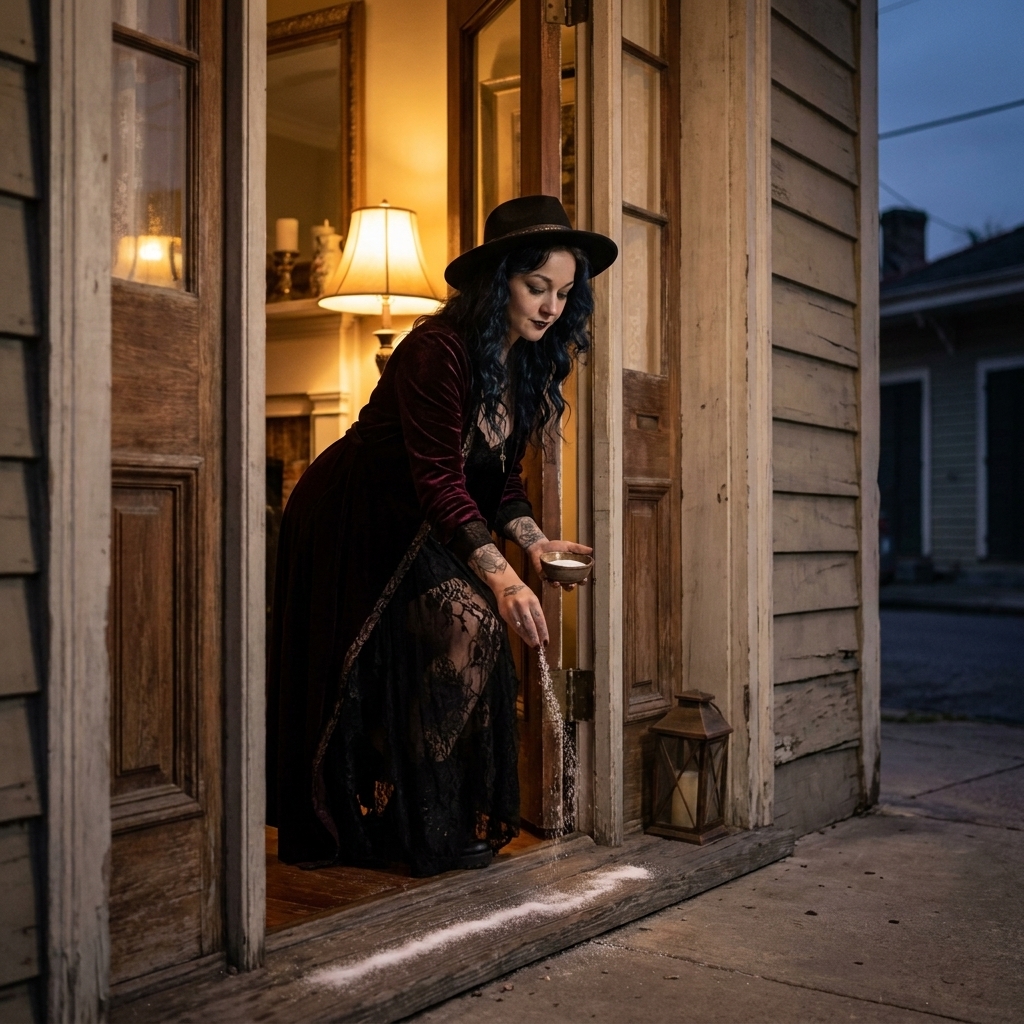
Planning a house cleansing after death, a long illness or months of fighting usually starts with one question: why does the house still feel heavy when the hard part is over? The beds are made and the floors are swept. Still, the air in one room feels thick, and you walk past it a little faster. In this guide, you’ll learn how old traditions handle a home after loss, sickness and conflict, why so many of them work at the front door, and how to shape a cleansing to what your house actually went through. If you’re not sure yet, start with these signs a home feels heavy.
- House Cleansing After Death Begins With Waiting
- After a Long Illness: Air, Light and Clean Linen
- After Conflict: Talk First, Then Wash the Floors
- Grief, Illness or Conflict: Matching the Cleanse to the Season
- Why House Cleansing After Death Ends at the Front Door
- A Home Cleansing Ritual Shaped to What Happened
- What Comes Up After a House Cleansing After Death or Strife
- Frequently Asked Questions
- References
House Cleansing After Death Begins With Waiting
Most people want to cleanse the day after the funeral. However, many traditions ask you to wait. In those traditions, the turn back toward normal life comes at the end of mourning, not the start. They set a fixed mourning time first, and the cleansing comes at its end.
For example, Jewish families sit shiva, a seven-day period of formal mourning at home. Many cover the mirrors during that week. The Reform movement explains the custom simply: it tells mourners that how they look does not matter right now.[1] When shiva ends, some families walk around the block together. That short walk marks their slow return to the world outside.[1]
In Japan, post-funeral observances run until the forty-ninth day. Friends who missed the funeral are expected to visit the family before that day passes.[2] So the home stays in a kind of in-between state for seven weeks.
Irish wakes moved faster but followed the same logic. In the 1930s, a man in County Kerry told a school folklore collector that the window was always opened when someone was dying. People said it was to let out the soul. Then, the moment the person died, the clock was stopped.[3] The window gave the soul a way out, and the stopped clock marked the moment time changed for the family.
So a house cleansing after death closes the time of mourning. It leaves your love for the person where it was. If you want a place to keep honoring them afterward, setting up an ancestor altar gives that love a home of its own.
After a Long Illness: Air, Light and Clean Linen
Illness leaves a different kind of weight. Rooms stay shut for weeks, and the same blankets stay on the bed long after anyone wants them there.
Florence Nightingale understood this in 1859. In Notes on Nursing, she called fresh air the first rule of caring for the sick: “to keep the air he breathes as pure as the external air.”[4] She also warned that dirty carpets, old papered walls and furniture that is never cleaned hold impurity in a room.[4] She meant this as practical nursing, not magic. Still, her two targets, stale air and unwashed cloth, are the same two things a spiritual cleansing after illness goes after first.
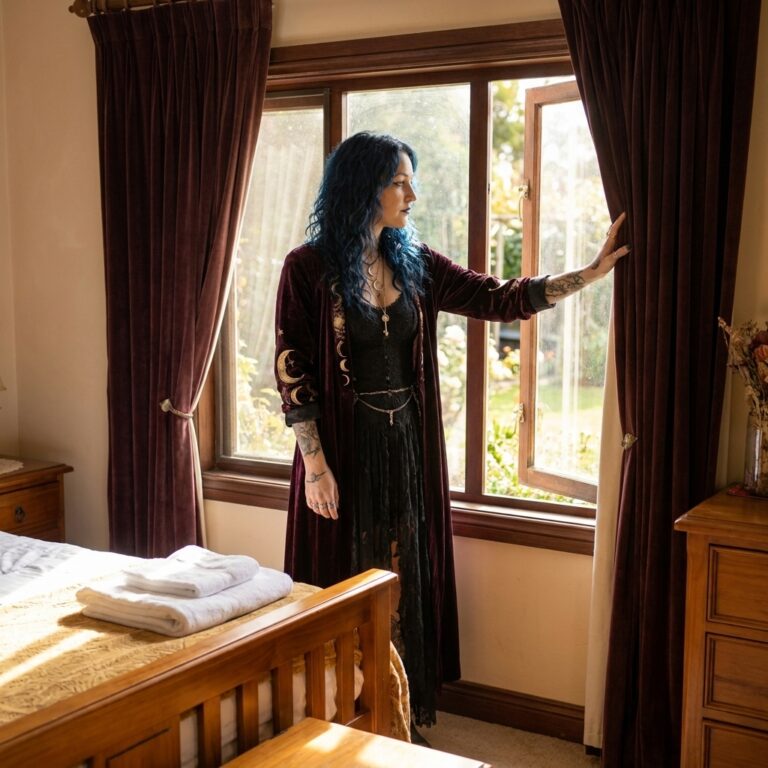
So a cleansing after illness leans on air and fabric. First, open every window in the sickroom. Then wash or air the bedding and curtains, because cloth is where practitioners believe a long illness settles. Finally, let sunlight into the room for a full day before any candle or smoke.
Wait until the person has recovered, or until the illness has truly ended. A cleansing while someone is still sick in that bed sends a mixed message. Also, if the illness was contagious, follow your doctor’s cleaning advice first. A spiritual cleansing comes after real hygiene, never instead of it.
After Conflict: Talk First, Then Wash the Floors
Arguments seem to leave the sharpest residue. Many people say they can feel the room where the shouting happened. Yet here the old traditions point to something people often skip.
In Hawaii, families used a process called ho’oponopono, which literally means “setting to right.” Mary Kawena Pukui, the noted Hawaiian scholar, described it as a way to restore good relationships among family members.[5] The family sat in a circle and opened with prayer. Then each person spoke honestly, someone asked for forgiveness, and everyone released the wrong so it would not be raised again. Finally, they closed with a prayer and often shared a meal.[5]
The talking comes first in that process, and the release comes after. If you cleanse a house while the argument is still alive, you only clear the stage for round two.
Once you’ve talked it through, many practitioners turn to a floor wash. In hoodoo, the Southern African American folk magic tradition, a floor wash is usually herbs or a little vinegar in a bucket of water. The common instruction is to wash from the back of the house toward the front. That way you’re always moving the old quarrel toward the exit. Then the used water goes out the front door, away from the house.
Grief, Illness or Conflict: Matching the Cleanse to the Season
Each hard season asks for a slightly different cleanse. Read together, the traditions above suggest four choices: how long to wait, which room to focus on, which element to lean on, and how to close.
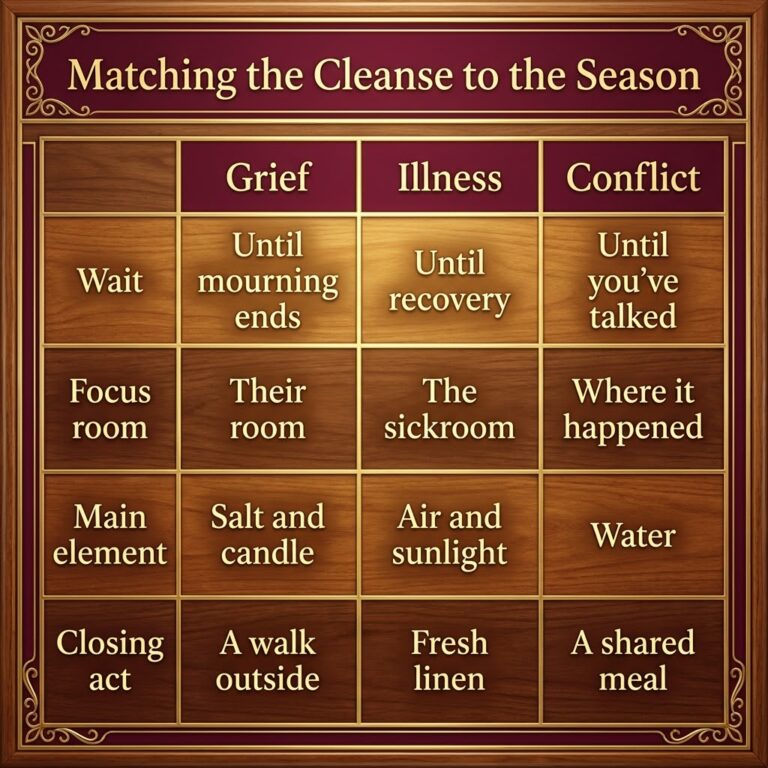
| Grief | Illness | Conflict | |
|---|---|---|---|
| Wait | Until mourning ends | Until recovery | Until you’ve talked |
| Focus room | Their room | The sickroom | Where it happened |
| Main element | Salt and candle | Air and sunlight | Water |
| Closing act | A walk outside | Fresh linen | A shared meal |
Notice the pattern in the bottom row. Each closing act brings the household back together or back outside, so the cleanse sits in the middle of the process. For more detail on the elements, see this guide to choosing between smoke, salt and water.
Why House Cleansing After Death Ends at the Front Door
Look again at the customs above, and one place keeps coming back. It is the threshold, the line between the house and the world. Each of these old customs around house cleansing after death does its main work right there.
In Kerry, the window opened so the soul could leave.[3] Jewish tradition asks mourners and friends to wash their hands before they enter the home after a burial.[1] In Japan, funeral guests receive a small packet of salt to sprinkle over themselves at their entrance, so they don’t carry impurity inside.[2] And in New Orleans, red brick dust is ground fine and sprinkled around a home’s borders and entrances to keep danger out.[6]
Put side by side, these four traditions share one idea. Heaviness is something that crosses a line, so the line is where you deal with it. Some customs let the heavy thing out. Others stop it from coming back in.
That is my reading, not a rule any one tradition states. Even so, it gives you a useful plan. Start your cleansing by opening the door, and finish it by sealing the door. This kind of New Orleans threshold protection is the step people most often forget.
A Home Cleansing Ritual Shaped to What Happened
This home cleansing ritual works for all three seasons. Adjust it with the chart above.
1. Pick the day. Choose a date after the waiting period ends. For a house cleansing after death, it helps to pick a date that means something to you, such as the end of the first week or the first month. A date gives the cleansing a clear before and after, the same job the stopped clock once did.
2. Clean the house first. Dust, vacuum and wash the floors. Practitioners believe a spiritual cleansing holds better in a clean house.
3. Open the front door and the windows. This gives the heaviness a way out, just as the Kerry window did.
4. Work from the back of the house to the front. Use your main element, whether that’s salt, smoke, sunlight or a floor wash. Then spend the most time in the focus room. In a house cleansing after death, that is usually the room where they slept or spent their last days. Speak plainly about what happened there and what you want the room to hold next.
5. Seal the threshold. Sprinkle a thin line of salt across the doorway, then close the door. This mirrors the Japanese salt at the entrance: the house is clear, so now you keep it that way. Sweep the salt outward the next morning.
6. Bring life back in. Cook a meal or invite a friend over. Each tradition above ends with people, so this one does too.
Belief, Intention & The Power of Magic
Witchcraft, spells, and manifestation are deeply rooted in belief, intention, and spiritual practice. If these practices do not resonate with you, this may not be the path for you, and that’s perfectly okay. But if you believe in divine powers, trust your intentions, and feel drawn to the mysteries of the unseen, we invite you to continue exploring with Madame Celestine and discover the magic that speaks to your soul.
What Comes Up After a House Cleansing After Death or Strife
People are often surprised by how they feel in the days after. Some feel sad or tired, even after a house cleansing after death that went smoothly. Others notice old arguments flaring up again.
Practitioners usually read this as stirred-up feeling, not failure. A cleansing asks you to look straight at the hard season, so grief that was packed away can surface. That is normal, and it often passes in a few days. If tempers flare, go back to the talking step before you cleanse again.
Also, keep the line between spirit and body clear. If you feel physically unwell after a cleansing, see a doctor. Smoke and strong herbs can bother the lungs, and illness has ordinary causes too.
Frequently Asked Questions
How soon should a house cleansing after death happen?
Many traditions wait until a set mourning period ends, such as seven days or seven weeks. Choose a date that feels like the close of your own mourning, not the day after the funeral.
Will a house cleansing after death push away a loved one’s spirit?
Practitioners generally say no. A cleansing is meant to clear heaviness, not erase love or memory. Many keep a photo or altar for the person and simply leave that space out of the cleanse.
Should I cleanse a house where someone died before I moved in?
You can, and many people do it when they move in anyway. Clean first, open the windows, work from back to front and close by sealing the front door.
Can I do a house cleansing after a pet dies?
Yes. The same steps apply. Many people focus on the pet’s favorite spot and keep a small memorial there instead of clearing it completely.
Is it normal to feel sad after a cleansing?
Yes, practitioners often see this. Facing a hard season can bring buried grief to the surface, and it usually eases within a few days.
References
- Everything You Need to Know About the Jewish Custom of Shiva. Rabbi Ana Bonnheim. Reform Judaism (Union for Reform Judaism). https://reformjudaism.org/everything-you-need-know-about-jewish-custom-shiva
- Funeral Etiquette in Japan. Nippon.com, March 19, 2025. https://www.nippon.com/en/guide-to-japan/gu020007/funeral-etiquette-in-japan.html
- Some Old Wake Customs, Gníomh go Leith (B.), Co. Kerry. The Schools’ Collection, National Folklore Collection, UCD (dúchas.ie). https://www.duchas.ie/en/cbes/4713236/4710108
- Notes on Nursing: What It Is, and What It Is Not. Florence Nightingale. Project Gutenberg. https://www.gutenberg.org/files/17366/17366-h/17366-h.htm
- How ho’oponopono can bring people together. Matthew Dekneef. HAWAIʻI Magazine, November 10, 2016. https://www.hawaiimagazine.com/content/how-hooponopono-can-bring-people-together
- Faith, Folklore, and Fun: Spirituality, Folk Magic, and Folk Practices in Black America. Francisco Rodriguez. Ernest J. Gaines Center, University of Louisiana at Lafayette, August 28, 2023. https://louisiana.edu/ernestgaines/blog/faith-folklore-and-fun-spirituality-folk-magic-and-folk-practices-black-america-francisco-rodriguez
Not sure where to start? You don’t have to do this alone.
Madame Celestine offers guided spellwork for beginners — real support for your first working, not just another guide to read.
Related reading: Herbs for Protection: Spices and Plants for Jars and Spells · The Energy You Bring Home Without Realizing It
About Madame Celestine
Madame Celestine has practiced and taught spellwork, divination, and seasonal ritual for over two decades, helping newcomers build a grounded, confident practice from their very first spell.