
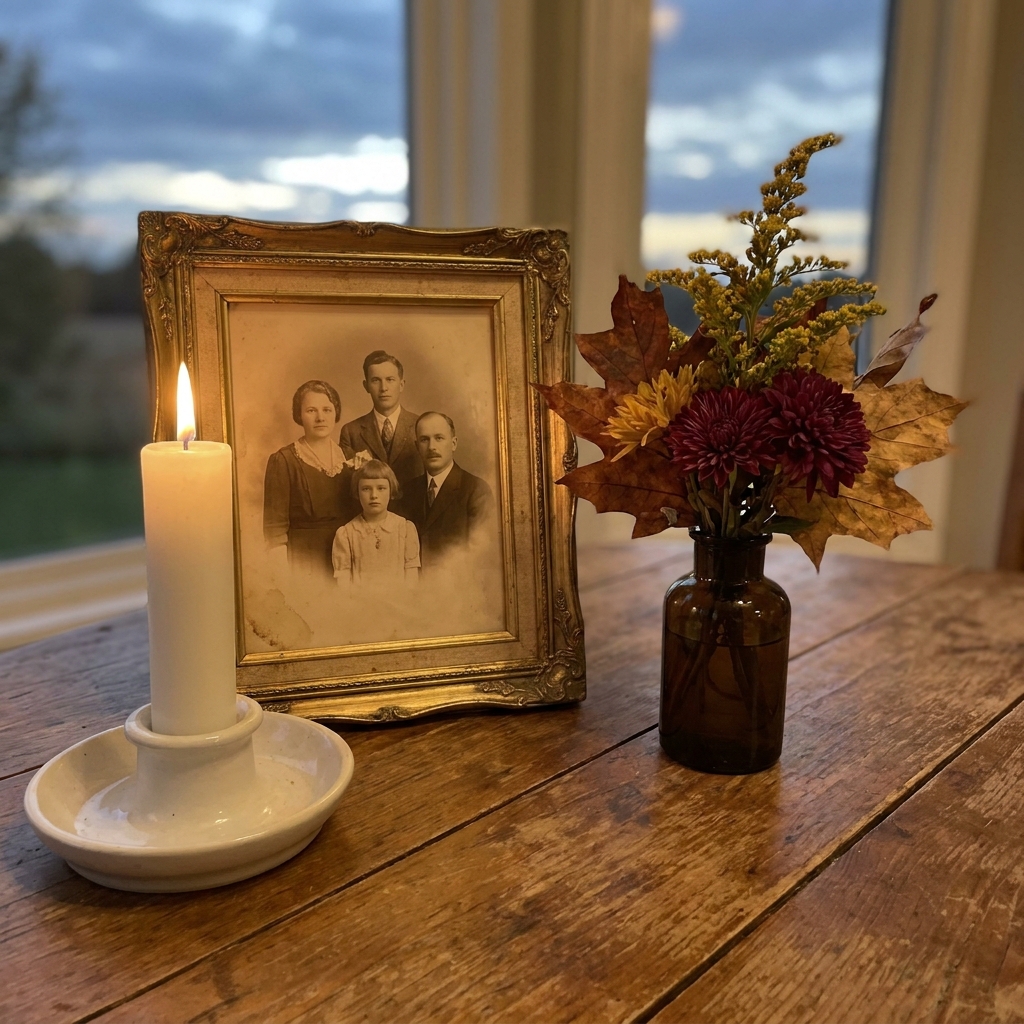
“The veil is thin” is a phrase you hear more often as October ends, usually said quietly, as if the speaker has noticed something you haven’t. But what does it actually mean, and where did the idea come from? Growing up around the old spiritual traditions of New Orleans, I often heard the elders speak about times when the veil between the living and the spirit world grows thin. In this article, I’ll explain what the phrase means spiritually and what the veil has symbolized across history. I’ll also cover why Samhain and All Saints’ Day share the same season, and how to tell a thinning veil from your own intuition.
- The Veil Is Thin: What It Means Spiritually
- What the Veil Symbolizes: From Sail to Temple Curtain
- Beyond the Veil Meaning and the Veil of Death
- Why the Veil Is Thinnest at Samhain
- When the Veil Is Thin in New Orleans: All Saints’ Day
- Three Traditions, One Season: Why the Veil Thins at Harvest’s End
- Signs the Veil Is Thinning (and When It’s Just You)
- How to Honor the Thin Veil: A Simple Candle Practice
- Respect, Not Fear: What to Avoid When the Veil Is Thin
- Frequently Asked Questions
- References
The Veil Is Thin: What It Means Spiritually
To me, a thinning veil means the spiritual world feels closer. Dreams become more vivid, intuition feels stronger, and memories of those who have passed seem to visit more often. The “veil” is the boundary between the world of the living and the world of spirit. When people say the veil is thin, they mean that boundary has become easier to sense, or even to cross.
You’ll hear two versions of the phrase. “The veil is thin” describes a state, a time when the boundary already feels close. “The veil is thinning” describes a process, the weeks when that closeness builds. So when someone asks what the veil thinning meaning is, the answer is simply the gradual lead-up. Most practitioners feel it start in early autumn and peak at the end of October.
The idea is not limited to witches, either. Many grieving people describe the same thing without any spiritual vocabulary at all. A song plays at the right moment, or a scent seems to come from nowhere. The language of the veil gives those moments a name.
What the Veil Symbolizes: From Sail to Temple Curtain
The word itself carries more history than most people expect. “Veil” comes through Old French from the Latin velum, a word that meant “sail, curtain, covering.” In English, it first appears around 1200, mostly for a head covering, especially a nun’s headdress. Then, by the early 1300s, “to take the veil” meant to become a nun.[1] In other words, a veil was never just cloth. It marked a line between one kind of life and another.
The most famous veil in Western religion is the curtain of the Temple in Jerusalem, which closed off its most sacred inner room. According to the Gospel of Matthew, at the moment of Jesus’ death, “the curtain of the temple was torn in two, from top to bottom.”[2] For Christians, that torn curtain became a symbol of heaven opening to ordinary people. So when someone asks about heaven’s veil symbol, this is usually the image behind it.
Put these together and you can see what the veil represents. It is a barrier that is also a doorway. A sail catches wind, a curtain hides a room, and a bridal or mourning veil marks a passage from one state to the next. Because of this, the symbolism of a veil has always been about thresholds, not walls.
Beyond the Veil Meaning and the Veil of Death
“Beyond the veil” means the other side of that threshold: the realm of the dead, of spirits, or of whatever lies past ordinary sight. When someone says a loved one has passed “beyond the veil,” they are saying the person still exists, just out of view. That is a gentler idea than a closed door.
The “veil of death” works the same way. In many traditions, death is the moment a person steps behind a curtain. As a result, the living and the dead stay connected through memory, offerings and prayer. Meanwhile, “behind the veil” meaning in everyday speech is close to “hidden” or “secret,” which keeps the same sense of something real but unseen.
This is why the spiritual veil matters so much to ancestor work. If the dead are only behind a curtain, then there are times when the curtain moves.
Why the Veil Is Thinnest at Samhain
Samhain is traditionally believed to be one of these powerful times, when the boundary between worlds is at its thinnest. The festival fell on November 1 and the evening before it, and its Irish name is commonly rendered as “Summer’s End.” It marked the turn from summer into winter in ancient Celtic religion.[3]
The old belief was not always comforting. People thought the divide between the living and the dead grew thin at Samhain, so possibly dangerous spirits could come through. For that reason, they took protective steps.[3] Samhain also partly shaped modern Halloween, and modern Pagans have since taken it up as one of their main festivals.[3]
Today, many witches hold a quieter view. Rather than guarding the door, they open it gently for their own beloved dead. If you want a full ritual for the night itself, these Samhain ritual ideas and traditions cover the practical side.
When the Veil Is Thin in New Orleans: All Saints’ Day
In New Orleans, the thin season has its own shape. Here, the veil is not only a Celtic idea. It also lives in Catholic custom and in the cemeteries themselves.
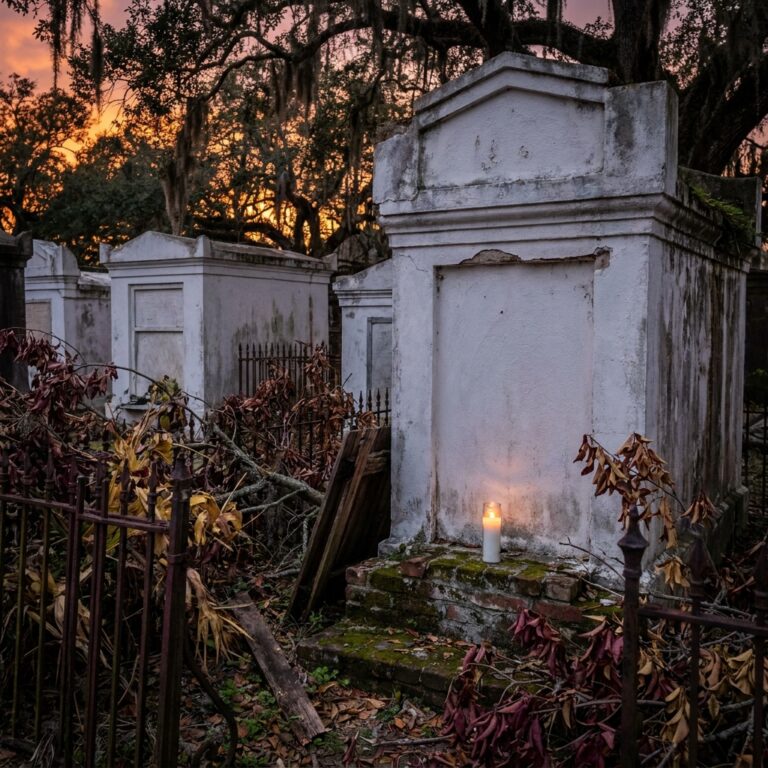
Because the water table is so high, Louisiana families bury their dead in above-ground tombs. For generations, families sealed those tombs with a whitewash of lime and water, cleared away weeds and cleaned the graves, often for November 1, All Saints’ Day. They laid wreaths on the tombs, and women once made paper or wax wreaths called immortelles to sell at churches and cemetery gates.[4]
In the 1800s and early 1900s, the cemeteries felt almost festive on that day. Families picnicked among the tombs, vendors sold food and flowers, and children learned their family history standing in front of the graves. Across Lake Pontchartrain in Lacombe, the custom still ends at sunset, when families light white candles on the graves while a priest sprinkles holy water.[4]
In New Orleans, then, the thin time has always been concrete: a whitewashed tomb, a lit candle, and a name said out loud.
Three Traditions, One Season: Why the Veil Thins at Harvest’s End
Samhain, All Saints’ Day and Mexico’s Day of the Dead grew from very different roots. Yet they land within days of each other. Placed side by side, they share more than a date.
| Tradition | When | What it marks |
|---|---|---|
| Celtic Samhain | Oct 31 to Nov 1 | Summer’s end |
| Day of the Dead, Mexico | Late Oct to early Nov | End of the maize growing cycle |
| All Saints’ Day, Louisiana | Nov 1 | Tombs cleaned, candles lit for family |

The Day of the Dead, which UNESCO added to its list of intangible cultural heritage in 2008, celebrates the brief return of dead relatives to Earth. It falls at the completion of the annual maize cycle, and families guide souls home by laying petals, candles and offerings along the path from the cemetery to the house.[5] Similarly, Samhain marked summer’s end[3], and Louisiana families gather at the tombs as the year turns toward winter.[4]
My reading is this. In each case, the thin time arrives when the growing work of the year is finished and the light is fading. With the harvest in, families finally have the time and the reason to turn toward the people they’ve lost. So the veil may be thin partly because we finally stop and look at it. That also explains why practitioners in the Southern Hemisphere often move these observances to their own autumn, as covered in this piece on why the Wheel turns backwards down under.
Signs the Veil Is Thinning (and When It’s Just You)
People describe the thinning veil in similar ways. Common signs include:
- Dreams that feel more vivid, especially dreams of people who have died
- A sudden, strong sense of a loved one’s presence
- Intuition that feels louder and quicker than usual
- Small coincidences: a familiar scent, a song, a name that keeps appearing
- Unusual behavior in candle flames or smoke during prayer or ritual
But I’ve always believed one thing. Not every strange feeling is a spirit trying to reach you. Sometimes it’s your own intuition asking you to listen. Autumn also brings anniversaries, shorter days and the holidays ahead, so grief often rises on its own. Before deciding that a sign comes from beyond the veil, ask what it might be telling you about yourself.
If you notice smoke or flame behaving oddly during your work, this guide to reading signs in smoke and dreams explains how practitioners interpret it.
How to Honor the Thin Veil: A Simple Candle Practice
My advice is simple. Light a candle, honor your ancestors, and approach the unseen with respect rather than fear. Here is a gentle way to do that during the thin season.
Prepare a Small Space
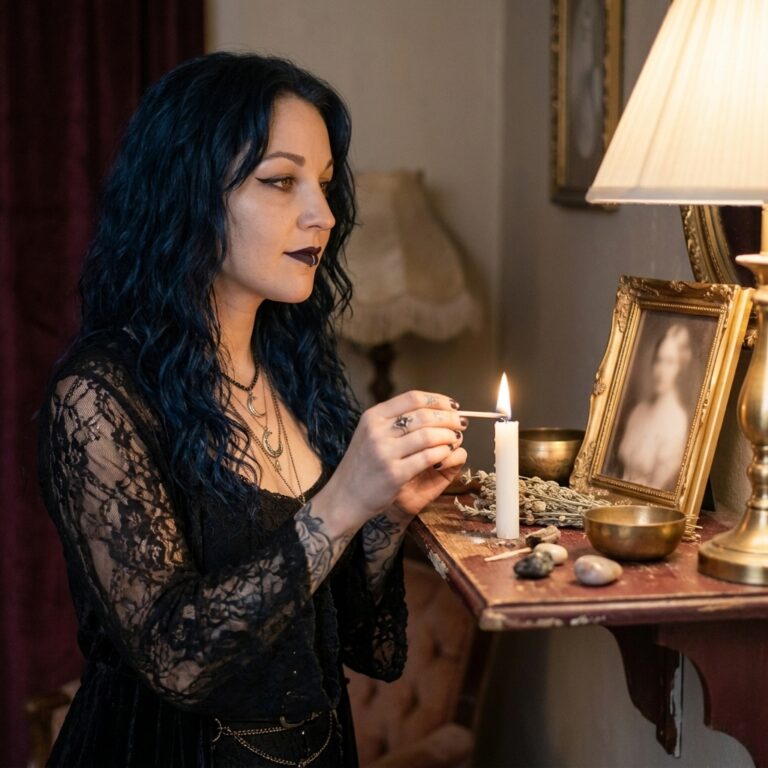
First, clear a shelf or table. Clean it the way New Orleans families once cleaned the tombs, because the act of tidying is itself a form of respect. Then add a photo or a written name of someone you’ve lost, along with something they loved.
Light a White Candle
Next, light one white candle, the same color families in Lacombe still place on graves. Say the person’s full name out loud. In many traditions, speaking a name keeps the dead remembered, and remembrance is the simplest bridge across the veil.
Offer, Speak and Listen
After that, offer something small: water, coffee, a flower or a favorite food. Talk to them as you would at a kitchen table. Then sit quietly for a few minutes and notice what comes up, whether memories, feelings or simply calm.
Close With Thanks
Finally, thank them and let the candle burn down safely or snuff it out. Clear away food offerings the next day. If you want a lasting place for this, a full ancestor altar for honoring your dead builds on the same steps.
Belief, Intention & The Power of Magic
Witchcraft, spells, and manifestation are deeply rooted in belief, intention, and spiritual practice. If these practices do not resonate with you, this may not be the path for you, and that’s perfectly okay. But if you believe in divine powers, trust your intentions, and feel drawn to the mysteries of the unseen, we invite you to continue exploring with Madame Celestine and discover the magic that speaks to your soul.
Respect, Not Fear: What to Avoid When the Veil Is Thin
A thin veil is not a reason for panic. Even so, a few habits tend to cause more distress than they solve.
First, avoid reading every bump in the night as a message. This leads to anxiety, and it often drowns out the quieter signs that matter. Second, don’t open the door to “whatever is out there.” Traditional ancestor work is specific: it calls on your own beloved dead by name, not on any spirit that happens to be passing. Third, don’t use the season to avoid grief. Candles and offerings can hold sorrow, but they don’t replace talking to the living people who share it.
Instead, keep your practice small, specific and kind. The old Celts took protective steps at Samhain[3], and New Orleans families answered the same season with whitewash, wreaths and candles.[4] Both responses came from respect for the dead.
Frequently Asked Questions
When is the veil the thinnest?
Most practitioners say the veil is thinnest at Samhain, on the night of October 31 into November 1. Many also feel it on the anniversary of a loved one’s death, whatever the date.
Is the veil thin all of October?
Many practitioners feel the veil thinning across October, with the closeness building toward the end of the month. After All Saints’ Day and the Day of the Dead in early November, most feel it begin to ease.
Is the veil also thin at Beltane?
Many modern Pagans believe so. Beltane on May 1 sits directly opposite Samhain on the Wheel of the Year, so some treat it as a second thin time, more tied to the fair folk and new life than to the dead.
Are dreams of the dead a sign the veil is thin?
Many people report more vivid dreams of lost loved ones in late autumn and read them as visits from beyond the veil. Others see these dreams as grief and memory surfacing, and both readings can hold comfort.
Is it dangerous when the veil is thin?
Older Samhain customs treated the season with caution and used protective steps. Most modern practitioners focus instead on honoring their own ancestors with respect, which they see as gentle rather than risky.
What does “beyond the veil” mean?
“Beyond the veil” means the realm of the dead or the spirit world. Saying someone has gone beyond the veil suggests they still exist, just out of ordinary sight.
References
- Veil: Etymology, Origin and Meaning. Online Etymology Dictionary. https://www.etymonline.com/word/veil
- Matthew 27:51 (English Standard Version). Biblia. https://biblia.com/bible/Mt27.51
- Samhain. Encyclopaedia Britannica. https://www.britannica.com/topic/Samhain
- Ryan Brasseaux, “All Saints Day.” 64 Parishes, Louisiana Endowment for the Humanities. https://64parishes.org/entry/all-saints-day
- Indigenous festivity dedicated to the dead. UNESCO Intangible Cultural Heritage. https://ich.unesco.org/en/RL/indigenous-festivity-dedicated-to-the-dead-00054
Not sure where to start? You don’t have to do this alone.
Madame Celestine offers guided spellwork for beginners — real support for your first working, not just another guide to read.
Related reading: Lilith: Symbols, Offerings and Her Place in Modern Witchcraft · Wolf Goddesses and Gods: What the Wolf Teaches in Myth
About Madame Celestine
Madame Celestine has practiced and taught spellwork, divination, and seasonal ritual for over two decades, helping newcomers build a grounded, confident practice from their very first spell.