
Money herbs are some of the first tools a new witch picks up, and for good reason. They’re cheap, they’re already in most kitchens, and they carry centuries of folklore. But which herbs actually belong in a money spell, and why those ones? This guide covers twelve herbs used to draw prosperity, where each tradition comes from and the surprising history behind them. Along the way, you’ll find out why so many of them were once worth their weight in silver. Then you’ll see how to use them in a money jar, a money bowl or a bath, step by step, and which mistakes waste them.
- Why Witches Reach for Herbs When Money Is Tight
- The 12 Money Herbs Witches Use, and Where Each One Comes From
- Money Smells Like the Spice Trade: The Pattern Behind Prosperity Herbs
- Jar, Bowl or Bath? Which Money Herbs Go Where
- How to Make a Money Bowl With Herbs, Step by Step
- Two Quick Ways to Use Herbs to Attract Money
- Grow Your Own Money Herbs: Why a Windowsill Pot Beats a Jar
- Five Mistakes That Waste Your Money Herbs
- When You Want More Than a Jar of Herbs
- Frequently Asked Questions
- References
Why Witches Reach for Herbs When Money Is Tight
Herbs have a practical appeal. A candle burns out and a written petition can feel abstract. A bowl of fragrant leaves, by contrast, sits on the table and reminds you of your intention every time you walk past it.
Herbs also have a long record in money magic. In African American hoodoo, practitioners carried mojo bags, small cloth charms filled with roots, herbs and other items, to attract love, protection, money and employment. The ingredients changed with the goal. A bag for gambling luck held different things than one for love, and some money bags held coins, including a dime with a hole in it.[1] In fact, the word “hand,” another name for a mojo, may come from the lucky hand root that gamblers favored.[1]
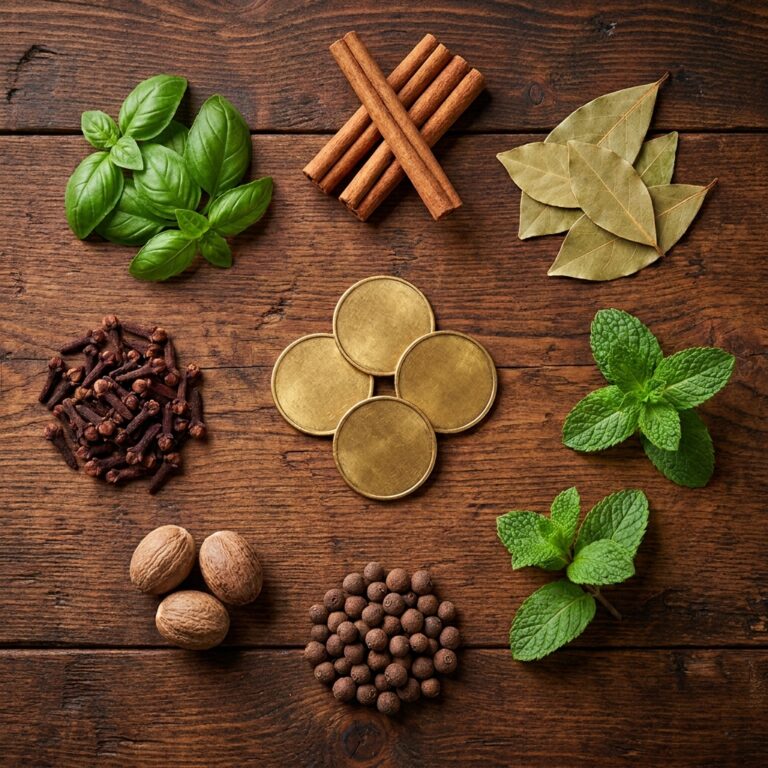
So when practitioners talk about money herbs, they mean plants chosen for what they’re believed to carry. Each one below has its own reason for being on the list.
The 12 Money Herbs Witches Use, and Where Each One Comes From
1. Basil: the “royal” herb for prosperity
Basil for prosperity is a staple in kitchen witchcraft. Its name comes from the Greek basilikón phytón, meaning “royal” or “kingly plant.” The French still sometimes call it “l’herbe royale.”[2] That royal name makes it a natural pick for wealth work. Oddly, the English herbalist Nicholas Culpeper didn’t see it that way in 1653. He called basil “an herb of Mars,” the planet of conflict, not of fortune.[3] Modern practitioners keep a pot by the door or tuck a leaf into a wallet. For a full spell, see the site’s guide to a money-drawing spell with basil leaves.
2. Cinnamon: once worth fifty months’ wages
Few money drawing herbs have a richer history. In antiquity, cinnamon was considered “a gift fit for monarchs.” The Roman writer Pliny the Elder reported that a pound of it could cost up to 1,500 denarii, about fifty months of a laborer’s pay.[4] Traders also spun stories to protect its price. Herodotus repeated a tale of giant “cinnamon birds” that built nests from the sticks, which Pliny later dismissed as a traders’ fiction.[4] Today, practitioners blow a pinch of ground cinnamon through the front door to “call money in.” The site has a separate piece on cinnamon in New Orleans money magic.
3. Bay laurel: the leaf of winners
Bay laurel crowned victors in the ancient world, so it carries a sense of success. Culpeper called it “a tree of the sun.” He also repeated an older claim that near a bay tree, “neither witch nor devil, thunder nor lightning” could hurt a person.[3] In money work, practitioners write a wish on a dried bay leaf and burn it, or keep a leaf in their wallet. Because of that sun connection, bay suits spells about career success as much as cash.
4. Mint: fresh money for fast needs
Mint grows fast and spreads everywhere, and that’s exactly why practitioners use it. They link its quick growth to quick money. A few leaves rubbed on a wallet, or a sprig kept by the cash drawer, is a common folk habit. In Greek myth, the nymph Minthe became the plant after a jealous goddess transformed her.
5. Clove: a spice older than coins
Cloves are native to the Maluku Islands of Indonesia and grew only on a few of them until the colonial era. Even so, they traveled astonishingly far. Archaeologist Giorgio Buccellati found cloves in a burned house in Terqa, Syria, dated to 1720 BC.[5] That’s thousands of kilometers from where they grew. In money spells, practitioners add whole cloves to jars and sachets, often to “fix” or hold the spell in place.
6. Nutmeg: the seed that bought Manhattan
Nutmeg may be the most valuable money herb in history. Until the mid-19th century, the Banda Islands of Indonesia were its only source. The Dutch East India Company seized the trade by force in 1621. Then, under the Treaty of Breda, England gave up the tiny nutmeg island of Run in exchange for New Amsterdam, now Manhattan.[6] Practitioners carry a whole nutmeg as a luck charm, especially for gambling and business deals.
7. Allspice: three spices in one berry
The English named allspice as early as 1621, because its flavor seemed to combine cinnamon, nutmeg and clove. It isn’t actually a blend. It’s a single berry, native to the Greater Antilles and Central America, and Jamaica is still the leading source.[7] That “all in one” quality makes it popular in money jars, where it’s meant to pull together several sources of income at once.
8. Ginger: the herb that speeds things up
Ginger is hot, sharp and fast-acting on the tongue. As a result, practitioners use it to speed up a money spell rather than as the main ingredient. A slice of dried ginger root, or a pinch of the powder, goes into a jar alongside slower herbs. It’s the folk equivalent of adding a spark to the fire.
9. Chamomile: the gambler’s hand wash
Chamomile seems like an odd choice, since it’s best known as a calming tea. Yet many hoodoo practitioners use it as a luck wash. They brew a strong tea and rinse their hands before playing cards or signing a deal. The calm is the point. A steady hand is thought to attract money better than a nervous one.
10. High John the Conqueror root: luck with a legend
This twisted root is said to come from Ipomoea jalapa, a relative of the morning glory and sweet potato. Practitioners associate it with luck, strength and victory, and it’s considered lucky for gambling. It’s carried in mojo bags, and an amulet root should be whole and unblemished.[8] Its name honors a folk hero drawn from Congolese stories of a prince sold into slavery whose spirit was never broken.[8] For other carried charms, see the site’s guide to luck herbs from the old country.
11. Patchouli: the earthy scent of abundance
Patchouli is native to island Southeast Asia, including Sri Lanka, Indonesia and the Philippines.[9] Its deep, earthy smell is linked to the soil, and practitioners treat it as a grounding abundance herb. A drop of the oil on a green candle, or a few dried leaves in a money bowl, is the usual use. It also tends to show up in spells for long-term, steady wealth rather than quick cash.
12. The money tree plant: a houseplant with a story
Finally, there’s the braided houseplant sold as a “money tree.” Its name likely comes from a story about a poor man who prayed for money, found an odd plant, took it home as an omen and then made money selling plants grown from its seeds.[10] There’s a twist, though. The braided plant usually sold as Pachira aquatica is actually Pachira glabra. The mix-up traces back to an early misidentification in Taiwan.[10] Practitioners keep one near the front door or in the “wealth corner” of a room.
Money Smells Like the Spice Trade: The Pattern Behind Prosperity Herbs
Look back at the list, and a pattern jumps out. Four of the twelve money herbs, namely cinnamon, nutmeg, clove and allspice, were once among the most expensive goods in the world. Cinnamon cost a Roman worker years of wages.[4] Nutmeg was valuable enough to trade for Manhattan.[6] Cloves crossed half a continent nearly four thousand years ago.[5]
Put side by side, these histories suggest a simple reason why these herbs feel like money. For centuries, they literally were wealth. Owning them showed that you could afford rare goods from far away. So when a modern witch drops a cinnamon stick into a money jar, they’re using a symbol that once meant riches in the most literal sense.
The other herbs follow a second pattern. Basil, bay and High John carry royal, victorious or heroic names. Mint and ginger are about speed and spread. In other words, money herbs fall into three groups: herbs that were once wealth, herbs that carry status, and herbs that move fast. That gives you a practical way to build a spell. Pick one herb from each group, and the jar covers value, success and momentum together.

Jar, Bowl or Bath? Which Money Herbs Go Where
Herbs for money spells work in three main ways, and each suits different plants.
A money jar is sealed and kept. Because it lasts for weeks or months, it suits dried, long-lasting herbs such as cloves, allspice, nutmeg, bay and cinnamon sticks. A money bowl is open and refreshed. As a result, it can hold fresh herbs like basil and mint alongside dried ones, plus coins and a candle. A bath, finally, is a one-time wash. It needs gentle herbs that are safe on the skin, such as chamomile, mint and basil.
Safety matters here. Cinnamon, clove and ginger can irritate skin, so most practitioners keep them out of baths or use only a tiny amount. If you have sensitive skin or allergies, test a small amount first. None of these spell recipes is meant to be eaten or drunk.
How to Make a Money Bowl With Herbs, Step by Step
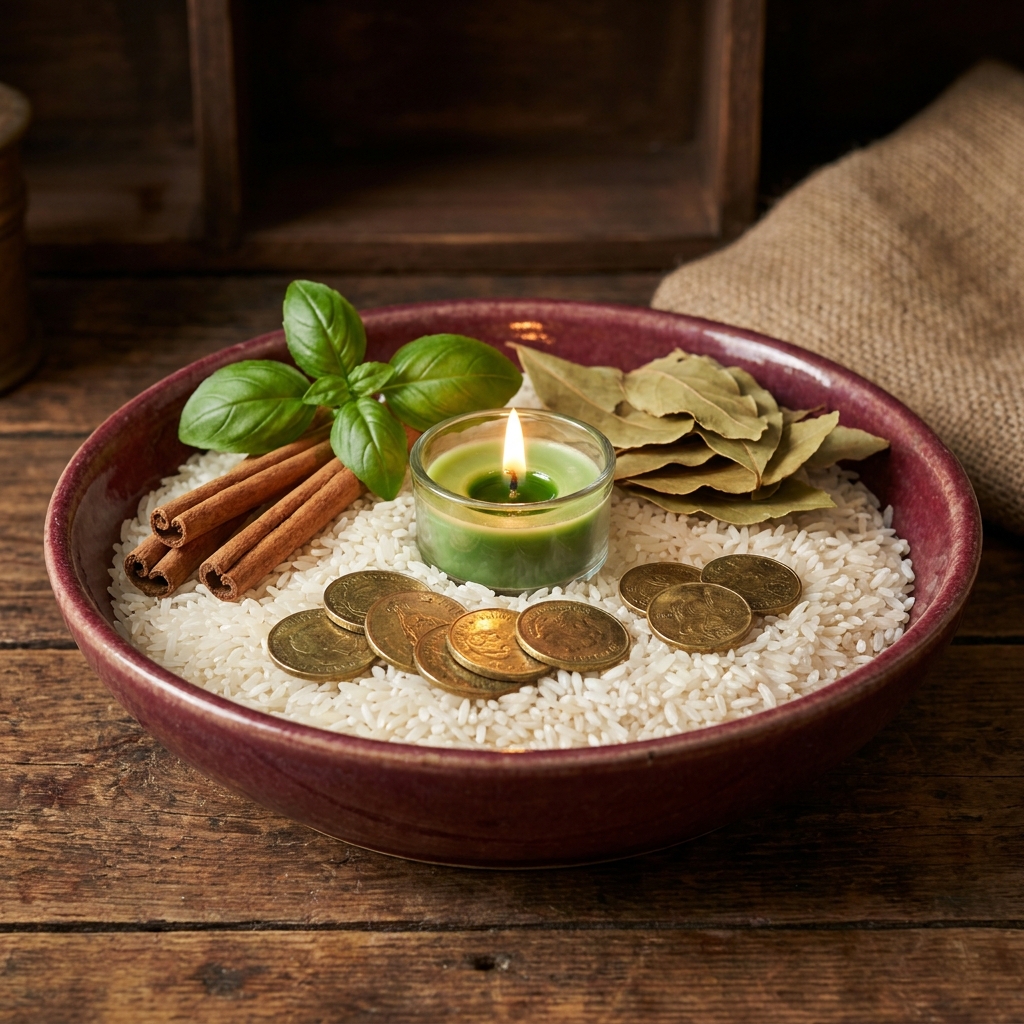
A money bowl is the most popular way to use herbs for abundance and money at home. Here’s a simple version and the reason behind each step.
1. Choose a bowl and a day
Use a small bowl you like looking at, since it will sit out in the open. Many practitioners start on a Thursday, the day linked to Jupiter, the planet of expansion, or during a waxing moon. The growing moon is meant to mirror growing income.
2. Lay a base of grain or salt
Next, cover the bottom with rice, cornmeal or salt. Grain stands for plenty, and salt is meant to protect what you gain. This base also gives the herbs and candle something stable to sit in.
3. Add three money herbs
Following the three-group idea above, choose one herb that was once wealth, one that carries status and one that moves fast. For example, try cinnamon, bay and mint. Sprinkle them over the base while stating what you want the money for.
4. Add coins and a petition
Place a few coins on top. Then write a short, specific petition, such as “steady clients for my business,” fold it toward you and tuck it into the herbs.
5. Light a green or gold candle
Set a small candle in the center and let it burn safely. Green is linked to growth and gold to wealth. While it burns, sit with the bowl for a few minutes and picture the money arriving for its purpose.
6. Feed it every week
Finally, refresh the bowl once a week. Add a pinch of fresh herbs or a new coin, and light another small candle. Like a mojo bag, a money bowl is thought to keep working only while it’s tended.[1]
Belief, Intention & The Power of Magic
Witchcraft, spells, and manifestation are deeply rooted in belief, intention, and spiritual practice. If these practices do not resonate with you, this may not be the path for you, and that’s perfectly okay. But if you believe in divine powers, trust your intentions, and feel drawn to the mysteries of the unseen, we invite you to continue exploring with Madame Celestine and discover the magic that speaks to your soul.
Two Quick Ways to Use Herbs to Attract Money
A simple money jar
Fill a small glass jar with cloves, allspice, a cinnamon stick and a bay leaf. Then add a coin and a folded petition, seal the lid and drip green candle wax over it. Keep it near where money comes into your home, such as by your desk or the front door. Shake it gently whenever you need a reminder of your goal.
A prosperity herb bath
Brew a strong pot of chamomile with a handful of fresh basil and mint, then let it cool. Pour it over yourself after a normal shower, from the neck down, while picturing doors opening. Many practitioners do this before a job interview, a sales call or the start of a new month.

Grow Your Own Money Herbs: Why a Windowsill Pot Beats a Jar
Many practitioners say a living herb carries more energy than a dried one. That’s one reason a pot of basil or mint by the front door is such a common money charm. It also has a practical upside. A living plant reminds you of your goal every day, and you have to tend it, just like the goal itself.
Basil, mint and bay are the easiest money herbs to grow at home. Basil wants sun and regular water, and it grows best when you pinch off the flower buds. Mint grows almost anywhere, so most gardeners keep it in its own pot to stop it taking over. Bay is slower, but a small bay tree in a container can live for years indoors.
When you harvest, practitioners suggest doing it during a waxing moon and saying a short word of thanks to the plant. Then hang small bundles upside down in a dry, dark place for one to two weeks. Once the leaves crumble easily, store them in a labeled jar away from light. Homegrown, freshly dried herbs smell stronger than most shop-bought ones, and scent is a big part of why money herbs are used at all.
Five Mistakes That Waste Your Money Herbs
Using stale herbs from the back of the cupboard
Dried herbs lose their scent over time, and scent is a big part of how practitioners believe they work. If the jar smells like dust, buy fresh.
Throwing in every herb at once
A jar with twelve herbs has no clear message. Instead, choose three with clear reasons, as in the money bowl above.
Leaving the petition vague
“More money” is hard to focus on. By contrast, “enough to cover rent by the first” gives the spell a clear target.
Forgetting to tend the work
An untended bowl gathers dust, and practitioners say the spell fades with it. A weekly pinch of fresh herbs keeps it active.
Skipping the real-world step
Money herbs work alongside action, not in place of it. Practitioners pair a money bowl with a sent invoice, a job application or a new price list, so the spell has a door to come through.
When You Want More Than a Jar of Herbs
A money bowl is a good start, and many people keep one for years. Still, some situations call for more. Maybe there’s a big decision ahead, a business launch or a long dry spell that home herbs haven’t shifted.
That’s where a practitioner can help. Hoodoo has a long history of this, too. Conjurers made and sold mojo bags as a full-time business.[1] A practitioner brings two things that are hard to supply alone. The first is perspective, so the work matches the real problem, whether that’s cash flow, career or a stuck pattern. The second is method. An experienced hand knows which herbs, candles and timing to combine, and how to tend the work over weeks.
If that sounds right for you, the money spells offered on this site start from your own situation. Each request starts with a conversation about what you need the money for and what’s been in the way. No spell can promise a specific amount or date. Still, a carefully made money spell gives your intention a clear shape and steady care.
Frequently Asked Questions
What herbs attract money the fastest?
Practitioners usually point to mint, ginger and cinnamon for quick results, because of their fast growth or sharp heat. They’re often added to a jar alongside slower, steadier herbs.
Which herbs are best for a money bowl?
A good money bowl mixes one herb that was once wealth, such as cinnamon, one that carries status, such as bay, and one that moves fast, such as mint. Rice, coins and a green candle complete it.
Is basil good for prosperity?
Yes. Basil’s name means “royal plant” in Greek, and practitioners keep it by the door or in a wallet to draw wealth.
What are the luckiest herbs for money and gambling?
High John the Conqueror root, nutmeg and chamomile are the classic choices. Many practitioners carry the root or a whole nutmeg and wash their hands in chamomile tea before a game.
Can you put money herbs in a bath?
Yes, but use gentle herbs such as chamomile, basil and mint. Cinnamon, clove and ginger can irritate skin, so most practitioners leave them out of baths.
References
- Mojo (African-American culture). Wikipedia. https://en.wikipedia.org/wiki/Mojo_bag
- Basil. Wikipedia. https://en.wikipedia.org/wiki/Basil
- The Complete Herbal, Nicholas Culpeper (1653; Thomas Kelly edition, 1850). Project Gutenberg. https://www.gutenberg.org/ebooks/49513
- Cinnamon. Wikipedia. https://en.wikipedia.org/wiki/Cinnamon
- Clove. Wikipedia. https://en.wikipedia.org/wiki/Clove
- Nutmeg. Wikipedia. https://en.wikipedia.org/wiki/Nutmeg
- Allspice. Wikipedia. https://en.wikipedia.org/wiki/Allspice
- John the Conqueror. Wikipedia. https://en.wikipedia.org/wiki/John_the_Conqueror
- Patchouli. Wikipedia. https://en.wikipedia.org/wiki/Patchouli
- Pachira aquatica. Wikipedia. https://en.wikipedia.org/wiki/Pachira_aquatica
Not sure where to start? You don’t have to do this alone.
Madame Celestine offers guided spellwork for beginners — real support for your first working, not just another guide to read.
Related reading: Black Pepper Magical Properties: Protection and Banishing · Color Magic: Candle Color Correspondences for Every Intention

About Valentine
Valentine is the pen name our editorial team uses for articles on West African spiritual traditions, protection and herbal lore. Articles under this byline are researched from published sources and reviewed by Madame Celestine before publishing.